
By Breanne Fariss, written for the benefit of the H.E.A.L. members, with notes from Dara at the end.
You are what you eat, drink, breathe, and think… AND what you don’t eliminate!
If this is your first time, the idea of an enema may make you feel really uneasy and awkward, and rightfully so. You also may not be confident in the purpose of it. Truth is, it may not be something you would choose to do at a day at the spa, BUT you may feel just as good when you’re done! At first it will be awkward, but it will become more natural and easier in a very short time. It’s only water… give it a try!
Why Do an Enema?
An enema washes the colon (large intestine) from the inside. The general American diet is made of highly processed foods that do not promote colon health. They become sticky and thick, line the colon walls, and slow the healthy wave-like contractions (peristalsis) that move waste along. Excess mucus thickens the waste and makes it move through sluggishly.
- Constipation. If you are not going daily (ideally as many times as you eat a meal), it’s time to make some changes. Think of the bulk of food you eat in a day: about that much should leave your body. Your body is a juicer, and it spits out the fiber. Enemas help get things moving while you also drink more water, change your diet, add fiber and probiotics, and use the Lower Bowel Formula until you are going frequently and thoroughly.
- Stomach aches and gas cramps. These are often caused by some level of constipation, a reaction to food, or the colon breaking loose old fecal matter, mucus and toxins during a cleanse. A series of enemas can give almost immediate relief.
- Headaches. Depending on the cause, a series of enemas can help by releasing pent-up toxins and hydrating the bowel.
- During a cleanse. When you give the body an opportunity to purge, it brings toxins up out of the places where it had them buried. If you don’t move them out quickly, they can be absorbed back through the colon wall and make you feel sick. Regular enemas keep the toxins moving out quickly and safely. Building the immune system with Echinacea is a great help at the same time. If anyone is doing any type of cleanse, they must be willing to do enemas.
Two Kinds of Enema
A regular enema only cleans out the rectum. These are the small Fleet-sized enemas you can buy. A high enema washes the whole length of the large intestine, sometimes with something added to the water for stimulation or a deeper cleanse. For your first few, use only warm, pure water.
Getting Ready
What to Buy
An enema bag system. These are often sold as a combination enema and douche kit; the bag is the same, only the nozzle differs. You will also need a lubricant. Natural oils such as pure olive oil or a water-soluble lubricant work. If you will be doing enemas daily, use BF&C Salve as your lubricant to protect the skin around the rectum.
Preparing Your Equipment
- Clamp the tube. The bag comes with a clamp that fits over the tube near the nozzle. Clamp it shut before filling, or you will have a mess.
- Fill with warm distilled water, about body temperature (95 to 100°F); test it on your wrist. Too hot and you cannot hold it and it is uncomfortable coming out. Too cold and the rectum will close up and won’t accept the water. Use the purest water you can, distilled is best, because you will absorb some of it through the colon.
- Hang it up about 3 to 4 feet above the floor, where you can reach the tube easily while lying flat. A doorknob or towel rack is usually about right. The higher the bag, the stronger the flow. A permanent hook on the bathroom wall makes this easy; leave the rinsed bag hanging there, covered with a towel.
- Clear the air from the tube. Hold the nozzle over the toilet, open the clamp for a couple of seconds until the air is out (you can hear it clear), then clamp it shut again.
- Prepare your spot. Lay a towel on the floor where you will lie. If getting up and down from the floor is hard because of back trouble or other difficulty, you can kneel, or even sit on the toilet; just hang the bag higher and keep the hose from kinking.
- Lubricate the nozzle and yourself so it goes in easily.
Prepare Yourself
Relax and breathe! Play some music, read your Bible or a book, or take advantage of some quiet time to think and pray.
What to expect. You will feel the water entering the colon and a slowly building pressure, perhaps some cramping. That means the water has met fecal matter or a gas bubble. Clamp the tube, relax, move side to side a little and massage, and it will often move along so more water can go in. If the pressure is too much, leave it clamped, remove the nozzle, release on the toilet, then go back and take the next bag. It is usually easier the second time, and easier still after a few days. It is not uncommon for only water to come back the first time or two; after a couple, you should start to see water mixed with fecal matter as things loosen.
Taking the High Enema
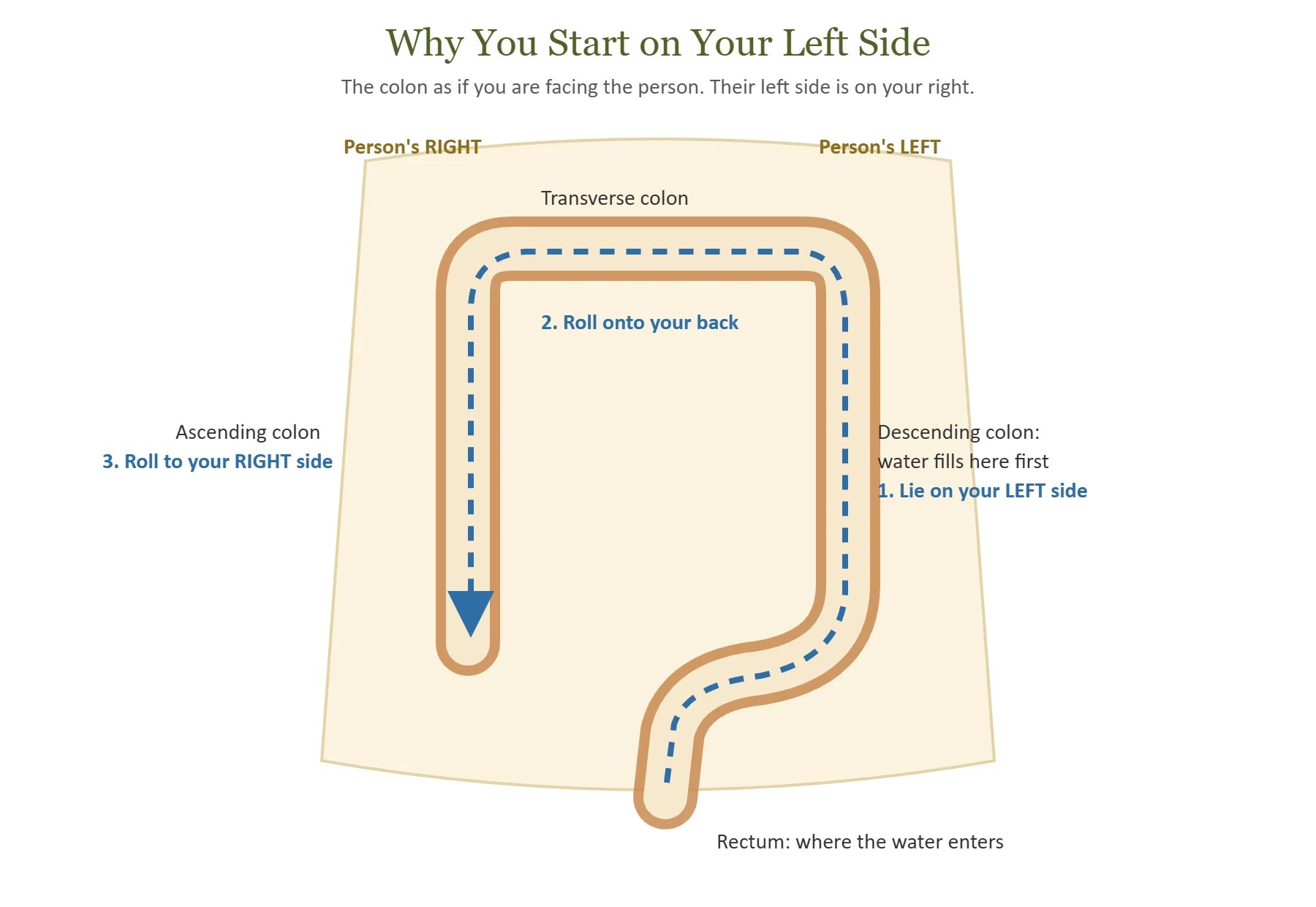
The water enters the rectum and fills the descending colon on your left side first, then crosses under the ribs and goes down the ascending colon on your right. Simplified diagram drawn for H.E.A.L.
- 1. Start on your LEFT side. Always begin an enema lying on your left side. From the rectum the colon runs up your left side, crosses your body under the ribs, and comes down your right side to where the small intestine joins it. Starting on the left lets the water flow along that path.
- 2. Insert gently. Slide the nozzle straight in, usually an inch or two (the kit’s instructions will say).
- 3. Let the water flow. Open the clamp. If it doesn’t flow well, check the hose for kinks and adjust the nozzle so it isn’t pressed against the wall of the rectum.
- 4. Massage your abdomen gently but firmly as the water flows in. It helps break up and release waste and lets trapped air move.
- 5. Roll with it. When about a third of the bag is in, turn onto your back. After another third, turn onto your right side. By then the water has traveled through most of the colon. Sometimes you can add more warm water to the bag and continue until you feel full.
- 6. Wait. Learn to hold the water 10 to 15 minutes; it is washing the inside of a dirty tube. At first you may not be able to hold it that long. Your first few times, just go to the toilet when the urge is strong.
- 7. Move and slosh. While the water is in, roll from your left side to your back to your right side, or lie on your back, raise your hips and slosh. When you stand to go, sway your belly side to side and around. The more the water sloshes, the more sludge breaks loose. Beware of sudden urges!
- 8. Release. When the urge is strong or your 10 to 15 minutes are up, sit on the toilet and release. A second or third urge may follow as more water and waste work their way out. Massage the colon in a clockwise circle to help. If a gas bubble causes a sharp cramp, bend over and keep massaging until it passes.
- 9. Repeat. Do the enema three times at each session for a thorough cleansing.
- 10. Clean up. Scrub the toilet right away, before old matter dries on like cement. Empty the bag, wash the nozzle well with hot soapy water, and hang it all to dry.
Great work! You have done a great service to your body, aiding it in its constant effort to keep you clean and healthy. Keep it up with pure food and water for a healthier, more energetic life.
Instructions by Breanne Fariss, written for the benefit of the H.E.A.L. members.
Dara’s Notes for the Healing Programs
- How often. It depends on how well the bowels are working. Three times a week (every other day) is good. Once a day takes time, but it has its benefits: done first thing in the morning, it clears the bowels so you will likely not need to go again until the afternoon. If you do it daily, use BF&C Salve as the lubricant.
- Cleansing tea for the enema water. On the Incurables Program, a tea of equal parts chaparral, Oregon grape root and red clover in distilled water makes a good cleansing high enema.
- Follow with an implant. After the high enema, put in a small amount to be held and absorbed. Soothing: 8 ounces of aloe vera gel with 8 ounces of distilled water. Detoxifying: 2 ounces of wheatgrass juice with 16 ounces of distilled water. Anti-bacterial, anti-viral and anti-fungal: 1 to 2 cloves of garlic blended into 8 ounces of raw apple cider vinegar and 8 ounces of distilled water; an excellent healing aid, but it can be very intense. Red clover tea for blood cleansing and Echinacea root tea for the immune system also make good implants.
The Skullcap and Catnip Liver Dump
A really good herbal mix for getting the liver to release. Put 1 rounded tablespoon of skullcap and 1 rounded tablespoon of catnip in a 32-ounce jar, fill it with boiling distilled water, set a saucer or loose lid on top, and leave it in the bathroom overnight. In the morning, strain it into your final enema bag of water: a small strainer that fits over the mouth of the enema bag works perfectly, or strain it into another glass first and then add it to the bag.
Hold it until the need to let it out is clear. It normally takes effect in 5 to 10 minutes, and the liver will release a good amount of toxic waste, so stay close to the bathroom. A wonderful way to start the day with a cleared-out liver.
I find it better than a coffee enema: it gets the liver to release without stressing the endocrine system with too much stimulation from the caffeine.
Use distilled water for all enemas, implants and teas.
When Not to Do an Enema
Don’t do an enema with severe or sudden belly pain, a fever with a hard, tender belly, rectal bleeding you can’t explain, or soon after bowel or rectal surgery without your doctor. If the bowels have not moved for several days and you are vomiting or the belly is swelling, get medical help. Stop if you feel faint or dizzy. For babies and young children, see Enema for an Infant or Young Child; they need much smaller amounts.


