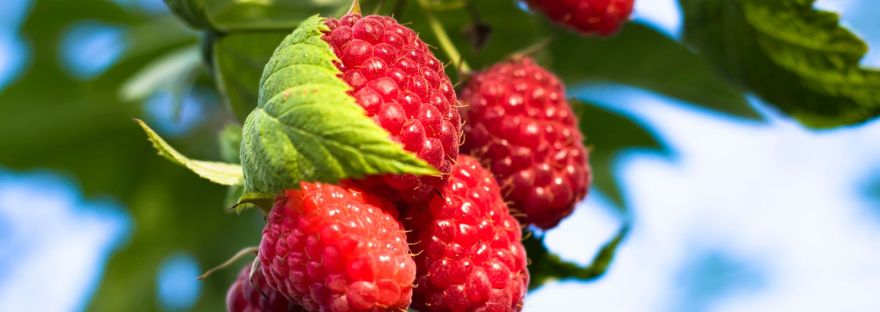
Ripe red raspberries and green raspberry leaves on a sunlit bush.
Herbal Healing, Women's & Men's Health

Menopause

Photo: Mirek Kielar / Pexels

Perimenopause, Hot Flashes, Night Sweats and the Change of Life

Understanding the Condition

Menopause is not a disease. It is a natural passage, as natural as the first period was in girlhood. Through the childbearing years, the ovaries make two main hormones each month. Estrogen builds the lining of the uterus and keeps the skin, bones, heart, bladder and vaginal tissue supple and strong. Progesterone, made after an egg is released, steadies the lining, calms the nerves and helps with sleep. The brain watches over all of it: the hypothalamus and pituitary send a hormone called FSH to call the ovaries into action each cycle.

As a woman moves through her forties, the ovaries’ supply of eggs runs low and they begin to answer that call less and less. The brain calls louder (FSH rises), and the hormones start to swing.
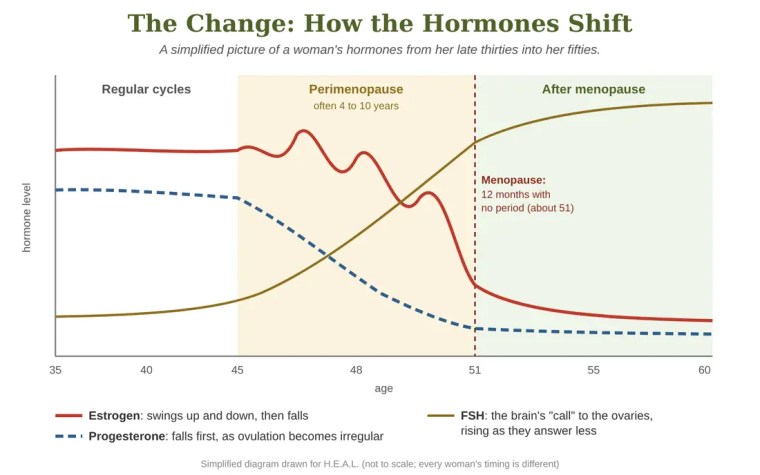
Line diagram of hormone levels from age 35 to 60: estrogen swings up and down through perimenopause then falls, progesterone falls first, and FSH rises steeply, with menopause marked at about age 51.
How the hormones shift through the change. Simplified diagram drawn for H.E.A.L. (not to scale).

How It Unfolds

  • Perimenopause (often four to ten years, usually starting in the forties). Ovulation becomes irregular, so progesterone falls first while estrogen swings high and low. This is the time of irregular or heavy periods, breast tenderness, PMS that grows worse, trouble sleeping, mood swings, and often thinning hair.
  • Menopause itself is one day: the point when a woman has gone 12 months in a row without a period. In this country it comes at about age 51 on average.
  • After menopause, the ovaries rest. The adrenal glands and fat tissue carry on making small amounts of hormones, and the liver keeps clearing used hormones from the body. This is why tired adrenals and a sluggish liver make the change so much harder.

Why the hot flashes come. The same part of the brain that calls to the ovaries also sets the body’s thermostat, sleep and heart rhythm. As estrogen falls and FSH rises, that center is unsettled. It decides the body is too hot, opens the blood vessels in the skin and turns on the sweat: a hot flash, or at night, a night sweat. Dr. Christopher wrote that this same disturbance can unsettle sleep, stamina, heartbeat, digestion and blood pressure, and that few women go through the change without some symptoms.

The common signs are hot flashes and night sweats; trouble sleeping; a racing or pounding heart; mood swings, anxiety and low moods; foggy memory; thinning hair; dryness of the skin and vaginal tissue; urgency or leaking of the bladder; weight settling around the middle; and joint aches. Over the longer term, falling estrogen leaves the bones and the heart with less protection, so this is the time to care for both.

Dr. Christopher believed the hard symptoms are not caused by the change itself but by a body that comes to it undernourished, without the raw materials it needs to make its own hormones. He saw women “glide smoothly through the changes of life” once that food was given. Medicine offers hormone replacement, but its own labels warn of risks to the uterus, breast and blood, and when it is stopped the symptoms often return.

The Emotional Side: the Energy Work

Healing the whole person. We are body, mind and spirit, and all three must heal together. When one part is neglected, the other two cannot find complete healing. A person can follow a perfect herbal program, but if she stays in a life that keeps wearing her down, or never makes time to care for herself, the body will keep losing ground. Healing the body often means facing what is happening in the heart and spirit as well.

The Hormonal Curtain

The real hormonal shift comes at the end, when the cycle stops. Many women think they’re home free when their cycles end without much drama, only to discover it has just begun.

From puberty on, the hormones that run a woman’s cycle also turn her attention outward. It is as if a curtain drops between her and the girl she was when it all began. Her focus turns to nesting, a home and babies, and all of that is hormonally driven. Something is lost during those years, too: the creative side of herself, so alive in her early teens. Not every woman loses it, but many put their inner selves on the back burner through the family years.

In perimenopause, the curtain lifts for longer and longer stretches, and at menopause it rises, never to fall again. The nesting urges simply fade, and you find yourself looking inward more and more. This is a gift. The old tales of the wise older woman, the understanding that comes from a lifetime of living, were always there. You just weren’t looking inward; too much else had your attention. Now you will bloom. You’ll write that book or pick up those paintbrushes again, and discover other amazing parts of yourself. It is time to make friends with yourself.

But behind that curtain is the stash of emotional bills: everything you swept under the rug or tucked away to deal with “later.” Later is here. The more unfinished business waiting there, the harder and more symptomatic your menopause will be.

Well, I hate to be the one to tell you, darlings, but the curtain is gone and the rug is up. It’s time to deal with yourself, or spend the rest of your life trying to medicate it away. You’re always free to keep denying the reality of your life, but you can no longer use the hormonal curtain as a barrier against the inner woman demanding your attention. Do the hard work on you, and become the woman you always knew you were.

Louise Hay, in her book Heal Your Body, describes these patterns:

  • Menopause problems: fear of no longer being wanted; fear of growing older; rejecting yourself; feeling you are not good enough. Turn it around: I am at peace through every change of life’s seasons, and I bless my body with love.

Emotional patterns paraphrased from Louise Hay, Heal Your Body (Hay House).

Areas Affected & Opening the Way to Healing

The change involves the whole hormone family: the ovaries stepping back, the hypothalamus and pituitary in the brain that set the thermostat and call to the ovaries, the adrenal glands that take over making hormones, the thyroid (whose troubles can look much like menopause), and the liver, which clears used hormones out of the body. It shows up in the skin and blood vessels (flashes and sweats), the heart, the nerves and sleep, the bones, and the bladder and vaginal tissue.

Opening the Way: Clearing the Liver and Bowels

  • Keep the bowels moving with LBF, building up one capsule a day until the bowels move two or three times a day. Used hormones the liver sends out through the bile are taken back into the blood if the stool sits.
  • Liver flushing. Juice fasting and flushing the liver are like hitting the restart button. When the body is out of balance, a good week of liver flushing clears a layer of toxins and helps the hormones settle. After that, an ELF (Emergency Liver Flush) once or twice a week until the symptoms have cleared.
  • Cool the triggers. Coffee and other caffeine, sugar, alcohol, spicy foods, hot drinks and stress all set off hot flashes. Many women find their flashes come at certain times of day once they start watching.
  • Hot and cold showers and fresh air. A hot and cold shower in the morning wakes up the circulation and trains the blood vessels to respond. Exercise, outdoor walks and sunshine steady the mood and protect the bones.

Feeding the Female System

  • Female Formula: the first support. Chaste tree berry, wild yam, dong quai, damiana, licorice and hops: it gives the body the raw material to balance its own hormones and calms the nerves, and it helps stop hot flashes, night sweats and the emotional free fall of the change. The daily amount is 1½ teaspoons. For hot flashes and night sweats, split it into three ½-teaspoon portions: ½ teaspoon in the morning, and the rest taken before your problem times. If the flashes come in the late afternoon, take the larger share in the early afternoon so the herbs are in the blood when they are needed most. For night sweats, take a dose at bedtime. Without these issues, take the full 1½ teaspoons in the morning.
  • Changease: hormonal food. Black cohosh, sarsaparilla, ginseng, licorice, blessed thistle, squaw vine, shatavari and vitex. When symptoms still persist after the Female Formula and liver flushing, add Changease alongside it: ½ to 1 teaspoon three times a day. It gives the body the raw material to make the hormones it needs in the last stages of the change; the shatavari is cooling and moistening, a help for hot flashes, night sweats and dryness, and the vitex supports the pituitary.
  • Wild yam cream: a helper alongside. Some women do best using both the Female Formula and a wild yam progesterone cream. Dara used the cream herself, mainly for thinning hair and the symptoms of perimenopause. It is valuable to a degree; the Female Formula is still the foundation, and the cream is an addition, not a replacement.
  • Feed the adrenals. The adrenals carry the load after menopause. The licorice in both formulas feeds them; when a woman is worn thin, see Rebuilding Tired Adrenals.
  • Heavy, breakthrough or lingering bleeding: kick it hard. The everyday Female Formula amount is 1½ teaspoons a day. When the bleeding turns heavy, comes between cycles, or a cycle refuses to end, even if it is only spotting, don’t let it drag on. Take 1 tablespoon all at once in a cup of hot water, and for heavy flooding with clots, up to three times a day. Keep it up for a day or two after the bleeding stops, then drop back to the usual dose. The natural progesterone in the wild yam can make the breasts tender at this higher dose; it eases within a day or two of returning to the normal dose. Any bleeding after menopause needs a doctor (see the box below).

Calming the Heart, Nerves and Sleep

  • A racing or pounding heart. Many women report palpitations through the change. Dara’s supports: NFX and the General Nervine for the nerves, with cayenne and hawthorn extracts for the heart. In hot water at bedtime, cayenne (working up gradually to 3 droppersful) and hawthorn (6 droppersful) make a calming evening tea; when palpitations wake you, take the cayenne and hawthorn every five minutes until the heart settles.
  • Sleep. 2 droppersful each of the General Nervine and NFX at bedtime help with falling asleep and staying asleep. See Two Formulas for a Good Night’s Sleep for more.

Thinning Hair

  • The Female Formula first. Thinning hair is one of the most common signs of perimenopause, and for many women it is the most upsetting. Dara’s own hair was falling out by the handful until she began the Female Formula; then it stopped. Use the daily amount above.
  • Clear the liver. The liver clears used hormones out of the body. When it is sluggish, the hormone swings are harder and the hair shows it. A week of liver flushing, then an ELF once or twice a week, supports the hair along with everything else.
  • Add Changease if it persists. When hair loss keeps on after the Female Formula and liver flushing, add Changease alongside them.
  • Wild yam cream. Dara used wild yam cream mainly for thinning hair, and some women do best using it together with the Female Formula.
  • Ease the stress and check the thyroid. Stress drives hair loss, and the nerve supports above help. Thyroid trouble also thins the hair and can look just like the change, so have it checked if the hair loss is heavy.

Protecting the Bones

  • Calcium the body can use. Dr. Christopher’s Calcium formula (horsetail grass, comfrey root, oat straw and lobelia) with Superfood: 1 teaspoon three times a day. Dara regards ordinary calcium pills as ground-up rock; plant calcium feeds the bones without leaving mineral residue for the kidneys.
  • Weight-bearing exercise and sunshine keep the bones strong; walking counts. Stop the calcium robbers: soft drinks, coffee and junk food.

Using Comfrey With Care

Comfrey root is one of the four herbs in the Calcium formula, used in traditional proportions as part of a blend. Take it at the dose on this sheet, 1 teaspoon three times a day. More is not faster.

When to Get Medical Care

Herbs are support alongside medical care, not a replacement for it. Any bleeding after menopause (once you have gone 12 months without a period) needs to be checked by a doctor, as does bleeding that is very heavy, comes every two weeks, or lasts much longer than usual during perimenopause. Have your thyroid checked if symptoms are strong, since thyroid trouble can look just like the change. A bone density scan in the years after menopause shows how the bones are holding up. If you are taking hormone replacement, work with your doctor to come off it gradually; stopping suddenly can bring a hard rebound.

Emergencies: chest pain or pressure, a racing heart with fainting, dizziness or shortness of breath, or heavy bleeding with lightheadedness. These need emergency care right away.

Level of Commitment

Most women pass through the change well with steady, simple support. How much you need depends on how much your body and your heart are carrying into it:

  • Gentle support. For most women in perimenopause and the change. The Female Formula, timed before your problem times; LBF to keep the bowels moving; cutting the triggers (caffeine, sugar, alcohol); water, walking and sunshine; the sleep supports as needed.
  • Focused cleansing. When the symptoms are strong or don’t settle: a week of liver flushing, then an ELF once or twice a week until the symptoms clear, with weeks of kidney flushing alternated in; add Changease to the Female Formula; the heart and nerve supports; the Calcium formula for the bones. Give it about three months.
  • Incurables Program. The change itself never calls for this. It is for a serious condition that comes along with it, such as fibroids, cysts, or cancer of the breast or uterus; see those sheets. The full Incurables Program includes cleansing the bloodstream with HEAL’s Blood Purifying formula. Blood Purifying contains chaparral, which has long been regarded as one of the strongest blood purifiers in herbal use. It has had years of bad press, but used wisely it supports the body in clearing growths, and over the years many members have used it to eliminate tumors. Use with care: take Blood Purifying in courses, not continuously: two dropperfuls 4 to 6 times a day for a week at a time, in a few ounces of grape juice, while drinking 64 to 128 oz. of liquid a day. Avoid it during pregnancy or nursing and with existing liver disease. If the skin or the whites of the eyes turn yellow, the urine turns dark, or there is pain under the right ribs, stop and have the liver checked.

More Is Not Faster

These doses are set to what the body can clear. Taking more stirs up more than the bowels, liver and kidneys can carry out, and that is when cleansing starts to feel like poisoning. Healing the body requires steady, consistent nutrition and action, not a bigger dose.

People are different, and now and then someone reacts poorly to a particular herb. If that happens, stop it. What I offer here is a guideline. You are the one living in your body, so work with the Holy Spirit and the wisdom the Lord has given you to apply these supports in the best way for your life.

A Loose Healing Plan

  1. Week 1: Build the foundation. Start your Foundational Program (Superfood and juicing, Echinacea, and bowel cleansing with LBF). Start the Female Formula, timed before your problem times, with a bedtime dose for night sweats. Begin cutting caffeine, sugar and alcohol, and notice what sets off your flashes.
  2. Week 2: Flush the liver. A week of liver flushing, then an ELF once or twice a week until the symptoms clear.
  3. Weeks 2 onward: Calm and protect. Add the sleep and heart supports if you need them, the Calcium formula with Superfood for the bones, and daily walking and sunshine.
  4. After a month or so: Take stock. If hot flashes, night sweats or mood swings persist, add Changease to the Female Formula. Weeks of kidney flushing can be alternated with the liver work.
  5. About 3 months: Most women are steady. Three months is the average time to bring the hormones into balance. Keep the Female Formula going through the change, easing down as the symptoms fade, and return to the supports whenever a rough patch comes.
  6. All along: the inner work. Make friends with yourself. Face what has been waiting behind the curtain, and give yourself the care you have given everyone else.

Stories from the Work

Dara’s Story: My Own Change

Menopause came for me in the middle of some of the most turbulent years of my life. Our move to Mountaindale, New York, had been a time of real growth, with all the drama that comes before growth. Our move to Hendersonville, North Carolina, gave us a little time to recover before our own family drama began, and perimenopause began right in the midst of it.

My hair started falling out by the handful. I had always had very thick hair, which was a good thing, because at that rate I was soon going to need a wig. My hairdresser suggested vitamins for stress. They helped a little, but nothing fixed it.

During those same years I was discovering the herbal cleansing programs and the herbs that support the female system. I began the Female Formula around 1997, when I was 37, with excellent results. My hair stopped falling out. My cycles improved, and the clots from the heavy bleeding that had been my lot for years were gone.

That was the beginning of a perimenopause that lasted about ten years. At 46 I began skipping cycles, and for several years I had one cycle every three months. In my 48th year, after 11 months without a cycle, I had one last one. It began with a feeling of emotional free fall, and my body seemed determined to make up for all 11 months: I was passing huge blood clots. I took a full tablespoon of the Female Formula three times that day and kept up that dose until the cycle ended. By midafternoon of the first day the bleeding had slowed to a normal flow, and my emotions felt steadier after that first large dose. The bleeding lasted five days and stopped. I kept taking the large dose for several more days. The last thing I wanted was to see that bleeding return.

During those twelve or thirteen years, I wrote my biography, recovered a marriage that was all but dead, and discovered who this woman really was.

The regular dose of the Female Formula is 1½ teaspoons a day. A tablespoon three times a day is the dose for controlling heavy bleeding, and the same approach handles breakthrough bleeding or a cycle that won’t end: kick it hard and get it done, then return to the regular dose. See Feeding the Female System.

A Member’s Story: Calming the Heart Through Perimenopause

A member in North Carolina shared how perimenopause brought what she called “panic attacks”: waking dizzy and lightheaded, her heart racing like a freight train, over and over. Every night she made herself a hot tea with 3 droppersful of cayenne (working up to it gradually) and 6 droppersful of hawthorn, and took 2 droppersful each of the General Nervine and NF (now NFX) formulas to fall asleep and stay asleep. When she woke with palpitations, she took the cayenne and hawthorn every five minutes until it stopped, usually just once. She used these supports at bedtime for years with great results; the only time the supports failed her was when she had overdone the caffeine or sugar.

Off the Hormones and Sleeping Through the Night (from Dr. Christopher)

A woman in Vancouver, British Columbia came to Dr. Christopher “climbing the wall” with nervous tension. Her hot flashes were driving her almost insane, she threw off the covers all night, and her husband was losing sleep and patience. She was taking estrogen but felt it was doing her more harm than good.

He put her on the three-day cleanse and the mucusless diet. She suffered for a time coming off the commercial hormones, but took the female corrective formula and the hormone formula (now Changease), each three times a day. A short time later she told him her whole life had changed: she slept all night without throwing off the covers, the nervous screaming jags were gone, and her husband fell in love with her again. She said it was worth every bit of the change in diet and the effort of taking the herbs.

More on the Female System

This information is for education only. It is not meant to diagnose, treat or replace care from a qualified health professional.
Ripe red raspberries and green raspberry leaves on a sunlit bush.
Herbal Healing, Women's & Men's Health

Endometriosis

Photo: Mirek Kielar / Pexels

When the Lining of the Uterus Grows Where It Doesn’t Belong

Understanding the Condition

The uterus is a strong, muscular organ about the size of a pear, sitting low in the pelvis. Its inner lining, the endometrium, is a living, blood-rich tissue that renews itself every month. Through the first half of the cycle, estrogen from the ovaries builds the lining up, thick and full of tiny blood vessels, ready to nourish a baby. If no baby comes, the hormones drop, the lining breaks down, and the uterus contracts to push it out as the monthly flow. It is one of the body’s regular cleansings: the old lining leaves, and a fresh one begins.

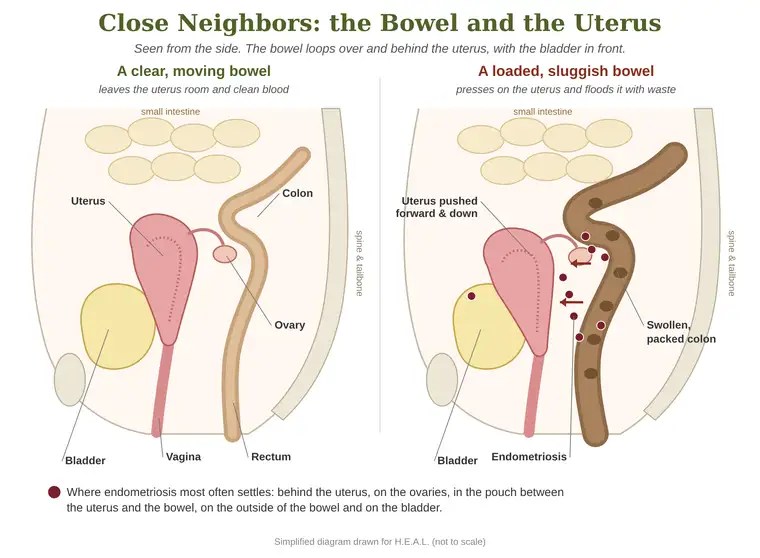
Endometriosis is what happens when tissue like that lining begins growing outside the uterus. It settles most often on the ovaries, on the ligaments and in the pouch behind the uterus, on the outside of the bowel and on the bladder (see the picture below). Wherever it lands, it still answers to the monthly hormones. Each cycle it swells and bleeds just as the lining inside the uterus does, but that blood has nowhere to go. It sits and irritates the tissue around it, the area becomes inflamed, and over months and years scar tissue forms. The scarring can glue neighboring organs together (adhesions), and on the ovaries the trapped old blood can form cysts, called endometriomas or “chocolate cysts.”

Side-view diagram of the pelvis: on the left a clear bowel leaves the uterus room; on the right a swollen, packed colon presses on the uterus, pushing it forward and down, with spots of endometriosis behind the uterus, on the ovary, on the bowel and on the bladder.
The bowel and the uterus are close neighbors. Simplified diagram drawn for H.E.A.L. (not to scale).

How It Develops

Medical science does not have one answer for why the tissue ends up where it does. The leading explanations are that some of the monthly flow travels backward through the fallopian tubes into the pelvis, which happens to most women at times; that the immune system, which normally clears that stray tissue, fails to do its job; and that the tissue is fed by too much estrogen and a body full of inflammation. What all of these have in common is a body that is overloaded and not clearing what it should.

That is where the bowel comes in. Look at the picture above: the colon loops right over and behind the uterus, and the rectum runs down its back. A bowel packed with old waste swells and presses on the uterus and its neighbors. The waste sitting there putrefies, and that poison is picked up by the blood and the lymph that serve the whole pelvis. Constipation also works against the hormones. The liver packs up used estrogen and sends it out through the bile into the bowel, to leave with the stool. When the stool sits, much of that estrogen is taken back into the blood, and more estrogen means more fuel for the misplaced tissue.

What Dara Has Seen

“It is completely preventable. I have found from my own observations that every woman I have supported with this issue has had a lifetime of chronic constipation. The bowels have putrefied the uterus.”

Dr. Christopher taught the same thing: many diseases, including disorders of the female organs, begin because the bowel and the bloodstream are filthy, and the first task is to clean them up and keep them clean. He shared Dr. Henry Bieler’s observation that when the diet overloads the body with wastes it cannot handle, the body pushes them out monthly through the uterus, using it like a garbage filter, until over the years the uterus breaks down. Dr. Christopher also counted the inorganic estrogen of birth control pills among the great contributors to female troubles.

What it feels like. Endometriosis affects roughly one woman in ten during the childbearing years, and many go years before they are diagnosed. The signs are periods that grow more painful over time, pelvic pain between periods, low back pain, pain with bowel movements or urination during the period, pain during intimacy, heavy or irregular bleeding, bloating, constipation or diarrhea that comes and goes with the cycle, deep tiredness, and trouble conceiving. How much it hurts does not always match how much is there: a little can hurt a great deal.

The only sure way medicine confirms endometriosis is by looking inside with a small camera (laparoscopy). An ultrasound can show cysts on the ovaries. The usual medical answers are hormone treatments that stop the cycle, surgery to remove the growths and, in the end, removing the uterus and ovaries. The growths often come back after surgery, which tells us the cause has not been touched. Dr. Christopher urged women to at least give the natural alternatives a try before surgery.

The Emotional Side: the Energy Work

Healing the whole person. We are body, mind and spirit, and all three must heal together. When one part is neglected, the other two cannot find complete healing. A person can follow a perfect herbal program, but if she stays in a life that keeps wearing her down, or never makes time to care for herself, the body will keep losing ground. Healing the body often means facing what is happening in the heart and spirit as well.

The female organs hold our feelings about being a woman: whether we feel safe, valued and cared for, and whether we care for ourselves. Louise Hay, in her book Heal Your Body, describes these patterns:

  • Endometriosis: feeling insecure, disappointed and frustrated; turning to sugar in place of loving yourself; blaming others. Turn it around: I am strong, and I am worth loving. Being a woman is a gift. I love myself, and my life is full.
  • Female problems in general: denying yourself; rejecting your own femininity and the feminine side of life. Turn it around: I am glad to be a woman. I love who I am, and I love my body.
  • Fibroids and cysts (endometriosis often forms cysts on the ovaries): nursing a hurt from a partner; a wound to your sense of yourself as a woman. Turn it around: I let go of the pattern in me that drew this hurt. I choose to bring only good into my life.
  • Constipation: refusing to let go of old ideas; stuck in the past; sometimes holding back and holding on. Turn it around: As I let go of the past, what is new, fresh and alive comes in. I let life flow through me.

Emotional patterns paraphrased from Louise Hay, Heal Your Body (Hay House).

Areas Affected & Opening the Way to Healing

Endometriosis involves the whole neighborhood of the pelvis: the uterus and its lining, the ovaries and fallopian tubes, the ligaments and pouch behind the uterus, and the outer walls of the bowel and bladder. Behind them all stand the liver, which must break down used hormones and clear the waste, and the kidneys, which carry it out. The work is to get the bowel moving and clean, open up the circulation in the pelvis so the stagnant blood and old tissue can be carried away, feed the female organs so they can rebuild, and keep the liver and kidneys clearing.

First, the Bowel

The bowel comes first and stays first the whole way through. Nothing else on this sheet can do its work while a loaded bowel is pressing on the uterus and pouring waste into it.

  • LBF (Lower Bowel Formula). Take 1 capsule with dinner the first day, 2 the second, 3 the third, and keep adding one a day until you have good, easy movements. Most people land at 3 to 5 a day; some need many more. There is no limit: the goal is two to three good movements a day. Once the bowel is moving, add the fiber blend so the bowel can be cleaned out as well as moved.
  • Water and food. Drink plenty of distilled water, and move toward Dr. Christopher’s mucusless diet: fresh fruits and vegetables, whole grains, nuts and seeds, with little or no meat, dairy, sugar, white flour or processed food. The diet that keeps the bowel clean is the diet that keeps the uterus clean.
  • High enemas. In the Focused and Incurables levels, a high enema with distilled water every other day, followed by a soothing implant (8 oz. aloe vera gel with 8 oz. distilled water), helps wash out the old waste packed in the colon.

Opening the Way: Packs, Warmth and Movement

  • Castor oil packs, every night. Soak a generous piece of flannel (at least a foot square) in castor oil, warm it, and lay it over the whole lower belly, from the navel to the pubic bone and from hip to hip. Cover with plastic wrap and a towel, add a hot water bottle, and leave it on all night. Castor oil draws circulation deep into the pelvis and helps soften and move congested tissue and old scar tissue. Don’t be stingy with the size or the oil. Baking soda with soap takes the oil off in the morning.
  • Hot and cold. A hot and cold sitz bath (sitting in hot water, then cold) or a hot and cold shower aimed over the lower belly and lower back, one minute hot and one minute cold, seven times, brings fresh blood in and carries the stagnant blood out. Massage the area as you go. Twice a day is ideal.
  • Abdominal massage. Gently knead the lower belly in the direction the colon moves (up the right side, across, and down the left) for 10 to 15 minutes a day, to help the bowel and to work the pelvic organs. Massaging while lying head-down on a slant board takes the weight of the bowel off the uterus.
  • Move. Walking, bouncing on a mini-trampoline or light jogging tones the bowel and the pelvic organs and moves the lymph. Start small and build up; never exercise to the point of exhaustion.

Drawing Out What Has Settled: the Vaginal Bolus

The bolus is an internal poultice. It works right where the trouble is, feeding and strengthening the female organs and drawing out the toxic waste that has settled there. Dr. Christopher reported many women clearing cysts, tumors and infections with this routine.

  • What goes in it. Equal parts of eight powdered herbs: squaw vine, slippery elm bark, yellow dock root, comfrey root, marshmallow root, chickweed, golden seal root and mullein. Work them into coconut oil until it reaches a pie-crust consistency, roll it into sticks about as thick as your finger, cut them about an inch long, and keep them in the refrigerator.
  • How to use it. Insert one at bedtime and wear a sanitary pad, not a tampon. Leave it in through the next day; a little coming out in the morning is normal. In the evening, douche with a pint of warm water and 2 tablespoons of fresh lemon juice or raw apple cider vinegar before inserting the next one. Six nights a week, resting over the Lord’s day. Pause the bolus during your period and start again once the flow has stopped. Not for a young woman who has not yet been sexually active.

Feeding the Female System

Dara keeps three formulas for the female system, each with its own job. For endometriosis, the Female Formula and Nu-Fem are the pair to use, and Nu-Fem is the one that rebuilds.

  • Female Formula: food for the female system. Chaste tree berry, wild yam, dong quai, damiana, licorice and hops. It gives the body the raw material to make and balance its own hormones and calms the nerves. The everyday dose is 1½ teaspoons a day, stopping the week of your cycle. Three months is the average time to bring a cycle back into balance; it is not unusual to skip a cycle the first month.
  • Nu-Fem: rebuilding the female organs. Dr. Christopher’s female corrective: golden seal, blessed thistle, false unicorn, red raspberry, squaw vine, cramp bark, uva ursi, ginger and a little cayenne. This is the formula that rebuilds the uterus, ovaries and tubes for endometriosis, cysts and fibroids, and it is added to the Female Formula. ½ to 1 teaspoon in a cup of distilled water two or three times a day, six days a week. Dr. Christopher saw many severe cases of years of suffering cleared up in 90 to 120 days.
  • Changease: hormonal food, only if needed. Black cohosh, sarsaparilla, ginseng, licorice, blessed thistle, squaw vine, shatavari and vitex. Not a regular part of the endometriosis program. Add it only when there is a clear need for hormonal food, such as the shifts of the teen years, after childbirth or around menopause: ½ to 1 teaspoon three times a day.
  • Red raspberry leaf tea. A cup or more a day. It has always strengthened the female organs, and it is the gentle start for young girls.
  • Potassium broth. Dr. Christopher taught that cysts and tumors will not grow where there is enough potassium. One to three cups a day of broth simmered from thick potato peelings, greens, celery, onion and garlic (see the Liver Flushing e-book for the full recipe).

Relief for the Hard Days

  • For cramps: Lobelia extract, usually one good dropperful (up to two, depending on the size of the person and how bad the pain is), or cramp bark extract, ½ to 1 teaspoon, in a little water. Within 10 to 15 minutes a wave of relaxation washes through and the uterus lets go. For pain that is already severe, alternate cramp bark and the antispasmodic tincture every 15 minutes, adding lobelia on the hour, until it eases. Starting at the first twinge works far better than waiting.
  • For a heavy flow: Ex-Mens Formula (red raspberry, prickly ash, blue cohosh, wild yam and cinnamon), 2 to 4 droppersful three or four times a day as soon as a heavy cycle begins, setting the Female Formula aside until the cycle has passed. The flow usually slows within a few hours. If bleeding goes past 7 days, or comes back too soon, Dara uses the Female Formula at 1 tablespoon a day in hot water for a day or two past the bleeding instead.
  • A castor oil pack and warmth over the lower belly on painful days, and rest.

Using Comfrey With Care

Comfrey root is one of the eight herbs in the vaginal bolus, where it feeds and rebuilds tissue. Used this way, as part of a blend placed right where it is needed, it is not taken in by mouth. Use the bolus six nights a week, resting one, as described above.

When to Get Medical Care

Herbs are support alongside medical care, not a replacement for it. Pelvic pain has many causes, so have new or worsening pain checked before assuming it is endometriosis. If you are trying to conceive, work with your doctor as well.

Emergencies: sudden, severe pain in the belly or pelvis (a burst or twisted ovarian cyst, or a pregnancy outside the uterus, can look like this), pain with fever and chills, fainting or dizziness, or bleeding that soaks a pad every hour for more than two hours. These need emergency care right away. For hemorrhage, Dr. Christopher’s remedy while you get help is a teaspoon of cayenne stirred into a glass of warm water.

Level of Commitment

Endometriosis is not a quick fix. It took years of a loaded bowel and an overloaded body to build, and it takes steady work to clear. Dara has seen many women who want to be well but are not willing to do the hard work it takes. Be honest with yourself about where you are:

What Dara Has Seen

“I have known several women who have worked with endometriosis. Sadly, none of them really put in the time and effort. They did find relief, and their symptoms eased and cleared up, but I don’t know of anyone who was able to become pregnant and have children.”

Relief can come with less, but if you hope to carry a child, give the program everything it asks, for as long as it takes.

  • Gentle support (prevention). For young women and girls with painful periods or a lifetime of constipation, before endometriosis takes hold. Get the bowel moving every day with LBF and good food, red raspberry leaf tea, and the Female Formula. This is where endometriosis is prevented.
  • Focused cleansing. For painful, heavy periods and pelvic pain that are building, or a milder case. Add Nu-Fem to the Female Formula, castor oil packs every night, hot and cold, the bolus six nights a week, high enemas, and weeks of liver flushing alternated with weeks of kidney flushing so the liver keeps clearing the old estrogen and waste.
  • Incurables Program. For diagnosed endometriosis. In Dara’s experience, true endometriosis needs the entire Incurables Program, because flushing the liver and kidneys clears the waste while the herbal supports rebuild the female organs. Everything on this sheet continues, along with the cold sheet treatment once or twice a week and cleansing the bloodstream with HEAL’s Blood Purifying formula. Blood Purifying contains chaparral, which has long been regarded as one of the strongest blood purifiers in herbal use. It has had years of bad press, but used wisely it supports the body in clearing growths, and over the years many members have used it to eliminate tumors. Use with care: take Blood Purifying in courses, not continuously: two dropperfuls 4 to 6 times a day for a week at a time, in a few ounces of grape juice, while drinking 64 to 128 oz. of liquid a day. Avoid it during pregnancy or nursing and with existing liver disease. If the skin or the whites of the eyes turn yellow, the urine turns dark, or there is pain under the right ribs, stop and have the liver checked.

More Is Not Faster

These doses are set to what the body can clear. Taking more stirs up more than the bowels, liver and kidneys can carry out, and that is when cleansing starts to feel like poisoning. Healing the body requires steady, consistent nutrition and action, not a bigger dose.

People are different, and now and then someone reacts poorly to a particular herb. If that happens, stop it. What I offer here is a guideline. You are the one living in your body, so work with the Holy Spirit and the wisdom the Lord has given you to apply these supports in the best way for your life.

A Loose Healing Plan

  1. Weeks 1–2: Open the bowel. Start your Foundational Program (Superfood and juicing, Echinacea, and bowel cleansing with LBF). Build up the LBF until the bowel moves two to three times a day, drink plenty of water, and begin moving toward the mucusless diet. Nothing else works until this does.
  2. Weeks 1–2: Begin feeding. Start the Female Formula, and add Nu-Fem as soon as the bowel is moving. Red raspberry leaf tea daily. Keep lobelia or cramp bark on hand for the hard days.
  3. Week 2 onward: Open the way. Castor oil packs over the lower belly every night, hot and cold once or twice a day, and abdominal massage and gentle movement daily. Begin the vaginal bolus six nights a week, with the lemon or vinegar douche each evening, pausing it during your period.
  4. Weeks 3 onward: Flush. A week of liver flushing, then a week of kidney flushing, for as many rounds as your level of commitment calls for. For diagnosed endometriosis, this is the full Incurables Program, with Blood Purifying in week-long courses and the cold sheet treatment once or twice a week.
  5. About 3 to 4 months: Take stock. Most women see the cycle steady and the pain lessen within three months; Dr. Christopher looked for results in 90 to 120 days. Many need to repeat the 30-day Incurables cycle a number of times. Ease down to the Focused level as you improve, and keep the bowel moving and the Female Formula going for life.

Stories from the Work

A Tipped Uterus Set Right (from Dr. Christopher)

A woman of about 45 came to Dr. Christopher with serious female troubles. Her transverse colon had dropped so low that it had tipped her uterus and pinched her bladder; both ovaries were infected, and she had a vaginal discharge. A clinic had confirmed it all and wanted to remove her uterus and stitch up her bladder. Frightened of the surgery, she asked for another way.

She took the female corrective and hormone formulas, used the vaginal bolus six nights a week with the slant board routine and daily abdominal massage, did the three-day cleanse and mucusless diet, drank a gallon of distilled water a day with plenty of red raspberry leaf tea, and kept her bowels clean with the lower bowel formula and her blood clean with the red clover combination. Six months later she came back a different woman. With no operation, her colon had gone back into place, and her uterus and bladder had returned to their proper position.

More on the Female System

This information is for education only. It is not meant to diagnose, treat or replace care from a qualified health professional.
Sunlight filtering through a golden underwater kelp forest.
Herbal Healing, Organs & Glands

Parathyroid Ailments

Photo: James Collington / Pexels

Overactive and Underactive Parathyroid, High and Low Blood Calcium, and Healing After Neck Surgery

Understanding the Condition

Tucked against the back of the thyroid, at the base of the throat, sit four tiny glands, each about the size of a grain of rice. These are the parathyroids. They share the thyroid’s neighborhood but not its job. The thyroid sets the pace of the body; the parathyroids guard one thing above all: the calcium in the blood.

Calcium is far more than bone. Every heartbeat, every nerve signal and every muscle that tightens and relaxes depends on just the right amount of calcium in the blood, and so does clotting. The bones are the body’s calcium bank, holding nearly all of it in reserve. The parathyroids decide when to make a withdrawal.

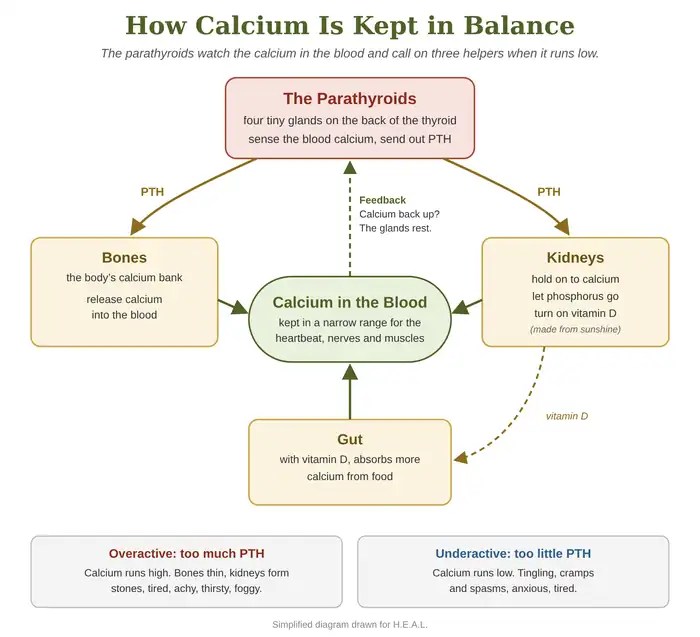
They work like a careful banker (see the picture below). When blood calcium dips even a little, they release parathyroid hormone (PTH). PTH draws calcium out of the bones, tells the kidneys to hold on to calcium and let phosphorus go, and has the kidneys turn on vitamin D, the vitamin we make from sunshine, so the gut can absorb more calcium from food. When calcium is back where it belongs, the glands rest. Dr. Christopher noted that the thyroid works in cooperation with the parathyroids in regulating the mineral salts of the body, especially calcium.

Diagram: the parathyroids send PTH to the bones and kidneys; bones release calcium, kidneys hold calcium and turn on vitamin D so the gut absorbs more; when blood calcium is back up, the glands rest.
How calcium is kept in balance. Simplified diagram drawn for H.E.A.L.

How It Develops

Parathyroid trouble is quiet. Many people feel only tired, achy and foggy, and the first real clue is a calcium number on a routine blood test. It tends to go one of three ways:

  • Overactive parathyroid (hyperparathyroidism). Most often one of the four glands grows a small lump that is not cancerous (an adenoma) and keeps sending out PTH even when calcium is already high. Less often several glands enlarge together. The bones are drained to keep the blood loaded, and the extra calcium has to go somewhere. The old saying is “stones, bones, groans and moans”: kidney stones and calcium settling in the kidneys; thinning bones and fractures; belly troubles (constipation, nausea, heartburn, ulcers); and tiredness, weakness, low mood, poor memory and foggy thinking. Great thirst, frequent urination, aching joints and a rise in blood pressure often come with it. It is most common in women after menopause. Radiation to the neck earlier in life, long use of lithium, and family history can play a part, but often no cause is found.
  • Glands working overtime for a reason. Sometimes the parathyroids are healthy but are being pushed. Low vitamin D (too little sun), poor absorption from a troubled gut, a diet that robs calcium, or weakened kidneys keep blood calcium low, and the glands work harder and harder to make up the difference. Blood calcium may look normal while PTH runs high, and the bones quietly pay the bill. Here the glands are answering a need, not causing the problem, and the healing is in meeting that need.
  • Underactive parathyroid (hypoparathyroidism). The glands make too little PTH, and calcium runs low. By far the most common cause is surgery on the neck, most often removal of the thyroid. The tiny glands can be bruised, lose part of their blood supply, or be removed along with the thyroid. Often they recover over weeks to months as the tissue heals; sometimes the damage lasts. Less often it comes from the immune system or from very low magnesium, which the glands need to work. Low calcium brings tingling around the mouth and in the fingers and toes, muscle cramps and spasms (especially the hands and feet), twitching, tiredness, anxiety, brain fog, dry skin and brittle nails. Severe drops can cause throat spasm, seizures or heart rhythm trouble, which is an emergency.

The blood tests tell the story: calcium, PTH and vitamin D, along with phosphorus, magnesium and kidney function. A bone density scan shows what the bones have lost. These are the best way to know which direction the glands have gone and to measure your progress.

The Emotional Side: the Energy Work

Healing the whole person. We are body, mind and spirit, and all three must heal together. When one part is neglected, the other two cannot find complete healing. A person can follow a perfect herbal program, but if she stays in a life that keeps wearing her down, or never makes time to care for herself, the body will keep losing ground. Healing the body often means facing what is happening in the heart and spirit as well.

The body and the heart are not separate. Long-held feelings settle into the body, and the throat is where we speak up and express who we are. Louise Hay, in her book Heal Your Body, does not single out the parathyroids; they share the throat with the thyroid, and the same patterns apply to both.

  • The thyroid and its neighbors: feeling humiliated, held down, always waiting for your turn. Turn it around: I move past old limits and let myself express who I am, freely and creatively.
  • Throat problems (a lump, hoarseness, trouble swallowing): not speaking up for yourself, swallowed anger, stifled creativity. Turn it around: It is safe for me to speak up. I express myself with ease and I am willing to change.

Emotional patterns paraphrased from Louise Hay, Heal Your Body (Hay House).

Areas Affected & Opening the Way to Healing

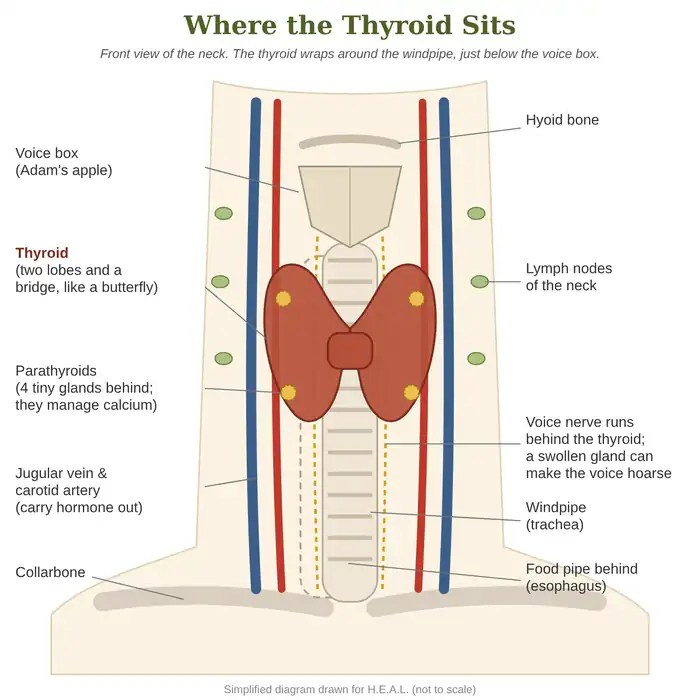
Look at the picture below. The parathyroids sit on the back of the thyroid, close beside the windpipe, the food pipe and the nerve that runs the voice box. Anything done to the thyroid, a swelling, an inflammation or an operation, reaches them too. But their work reaches far beyond the neck: into the bones they draw from, the kidneys that must carry the extra calcium out or hold it in, the gut that absorbs it, and the nerves and muscles that need it to fire and relax.

Diagram of the front of the neck showing the thyroid with the four parathyroid glands behind it, the windpipe, food pipe, voice nerve, blood vessels and lymph nodes.
Where the thyroid and parathyroids sit, and their neighbors. Simplified diagram drawn for H.E.A.L. (not to scale).

Why the neighbors matter. When calcium runs high, the kidneys take the brunt: they are flooded with calcium they must carry out, and stones form. A constipated bowel holds waste the kidneys and liver then have to clear. When calcium runs low, the nerves and muscles complain first. So caring for the parathyroids always means caring for the kidneys, the bowels and the bones along with the glands themselves.

Opening the Way: Packs and Warmth

  • M&L Salve pack or Gland Formula fomentation. Dr. Christopher’s glandular formula, mullein and lobelia, is food for the glands, and a pack over the front of the throat reaches the parathyroids as well as the thyroid. Spread M&L Salve on flannel, lay it over the throat, cover with plastic wrap and a towel, and add gentle heat. Or soak a flannel in a hot tea of three parts mullein to one part lobelia, lay it over the throat, cover it and leave it on overnight. Six nights a week.
  • Gentle hot and cold. Alternating hot and cold compresses over the neck bring fresh circulation and nutrients into the area. Be generous with the warmth and keep the cold brief.
  • Keep the bowels moving. Constipation is common when calcium runs high. Bowel cleansing with LBF keeps the waste moving out so the rest of the body can do its work.
  • Keep the kidneys clear. With an overactive gland, drink plenty of water every day so the extra calcium is carried out instead of settling into stones, and include kidney flushing in your program. If stones have already formed, see Kidney Disease.

After Neck Surgery: Calming and Rebuilding

When the parathyroids have been bruised or their blood supply disturbed during an operation, the work is to calm the area first and then rebuild the tissue. Begin only once the incision has fully closed, and keep taking any calcium and vitamin D your doctor has prescribed while the glands recover.

  • First, calm the inflammation: Healing Salve. Comfrey root, marshmallow root and marigold with rosemary, lavender, frankincense and helichrysum oils, soothing and healing to inflamed tissue and a salve Dara uses over incision and biopsy sites. Make a salve pack over the front of the neck and leave it on overnight.
  • Then, rebuild the tissue: BF&C Salve packs. Once the soreness and swelling have settled, switch to Dr. Christopher’s Bone, Flesh and Cartilage formula, led by white oak bark and comfrey root, traditionally used wherever bone, flesh and cartilage need to be restored. Spread it on flannel over the neck, add gentle heat for 30 minutes to an hour, and leave the pack on overnight. Steady, ongoing use is what rebuilds.
  • Let the skin breathe. With any salve pack, leave the area open and clear of salves for at least 6 hours each day.
  • Rebuild from the inside as well: BF&C extract. The adult dose is 1 teaspoon three times a day, so the tissue is fed from within while the salve works from without.

Feeding the Body

  • Calcium the body can use. Dr. Christopher’s Calcium formula (horsetail grass, comfrey root, oat straw and lobelia) gives calcium that has already passed through plant life, so the body can assimilate it without leaving mineral residue for the kidneys. Dara regards ordinary calcium pills as ground-up rock. 1 teaspoon three times a day, taken with a good whole-food blend such as Superfood; it is a food formula and can be used freely. This is the first support when calcium runs low: after neck surgery, when the glands are working overtime, and for the cramps and twitching of low calcium. It is safe with an overactive gland too. The body builds its calcium from these herbs after they are taken in, so the formula does not dump a load of calcium into the blood; when the blood runs high but the bones are still lacking, it feeds the bones.
  • For cramps and spasms. While calcium is being rebuilt, the M&L Salve or Lobelia eases any kind of cramping. Rub the M&L Salve into the cramping muscle or lay a salve pack over it; the lobelia in it is the antispasmodic that lets a locked muscle go. Lobelia extract can also be taken by mouth: usually one good dropperful does the job; take up to two, depending on the size of the person and how bad the cramps are. Cramping that will not let go, or tightness in the throat, is an emergency (see the box below).
  • Parsley root tea. Dr. Christopher’s food for the parathyroids: the root brings calcium, B vitamins and iron that nourish the glands. Pour a quart of boiling water over a cup of firmly packed fresh parsley, steep 15 minutes, strain and refrigerate. Drink it through the day. Parsley also keeps the urine flowing, a help to the kidneys when calcium runs high.
  • BF&C for the bones. When an overactive gland has been draining the bones, the BF&C extract (1 teaspoon three times a day for an adult) helps rebuild them, and it has long been used to help move calcium deposits along.
  • Super Kelp and the greens. Super Kelp (Atlantic kelp, Irish moss and dulse) and daily dark greens bring the magnesium and trace minerals the glands need to do their work.
  • Sunshine. Vitamin D is made in the skin from sunlight, and without it the gut cannot take in calcium. Get out in the sun regularly, and have your vitamin D checked; if it tests low, ask your doctor how best to bring it up, since calcium cannot be put to use without it.
  • Stop the calcium robbers. Soft drinks, coffee, chocolate and junk foods draw on the body’s calcium and leave the glands working harder. Fresh fruits, vegetables, whole grains, nuts and seeds feed the body instead.

Using Comfrey With Care

Comfrey root, the great tissue rebuilder, is at the heart of the BF&C extract and salve on this sheet. Modern guidance cautions against long, heavy use of comfrey by mouth because of its natural alkaloids; the BF&C formula uses it in traditional proportions, as part of a blend.

  • BF&C extract: the adult dose is 1 teaspoon three times a day. More is not faster.
  • During pregnancy: in Dara’s experience the BF&C formula is beneficial, its nutrients helping the baby knit together well.
  • BF&C Salve: use it as an overnight salve pack, and leave the area open and clear of salves for at least 6 hours each day.

When to Get Medical Care

Herbs are support alongside medical care, not a replacement for it. Have a high blood calcium followed up with calcium, PTH and vitamin D tests. A truly overactive gland with a growth on it is a medical matter; it is usually treated by removing the one enlarged gland, and the supports on this sheet can be used before and after. After neck surgery, keep taking any calcium and vitamin D prescribed and keep your lab appointments; don’t stop or change them on your own.

Emergencies. Very high calcium: confusion, vomiting, extreme thirst, great weakness or an irregular heartbeat. Very low calcium: cramping of the hands or feet that won’t let go, tightness in the throat or trouble breathing, a seizure, or an irregular heartbeat. Either needs emergency care right away.

Level of Commitment

How much work the parathyroids take depends on which way they have gone and why. Be honest about where you are:

  • Gentle support. For glands working overtime because of low vitamin D or a calcium-poor diet, borderline labs, or a mild, temporary drop in calcium after surgery. The Calcium formula with Superfood, parsley root tea, greens and Super Kelp, sunshine, and an end to the calcium robbers.
  • Focused cleansing. For a diagnosed overactive or underactive parathyroid, or tissue damaged by neck surgery. Add the M&L Salve pack or Gland Formula fomentation six nights a week; after surgery, the Healing Salve and then BF&C packs with the BF&C extract; bowel cleansing; and weeks of liver flushing alternated with weeks of kidney flushing, so the body stays on top of the healing. Plenty of water when calcium runs high. Have your labs rechecked as you go.
  • Incurables Program. For parathyroid cancer, which is rare, or a long-standing, serious case that has already damaged the kidneys or bones. The supports on this sheet continue, while the full Incurables Program, which includes cleansing the bloodstream with HEAL’s Blood Purifying formula, is done hand in hand with your medical team. Blood Purifying contains chaparral, which has long been regarded as one of the strongest blood purifiers in herbal use. It has had years of bad press, but used wisely it supports the body in clearing cancer, and over the years many members have used it to eliminate tumors. Use with care: take Blood Purifying in courses, not continuously: two dropperfuls 4 to 6 times a day for a week at a time, in a few ounces of grape juice, while drinking 64 to 128 oz. of liquid a day. Avoid it during pregnancy or nursing and with existing liver disease. If the skin or the whites of the eyes turn yellow, the urine turns dark, or there is pain under the right ribs, stop and have the liver checked.

More Is Not Faster

These doses are set to what the body can clear. Taking more stirs up more than the bowels, liver and kidneys can carry out, and that is when cleansing starts to feel like poisoning. Healing the body requires steady, consistent nutrition and action, not a bigger dose.

People are different, and now and then someone reacts poorly to a particular herb. If that happens, stop it. What I offer here is a guideline. You are the one living in your body, so work with the Holy Spirit and the wisdom the Lord has given you to apply these supports in the best way for your life.

A Loose Healing Plan

  1. First: know which way the glands have gone. Have calcium, PTH and vitamin D checked, along with phosphorus, magnesium and kidney function, and a bone density scan if calcium has been high. The plan depends on the answer.
  2. Weeks 1–2: Build the foundation. Start your Foundational Program (Superfood, Echinacea, Vitamin C, and bowel cleansing with LBF).
  3. Feed the body. Begin the Calcium formula with Superfood, whether calcium runs low or high; it feeds the bones without loading the blood. If calcium is high, drink plenty of water. Either way: parsley root tea, greens, Super Kelp, sunshine, and no calcium robbers.
  4. Open the way. An M&L Salve pack or Gland Formula fomentation over the throat at bedtime, six nights a week, with gentle hot and cold over the neck.
  5. After neck surgery: once the incision has closed, Healing Salve packs to calm the area; when it has settled, BF&C Salve packs overnight with the BF&C extract by day (1 teaspoon three times a day), leaving the area open and clear of salves at least 6 hours each day. Keep taking what your doctor prescribed while the glands recover.
  6. Weeks 4 onward: Alternate. A week of liver flushing, then a week of kidney flushing, for as many rounds as your level of commitment calls for, with gentle-support weeks in between. The kidneys matter most when calcium has been high.
  7. About 3 months: Check your progress. Have your labs rechecked. If an overactive gland is still pushing calcium up, talk with your doctor about removing it, and keep the supports going before and after. After surgery, recheck as often as your doctor advises, since prescriptions may come down as the glands heal.

More on the Parathyroids

This information is for education only. It is not meant to diagnose, treat or replace care from a qualified health professional.
Sunlight filtering through a golden underwater kelp forest.
Herbal Healing, Organs & Glands

My Thyroid Story

Photo: James Collington / Pexels

Childhood Thyroid Issues

Dara Dietz age 16

My mother used to joke that when puberty hit it knocked me out. She was right. It seemed I could not get enough sleep. On a typical day I’d drag myself out of bed in the morning. Somehow I’d manage to get through school without falling asleep, come home, sleep on the couch until dinner, take a bath, and crawl back to bed, where I’d sleep until morning when I’d do it all again. Sometime during the fifth grade my parents took me to a pediatrician and discovered my low-functioning thyroid. The doctor prescribed thyroid medication, which she said I’d need for the rest of my life.

Life began to get interesting after I woke up. I faithfully took my little pill every day. I noticed even one day without my medication would bring on a brain fog along with the urge to sleep the day away. After giving birth to my daughter the brain fog was more dangerous. If I missed a dose I noticed I did not have the mental ability to keep up with my active toddler. She could wander away from me and I would not even know she had gone until a crash or some other heart-stopping noise made me aware of her whereabouts. It began to bother me that I was only me when I took my pill.

Discovering the Power of Kelp

Kelp came into my life through the suggestion of a trusted friend. She said kelp would safely provide me natural energy. I was very interested. Several years earlier I had experienced the consequences that follow overdosing on caffeine. The energy needed to maintain life as a single parent and full-time student was enormous. I would have done anything short of taking illegal drugs for more energy. My friend shared that she had used kelp pills freely for years. This sounded too good to be true, but also too good not to check out. I began taking four or five kelp pills a couple of times a day. Right away I noticed I did have more energy. This was great! I also did not experience the crash that usually followed after hopping myself up on caffeine.

After using kelp freely for over a year I experienced heart palpitations one morning after taking my normal thyroid medication. The emergency room doctor checked my blood levels and found my thyroid functioning within the normal range. This was shocking information; I had understood there was no healing my thyroid condition. At twenty-five years old I had taken my last thyroid pill.

Kelp has continued to be an important part of my daily food program. After founding HEAL Marketplace I experimented with combining the different kelps until I found a combination that suited me well. We call this our Super Kelp Blend, a mix of Atlantic Kelp, Irish Moss and Dulse. These herbs are excellent food for a malfunctioning thyroid; it does not matter if the thyroid is over producing or under producing. Kelp is God’s gift, His master herb for the thyroid gland.

More on the Thyroid

This is shared for educational purposes, from my own study and experience. It is not medical advice.

Sunlight filtering through a golden underwater kelp forest.
Herbal Healing, Organs & Glands

Thyroid Ailments

Photo: James Collington / Pexels

Underactive and Overactive Thyroid, Hashimoto’s and Graves’, Goiter, Nodules and Thyroid Cancer

Understanding the Condition

The thyroid is a small, butterfly-shaped gland at the base of the throat. Its two lobes sit on either side of the windpipe, joined by a narrow bridge, just below the voice box. When it is working properly, we are hardly aware it exists.

Small as it is, the thyroid sets the pace for the whole body. It stores practically all of the body’s iodine and uses it to make thyroid hormone (thyroxine, called T4, and its more active form, T3). That hormone tells every cell how fast to burn its fuel. It governs body temperature, energy, heart rate, digestion and the speed of the bowels, growth, the menstrual cycle and fertility, and, to a great degree, mental and emotional balance.

The thyroid does not work alone. The pituitary gland in the brain acts like a thermostat. When the body needs more hormone, the pituitary sends a signal called TSH, and the thyroid answers. When there is enough, the pituitary eases off (see the picture below). Iodine from food is the raw material the thyroid needs to answer that call.

Diagram: the pituitary gland sends TSH to the thyroid, which uses iodine from food to make thyroid hormone for every cell; feedback tells the pituitary to ease off.
How the thyroid is kept in balance. Simplified diagram drawn for H.E.A.L.

How It Develops

Thyroid trouble usually creeps in slowly. Because the hormone touches everything, the early signs are easy to blame on something else for months or years. It tends to go in one of these directions:

  • Short on raw material. Without enough iodine coming in, the thyroid has to work overtime to make its hormone. It often enlarges in the effort; this swelling in the neck is a goiter. Function slowly drifts low.
  • Underactive (hypothyroidism). Too little hormone, so everything slows down: tired even after 12 hours of sleep, cold hands and feet, weight gain, constipation, dry skin and cracked heels, brain fog and poor memory, thinning hair and eyebrows, heavy periods, puffiness in the face, depression, and cholesterol that climbs. It has been called “the unsuspected illness” because it is so often missed. Today the most common cause is Hashimoto’s thyroiditis, where the body’s own immune system slowly attacks the gland.
  • Overactive (hyperthyroidism). Too much hormone, so everything speeds up: a racing or pounding heart, trembling hands, feeling hot and sweaty, weight loss even while eating well, anxiety and irritability, trouble sleeping, loose bowels, and sometimes gritty or bulging eyes. The most common cause is Graves’ disease, where the immune system over-stimulates the gland.
  • Nodules and lumps. One or more lumps can form in a gland that has struggled for years. The great majority are never cancerous. Some “hot” nodules start making hormone on their own, apart from the rest of the gland.
  • Thyroid cancer. Most often it grows out of a nodule or a long-troubled gland rather than healthy tissue. The common types grow slowly, and caught early, while still inside the gland, the outlook is very good. It needs medical care (see the box below).

Women are affected far more often than men. Thyroid changes often first show up at turning points in a woman’s life: puberty, pregnancy, after childbirth and at menopause. The blood tests a doctor runs (TSH, free T4, and thyroid antibodies for Hashimoto’s) show which way the gland has gone and are the best way to measure your progress.

The Emotional Side: the Energy Work

Healing the whole person. We are body, mind and spirit, and all three must heal together. When one part is neglected, the other two cannot find complete healing. A person can follow a perfect herbal program, but if she stays in a life that keeps wearing her down, or never makes time to care for herself, the body will keep losing ground. Healing the body often means facing what is happening in the heart and spirit as well.

The body and the heart are not separate. Long-held feelings settle into the body, and the throat is where we speak up and express who we are. Louise Hay, in her book Heal Your Body, ties thyroid trouble to the sense that life keeps passing us by, that our own turn never comes. Healing the thyroid often means also giving ourselves permission to speak, to create and to live our own life.

  • Thyroid in general: feeling humiliated, held down, always waiting for your turn. Turn it around: I move past old limits and let myself express who I am, freely and creatively.
  • Underactive (hypothyroidism): giving up; feeling stifled with no way out. Turn it around: I build a new life on terms that truly support me.
  • Overactive (hyperthyroidism): rage at being left out or overlooked. Turn it around: I am at the center of my own life, and I approve of myself and what I see.
  • Goiter: resentment at having things forced on you; feeling like a victim, thwarted and unfulfilled. Turn it around: I am in charge of my own life, and I am free to be myself.
  • Throat problems (a lump, hoarseness, trouble swallowing): not speaking up for yourself, swallowed anger, stifled creativity. Turn it around: It is safe for me to speak up. I express myself with ease and I am willing to change.

Emotional patterns paraphrased from Louise Hay, Heal Your Body (Hay House).

Areas Affected & Opening the Way to Healing

Look at the picture below and notice what the thyroid is wrapped around and pressed against. It hugs the front of the windpipe, with the food pipe just behind. The nerve that runs the voice box travels up behind it. Four tiny parathyroid glands, which manage the body’s calcium, sit on its back. The great blood vessels on either side carry its hormone to every part of the body, and the lymph nodes of the neck drain the area.

Diagram of the front of the neck: the butterfly-shaped thyroid wraps the windpipe below the voice box, with the parathyroids behind it, the voice nerve, food pipe, jugular vein, carotid artery and lymph nodes nearby.
Where the thyroid sits, and its neighbors. Simplified diagram drawn for H.E.A.L. (not to scale).

Why the neighbors matter. A swollen gland presses on its neighbors: a feeling of a lump in the throat, trouble swallowing, a hoarse voice or a tight, full neck. The rest of the body matters too. Much of the hormone the thyroid makes (T4) has to be turned into its active form (T3) in the liver and the gut, so a congested liver and a backed-up bowel leave the body short even when the gland is working. And a slow thyroid slows the bowel, which adds to the load. That is why bowel cleansing and liver flushing are part of every thyroid program.

The Parathyroids: the Calcium Regulators

The four parathyroid glands sit on the back of the thyroid, each about the size of a grain of rice. They share the neighborhood but not the job. The thyroid sets the pace of the body; the parathyroids guard the calcium in the blood, which the heart, nerves and muscles depend on. When blood calcium dips, they release parathyroid hormone (PTH), which draws calcium out of the bones, tells the kidneys to hold on to calcium, and turns on vitamin D so the gut absorbs more. When calcium is back up, they ease off.

  • Overactive parathyroid (hyperparathyroidism). Most often one of the four glands has grown a small, non-cancerous lump and keeps making hormone even when calcium is already high. Calcium is pulled out of the bones and builds up in the blood. The old saying is “stones, bones, groans and moans”: kidney stones, thinning bones, aches and belly troubles (constipation, nausea, heartburn), and tiredness, low mood and foggy thinking, often with great thirst and frequent urination. Many people have few signs, and it is found when a routine blood test shows high calcium.
  • When the glands are working overtime for a reason. Low vitamin D, poor calcium absorption or failing kidneys keep calcium low, so the parathyroids work harder to make up for it. Here the glands are answering a need, not causing the problem, and the healing is in feeding the body and caring for the kidneys.
  • Underactive parathyroid. Uncommon, and usually follows surgery on the neck. Calcium runs low, bringing tingling around the mouth and fingers and muscle cramps. It needs medical care.

Not the same as an overactive thyroid. With an overactive parathyroid the thyroid labs are usually normal; the blood calcium and PTH tell the story. Bugleweed and the kelp guidance on this page are for the thyroid. For the parathyroids, Dr. Christopher used parsley root tea: the root brings calcium, B vitamins and iron that nourish these glands. Pour a quart of boiling water over a cup of firmly packed fresh parsley, steep 15 minutes, strain and refrigerate. Because high calcium so often ends in kidney stones, keep the water coming in and the kidneys flushing well. A true overactive gland is a medical matter: a doctor will confirm it with calcium and PTH tests, and it is usually treated by removing the one enlarged gland.


That is the short version on the parathyroids. For the full picture, see my Parathyroid Ailments sheet. Now, back to the thyroid.


Opening the Way: Fomentations and Warmth

  • Gland Formula fomentation. Dr. Christopher’s glandular formula, mullein and lobelia, is the first support for a malfunctioning thyroid, whether it is underactive or overactive. Make a tea of three parts mullein to one part lobelia, soak a flannel in it as hot as can be tolerated, and lay it around the throat over the thyroid. Cover it with plastic and leave it on all night, six nights a week, until relief is obtained.
  • M&L Salve pack. The same two herbs in a salve, without the mess. Spread the M&L Salve on flannel, lay it over the throat, cover with plastic wrap and a towel, and add gentle heat. The heat drives the herbs into the surrounding tissue so they can do their work more quickly.
  • Gland Formula as a tea or extract. Alongside the fomentation, drink a cup of the mullein and lobelia tea two or three times a day, or take the Gland Formula extract, 2 to 4 droppers (½ to 1 teaspoon) three times a day.
  • Gentle hot and cold. Alternating hot and cold compresses over the neck bring circulation to a sluggish gland. Be generous with the warmth and keep the cold brief, especially if the heart is racing from an overactive thyroid.

Feeding the Thyroid

  • Super Kelp. Kelp is the master herb for the thyroid. It feeds the gland the iodine and trace minerals it is short on, and in Dara’s experience it helps whether the gland is over-producing or under-producing. Super Kelp is HEAL’s blend of Atlantic kelp, Irish moss and dulse. Dr. Christopher suggested 10 to 15 kelp tablets a day if there is any sign of a thyroid problem, or 2 or more a day to keep the gland in good condition. Dara takes 10 capsules in the morning and another 5 later in the day.
  • Kelp in the kitchen. Use kelp powder in place of table salt, on salads and in cooking. A money-saving tip from Dara: buy Super Kelp powder by the pound and blend it with coconut oil into small chunks, so you get your kelp and coconut oil at the same time.
  • Thyroid greens. Dr. Christopher fed the thyroid with parsley, watercress, romaine lettuce, turnip tops, Irish moss and Iceland moss. Put the greens on your plate and in your juices every day.
  • Bugleweed for a racing heart. With an overactive thyroid, bugleweed is the traditional herb for calming the gland and the racing, pounding heart that goes with it. Dr. Christopher’s sources call it a superior sedative: it lowers the pulse without bad side effects, steadies heart palpitations, calms the nerves, and helps with the insomnia and worry that so often come with an overactive thyroid. Use bugleweed tincture on its own: ½ teaspoon stirred into a glass of juice, or into a cup of hot water as a tea with a touch of cayenne for more heart support. It is a support herb: take it as needed when the heart races or the nerves are on edge, and keep using it until the need for it clears. It is meant to quiet an overactive gland, so it is not for an underactive thyroid or Hashimoto’s, during pregnancy or nursing, or alongside thyroid medication without someone watching the labs.
  • Rest. The pull toward sleep with an underactive thyroid is real. Honor it rather than pushing through with coffee or other stimulants; rest gives the gland room to rebuild.

Using Kelp With Care

Kelp is a food, and for most people it can be used freely. Because it brings real iodine, a few situations call for starting low, going slowly and having the labs checked:

On thyroid medication. As kelp feeds the gland, it may start making more of its own hormone, and the medication dose can become too much. Dara’s own story below shows this: palpitations one morning once her thyroid had healed. Keep taking your medication and have your levels checked every few months, so your doctor can lower the dose as you need less. Don’t stop or change it on your own.

Hashimoto’s, Graves’ or an overactive thyroid, or a thyroid nodule. Start with a small amount and build slowly, with your labs checked along the way.

Before a radioactive iodine scan or treatment, stop kelp and other sea vegetables for one to two weeks.

Kidney disease, pregnancy and nursing: use food-level amounts only.

For the full story on kelp, see Kelp: Food from the Sea for the Thyroid.

When to Get Medical Care

Herbs are support alongside medical care, not a replacement for it. Get prompt care for: a lump in the neck that is growing, hard or fixed in place; hoarseness that lasts more than a few weeks; trouble swallowing or breathing; chest pain or a racing, irregular heartbeat; or eyes that become painful, red or bulging. Have a high blood calcium followed up, since it points to the parathyroids.

Emergencies. A very high fever with a racing heart, agitation or confusion (an overactive thyroid out of control), or extreme cold, drowsiness and confusion (a severely underactive thyroid) need emergency care right away, as do signs of very high calcium: confusion, vomiting, extreme thirst or an irregular heartbeat.

Thyroid cancer needs a medical team. The supports on this page can be used alongside their care.

Level of Commitment

How much work the thyroid takes depends on how long it has been struggling and which way it has gone. Be honest about where you are:

  • Gentle support. For a tired, cold, sluggish body with labs on the low side of normal, a family history of thyroid trouble, or simply keeping the gland strong. Super Kelp daily, kelp in place of salt, thyroid greens, and real rest. Most people can live on this for good; Dara has for over 40 years.
  • Focused cleansing. For a diagnosed underactive or overactive thyroid, Hashimoto’s, Graves’ or a goiter. Add the Gland Formula fomentation or M&L Salve pack six nights a week and the Gland Formula tea or extract by day; bowel cleansing; and weeks of liver flushing alternated with weeks of kidney flushing, so the body stays on top of the healing. Bugleweed for a racing heart. Have your labs rechecked as you go.
  • Incurables Program. For thyroid cancer or a long-standing, serious thyroid condition. The thyroid supports on this page (fomentations, salve packs, the Gland Formula and Super Kelp) continue, while the full Incurables Program, which includes cleansing the bloodstream with HEAL’s Blood Purifying formula, is done hand in hand with your medical team. Blood Purifying contains chaparral, which has long been regarded as one of the strongest blood purifiers in herbal use. It has had years of bad press, but used wisely it supports the body in clearing cancer, and over the years many members have used it to eliminate tumors. Use with care: take Blood Purifying in courses, not continuously: two dropperfuls 4 to 6 times a day for a week at a time, in a few ounces of grape juice, while drinking 64 to 128 oz. of liquid a day. Avoid it during pregnancy or nursing and with existing liver disease. If the skin or the whites of the eyes turn yellow, the urine turns dark, or there is pain under the right ribs, stop and have the liver checked.

More Is Not Faster

These doses are set to what the body can clear. Taking more stirs up more than the bowels, liver and kidneys can carry out, and that is when cleansing starts to feel like poisoning. Healing the body requires steady, consistent nutrition and action, not a bigger dose.

People are different, and now and then someone reacts poorly to a particular herb. If that happens, stop it. What I offer here is a guideline. You are the one living in your body, so work with the Holy Spirit and the wisdom the Lord has given you to apply these supports in the best way for your life.

A Loose Healing Plan

  1. Weeks 1–2: Build the foundation. Start your Foundational Program (Superfood, Echinacea, Vitamin C, and bowel cleansing with LBF). Have your thyroid labs done so you know where you are starting.
  2. Start feeding the gland. Begin Super Kelp. If you have Hashimoto’s, an overactive thyroid or a nodule, or take thyroid medication, start with a small amount and build up slowly. Use kelp in place of salt and add the thyroid greens.
  3. Open the way. A Gland Formula fomentation or M&L Salve pack over the throat at bedtime, six nights a week, with the Gland Formula tea or extract two or three times a day.
  4. If the thyroid is overactive: add bugleweed for the racing heart, keep kelp modest, and work with someone who is watching your labs.
  5. Weeks 4 onward: Alternate. A week of liver flushing, then a week of kidney flushing, for as many rounds as your level of commitment calls for, with gentle-support weeks in between.
  6. About 3 months: Check your progress. Have your labs rechecked. If you take thyroid medication, check sooner and more often, since the dose may need to come down as the gland heals. Then keep kelp as part of your daily food for life.

Stories from the Work

Dara: A sleepy fifth-grader

My mother used to joke that when puberty hit it knocked me out. She was right. It seemed I could not get enough sleep. I’d drag myself out of bed in the morning, somehow get through school without falling asleep, come home and sleep on the couch until dinner, then crawl back to bed and sleep until morning. Sometime during the fifth grade a pediatrician discovered my low-functioning thyroid and prescribed thyroid medication, which she said I’d need for the rest of my life. I faithfully took my little pill every day. Even one day without it would bring on a brain fog along with the urge to sleep the day away. After my daughter was born, missing a dose meant I could not keep up with my active toddler. It began to bother me that I was only me when I took my pill.

Dara: Twenty-five and off the pill for good

Kelp came into my life through the suggestion of a trusted friend, who said it would safely give me natural energy. I began taking four or five kelp pills a couple of times a day, and right away I had more energy, without the crash that always followed caffeine. After using kelp freely for over a year, I had heart palpitations one morning after taking my normal thyroid medication. The emergency room doctor checked my blood and found my thyroid working in the normal range. This was shocking; I had understood there was no healing my thyroid condition. At twenty-five years old I had taken my last thyroid pill. Kelp has been an important part of my daily food ever since. After founding HEAL I experimented with combining different sea plants until I found the blend that suited me, our Super Kelp. Kelp is God’s gift, His master herb for the thyroid gland.

More on the Thyroid

This information is for education only. It is not meant to diagnose, treat or replace care from a qualified health professional.
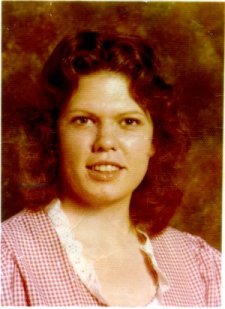
Sliced grapefruit, oranges, limes and green apples on fresh green leaves
Herbal Healing, My Opinion, Organs & Glands

My Kidney Stories

Photo: Julia Filirovska / Pexels

These are my own kidney stories, gathered from over the years. For the full information sheet, see Kidney Disease, and for the flushing routines and videos, see Kidney Flushing: From Light to Intense.

A Lifetime with Weak Kidneys

Kidney issues seem to have always been a part of my life. Kidney infections started in my childhood, and by sixteen an infection and high fevers put me in the emergency room in convulsions. Until I was introduced to herbs and natural healing in the early 1990s, prescribed antibiotics were a regular part of my life; I lived on them for fifteen years.

Since discovering the healing power of herbs, I have taken no prescribed drugs for infection. Combining the infection-fighting herbs into herbal extracts for my infections has proven effective every time I have used them. Kidney Support in my Kidney/Bladder Tea, along with my Hot Lemonade, have been my daily supports ever since, and I haven’t had a kidney attack or kidney pain in over 20 years. I know my kidneys are a weak spot, so I keep animal proteins very low, and I have no soda, sugary drinks or junk food. The body just doesn’t need that stuff.

Care and Feeding of the Kidneys

Kidneys or My Back?

During this time of my life, when my back began to ache there were three possible reasons. One was my cycle, which was easy to rule in or out. The other two were trickier. In 1985 I was in a car accident that fractured my lower back. I could go long periods without any discomfort, then out of the blue it would begin to spasm. Since the fracture was in my lower back, right at the same level as my kidneys, I needed to figure out which one was talking to me. When my back began hurting I would do the three kidney drinks. Within an hour, if it was my kidneys, the discomfort would be gone. If it did not go away, I knew it was my back, and I began using the BF&C formula for my back along with Lobelia for the spasm. We were not yet making salves, so my only relief was hydrotherapy and the extracts.

Ground-Up Rocks and My Kidneys

Regular calcium supplements are nothing but ground-up rocks, and my kidneys cannot take that at all. A friend told me about a high-quality calcium supplement that would never affect my kidneys. Within four hours of taking only one capsule, I could not even walk straight; my kidneys were completely spasmed. I had to drink emergency kidney teas and Hot Lemonade to clear the congestion and calm it down. I never touched those capsules again. Then I discovered Dr. Christopher’s Calcium extract. My mentor at the time talked me into making it, as I was very leery. It has been amazing: no kidney issues.

Michael’s Kidney Stone on the Road

My husband, Michael, and I made a weekend trip to Dr. Tim Jennings’ class in Collegedale, Tennessee. While we were there, Michael had a kidney stone attack. He admitted to feeling a little discomfort before we left but did not think it would become a problem over the weekend. The lack of proper fluids during the four-and-a-half-hour car trip likely set the active stones off.

One of the worst things you can do with a kidney stone is let yourself become dehydrated. The walls of the vessels in the kidneys are lined with nerve tissue. When the fluid in the kidneys falls off, the vessels collapse around the stones, and all the rough edges rip and tear into the nerve tissue as they pass through. Staying hydrated fills the vessels with fluid, keeping the stones buoyant and floating in the center, with much less ripping and tearing.

I learned a lot over two days in a hotel with a husband passing a kidney stone. First, hot fomentations can be done very effectively in a hotel room. I wet and wrung out two small hand towels and put them in the microwave for a minute and a half. That made them steaming hot, and by the time they made it across the room to the bed they were the perfect heat to lay over his kidneys. The stone began in the back and moved to the front over the next few hours. The wet heat kept the kidney calm and the pain all but gone. He also took some Advil, an over-the-counter pain reliever, which was an added help with the pain. I massaged the area with our Anti-Spasmodic Salve too. Our M&L Salve is normally perfect for muscle spasms, but the Anti-Spasmodic Salve is a bit stronger and proved helpful that weekend.

Friday night into Saturday morning he slept well, but the pain began to build again in the morning, likely because he had not kept up his fluids while he slept. The hot fomentations were what really eased it. He has said they were the only thing that truly helped.

Michael’s pain routine. Michael has given birth to many, many stone children over the years, and he has worked out his own routine for the pain. When a stone starts moving, he takes a nighttime pain reliever, either ibuprofen or Aleve. If there’s no relief in an hour, he takes two gel Tylenol and waits another hour or so. All the while I’m keeping hot fomentations over his kidneys, or he’s soaking in a very hot bath. He usually only needs to go through the routine once or twice per stone attack, and between the heat and his routine he can get the pain under control without breaking into the heavy-duty pain pills. Those save us trips to the ER and those awful bills.

This is what works for Michael, whose kidneys are otherwise healthy. Ibuprofen and Aleve are hard on weak kidneys, so anyone with kidney disease should ask their doctor what is safe for them.

A jagged kidney stone about 3/8 inch across beside a dime and a ruler
One of Michael’s “stone children,” passed in 2013, beside a dime and a ruler. Photo: Dara Dietz, H.E.A.L.

The Night at the Cabin Door

One night my husband’s boss showed up at our cabin door in severe kidney stone pain. His nephew was on the way to take him to the emergency room, but it would be over an hour before he arrived. I was setting him up for hot fomentations when he threw up blood all over my bathroom. I gave him an ounce of fresh-squeezed ginger root juice and an ounce of Cayenne extract. His stomach settled and the bleeding stopped. I left the mess, got him into bed and put the hot fomentations on his kidneys. About 15 minutes later he had fallen asleep, relaxed and exhausted from the pain. When his nephew arrived, he drove him, now comfortable, to the emergency room, where they could find no hole in his stomach lining and no internal bleeding at all. He later told me there was no way he had thrown up blood in my bathroom; I assured him I’d had to scrub the proof off the walls and floor. For as long as I knew him, he joked that I had tried to kill him with that ounce of Cayenne. It was the only part of the whole night he remembered. It worked.

I have had people rolling on the floor in agony from a kidney stone who were comfortable in 15 minutes or less with hot fomentations over the kidneys. They are so helpful.

A Member’s Bright Idea

So many of the healing truths I have learned have come from our members. A member called to order a Kidney Stone Dissolve Kit. When I asked if her stones were coming back, she said no: her blood pressure was ticking up without a real reason, and she knew that clogged kidneys full of sediment make the heart work harder to push the blood through. She wanted an intense kidney flush. What a brilliant thought, an ELF for the kidneys! That is how the Ultimate Kidney Flush was born.

More on the Kidneys

This information is for education only. It is not meant to diagnose, treat or replace care from a qualified health professional.
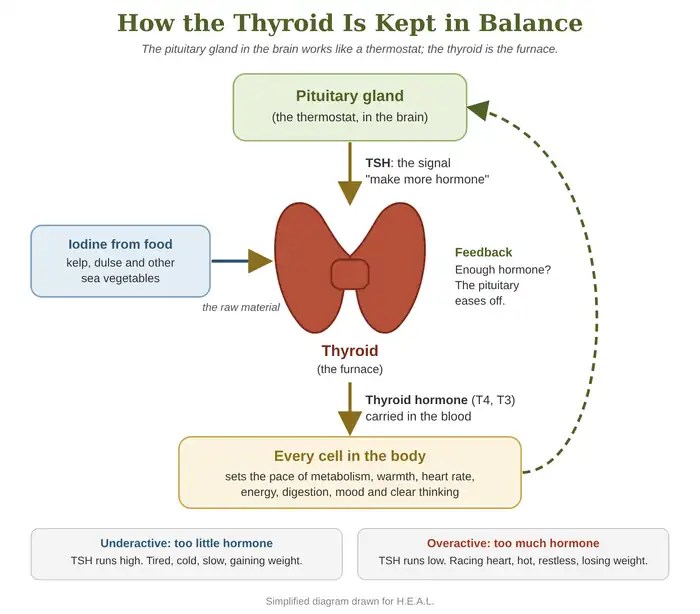
Sliced grapefruit, oranges, limes and green apples on fresh green leaves
Cleansing & Flushing, Herbal Healing, Organs & Glands

Kidney Flushing: From Light to Intense

Photo: Julia Filirovska / Pexels

This post gathers my kidney flushing routines and class videos in one place. For the full picture of what is happening in the kidneys and a loose healing plan, start with my Kidney Disease information sheet.

From Light to Intense

Kidney flushing runs from a light daily or seasonal flush all the way to an intense flush used to lower rising blood pressure, dissolve kidney stones, and help the renal system clear edema. It is part three of the Incurables Routines, and it goes hand in hand with liver flushing: every week of liver flushing should be followed by a week of kidney flushing, so the body can stay on top of the healing.

  • Light: Hot Lemonade every day, Kidney/Bladder Tea with Kidney Support, and plenty of distilled water.
  • Moderate: a full Kidney Flushing week, alternated with liver flushing weeks.
  • Intense: the Ultimate Kidney Flush, also known as the Stone Dissolve Routine, below.
Kidney Flush Class

Download the handout from the Kidney Flushing Class here:

The Daily Flush: Hot Lemonade

Using the Hot Lemonade as a daily kidney flush is an excellent idea. Those who have suffered through kidney stones will want to keep up with this routine to keep new stones from forming. In a 16-ounce glass of hot water: 1 teaspoon cayenne, 1 tablespoon apple cider vinegar, and fresh lemon juice and maple syrup to taste.

Learning to Use Cayenne: Hot Lemonade

The Ultimate Kidney Flush & Stone Dissolve Routine

So many of the great healing truths I have discovered have come from our members. The idea of using the Kidney Stone Dissolve Routine as an extreme kidney flush came from one of our brightest members, whose blood pressure was ticking up without a real reason. She understood that clogged kidneys, full of pus or sediment, make the heart work harder to force the blood through, and she wanted an intense flush. What a brilliant thought: an ELF* for the kidneys! (*ELF = Emergency Liver Flush.) It quickly clears excess sediment from the filters, and when the kidneys are free and clear the heart does not need to work as hard. All flows more freely.

This routine does not take the place of the daily Hot Lemonade for preventing new stones, but it quickly flushes the kidneys so they can filter better. Uric acid crystals dissolve quickly. Small calcium gravel and plaque dissolve faster than one large stone. Whatever the size of your crystal and rock collection, if you have or even suspect sediment, gravel or stones in your kidneys or bladder, it is time to get to work.

Ultimate Kidney Flush & Stone Dissolve Routine

What you need (the Kidney Stone Dissolve Kit):

  • Kidney Support: uva ursi leaves, juniper berries, corn silk, horsetail herb, pipsissewa leaf, burdock root and seed, goldenrod flower and parsley root.
  • Kidney/Bladder Tea: juniper berries, corn silk, uva ursi leaves, parsley root and leaf, dandelion leaf, horsetail herb, goldenrod flower, hydrangea root, gravel root, marshmallow root, orange peel and peppermint leaf.

In a gallon jug, combine:

  • 98 ounces organic, freshly juiced apples (use the tartest available, such as Granny Smith)
  • 10 ounces organic, fresh-squeezed lemon juice
  • 10 ounces organic, fresh-squeezed lime juice
  • 10 ounces organic, raw, unfiltered apple cider vinegar
  • 8 ounces of dry Kidney/Bladder Tea (unbrewed)
  • A 2-ounce bottle of Kidney Support (added after the dry herbs are strained out)

The routine takes 3 days and can be repeated.

  1. Day One: Combine everything except the Kidney Support in the gallon jug. For a stronger brew, run it all through a blender to break down the herbs. Let it steep at room temperature for 24 hours, shaking for a minute or two every couple of hours.
  2. Strain through a stainless steel strainer, or squeeze it through a clean cotton T-shirt. Add the 2-ounce bottle of Kidney Support. Keep the strained brew in the refrigerator until it is gone.
  3. Days Two and Three: Drink 4 ounces every waking hour, each followed by a glass of distilled water (or an ounce every 15 minutes). At 4 ounces an hour over a 16-hour day, you will drink about 64 ounces a day, so the gallon lasts almost two days.

Drink up to 64 ounces of distilled water a day along with it. Only distilled water, the emptiest water, is allowed. It acts like a vacuum, the universal solvent for unwanted mineral deposits. Just drinking distilled water regularly helps dissolve stones and keep new ones from forming; added to this routine, you have a real winner. Repeat at one-week intervals if needed; one large stone dissolves more slowly than many small ones.

Hydrangea, the gravel remover. There is much disagreement about hydrangea’s stone-dissolving properties. Most authorities agree it removes stones, but not all consider it a solvent. Dr. Butler affirmed that it relieves the pain of passing stones. Dr. Shook explained that the sharp pain of gravel comes from the crystal’s sharp points piercing the kidney or ureter; when those points are even partly dissolved, the pain, bleeding and inflammation subside and the stones often pass with just a stretching of the tubes. He asked how else to account for stones that x-rays showed with sharp points, yet passed smooth and round after hydrangea. His clinical evidence, he said, proved hydrangea a true stone solvent.

Kidney Infections

If you have back pain and are not sure whether it is your kidneys, try my three drinks (Echinacea, Herbal Aid 1 and Hot Lemonade), explained on the Kidney Disease sheet. If you determine you have a kidney infection, the Infection Program has proven very helpful in aiding the body to clear it.

Infection Program: Light to Intense

Feeding the Kidneys and Salve Packs

Care and Feeding of the Kidneys

A hot herbal fomentation brings healing herbs right into a struggling kidney, but it is messy and time-consuming, and few people will set one up. A salve pack does the same work without the hassle: spread the salve on flannel, lay it over the kidneys, and cover it with plastic wrap, a towel and a moist heating pad. For the Kidney Salve herbs, proportions and how to make it, see A Salve Pack for Struggling Kidneys.

Topical Application: Herbal Salve Overview

When to Get Medical Care

Herbs are support alongside medical care, not a replacement for it. Get prompt care for fever and chills with back or side pain, blood in the urine, being unable to pass urine, stone pain that is severe or comes with vomiting, or swelling with shortness of breath. These routines are not for anyone on dialysis or with kidney failure.

More on the Kidneys

This information is for education only. It is not meant to diagnose, treat or replace care from a qualified health professional.
Sliced grapefruit, oranges, limes and green apples on fresh green leaves
Cleansing & Flushing, Herbal Healing, Infection, Colds & Flu, Organs & Glands

Kidney Disease

Photo: Julia Filirovska / Pexels

Infection, Inflammation, Gravel & Stones, and Failing Kidney Function

Understanding the Condition

Dr. Christopher called the kidneys “the filters of the blood,” and that is exactly what they are. Every drop of blood in the body passes through them many times a day, roughly 45 to 50 gallons of blood filtered every 24 hours. Each kidney holds about a million tiny filtering units called nephrons. In each one, a little knot of blood vessels (the glomerulus) strains the blood, and a long, thin tubule then takes back the water, minerals and nutrients the body needs to keep. What is left, the waste, acids and excess fluid, becomes one to two quarts of urine a day.

The kidneys do more than make urine. They keep the body’s water, salt, potassium and acid balance steady; they help set the blood pressure; they make the hormone that tells the bone marrow to build red blood cells; and they turn vitamin D into the form the body uses for strong bones. When the kidneys struggle, all of these jobs slip, which is why kidney trouble can show up as tiredness, anemia, high blood pressure, swelling, cramps and weak bones long before anyone thinks of the kidneys.

How It Develops

Kidney disease is seldom one sudden event. It is usually a slow wearing-down of the filters, and it tends to move through stages (see the picture below):

  • Overload. The most common beginning is simply not drinking enough water, combined with a heavy load for the filters to handle: lots of animal protein, salt, soda, coffee, alcohol and processed food. Urine becomes dark and concentrated, and minerals and uric acid begin to settle out as fine sediment.
  • Irritation and infection. Sediment and concentrated urine irritate the delicate tubules. Bacteria, most often climbing up from the bladder, find a home there. The tissue swells and heats, bringing the deep back ache, fever and burning that go with a kidney infection (pyelonephritis). Inflammation of the filters themselves is called nephritis; the old books call long-standing nephritis Bright’s disease.
  • Gravel and stones. Left in place, crystals grow into gravel and stones. Their sharp points tear at the lining of the kidney and ureter, which is where the terrible pain and the blood in the urine come from. A stone can also block the flow of urine, backing pressure up into the kidney.
  • Scarring and lost function. Each round of infection, inflammation or blockage leaves some nephrons scarred. Nephrons do not grow back, so the ones that remain have to work harder. Over years the kidney can shrink and lose function. This is chronic kidney disease (CKD). The two biggest causes today are diabetes and high blood pressure, both of which damage the tiny blood vessels of the filters; long-term use of some pain relievers and other drugs is another.

The hard part is that, as Dr. Christopher said, “our kidneys cannot talk.” Chronic kidney disease is usually quiet until much of the function is gone. Early signs are easy to brush off: tiredness, a dull ache across the lower back, restless legs and night cramps, puffy eyes or ankles, foamy or very dark urine, getting up often at night, itching, and blood pressure that creeps up for no clear reason. The simple blood and urine tests a doctor runs (eGFR, creatinine and urine protein) show how well the filters are working, and they are the best way to measure your progress.

Diagram of four kidneys showing how kidney trouble builds: healthy filter, overloaded, inflamed or infected, and stones and scarring
How kidney trouble builds. Simplified diagram drawn for H.E.A.L.
A jagged kidney stone about 3/8 inch across beside a dime and a ruler
A real kidney stone, passed by Dara’s husband in 2013, beside a dime and a ruler: about 3/8 inch across, with rough, jagged edges. Photo: Dara Dietz, H.E.A.L.

The Emotional Side: the Energy Work

Healing the whole person. We are body, mind and spirit, and all three must heal together. When one part is neglected, the other two cannot find complete healing. A person can follow a perfect herbal program, but if she stays in a life that keeps wearing her down, or never makes time to care for herself, the body will keep losing ground. Healing the body often means facing what is happening in the heart and spirit as well.

The body and the heart are not separate. The kidneys sort what we keep from what we let go, and feelings we hold on to instead of releasing can settle here too. Louise Hay, in her book Heal Your Body, ties kidney trouble to old hurts, disappointment and anger that never got cleared out. Letting those go is part of the flush.

  • Kidney problems: criticism, disappointment and a sense of failure; shame; reacting to life like a hurt child. Turn it around: Everything happening in my life is working toward good, and good comes from every experience. It is safe for me to grow up.
  • Kidney stones: hard lumps of anger that were never dissolved. Turn it around: I let go of past problems easily.

Emotional patterns paraphrased from Louise Hay, Heal Your Body (Hay House).

Areas Affected & Opening the Way to Healing

The kidneys sit high in the back, tucked under the lower ribs on either side of the spine, with the adrenal glands resting on top of each one. Two thin tubes, the ureters, carry urine down to the bladder. Look at the picture below and notice what sits around them: the liver over the right kidney, and the colon lying in front of both.

Diagram showing where the kidneys sit, with the liver, adrenal glands, colon, ureters and bladder around them
Where the kidneys sit, and their neighbors. Simplified diagram drawn for H.E.A.L. (not to scale).

Why the neighbors matter. The kidneys never work alone. The liver breaks down poisons and hands much of that waste to the kidneys to carry out, so when the liver is cleansed, the kidneys get extra work. That is why every week of liver flushing should be followed by a week of kidney flushing, so the body can stay on top of the healing. The bowel matters just as much. A backed-up colon sends its waste back into the blood the kidneys must filter, and a full, heavy bowel presses on the ureters and bladder. Keeping the bowels moving is part of every kidney program.

Opening the Way: Flow, Circulation and Warmth

  • Water first. Fluid is what keeps the filters open and keeps sediment floating so it can pass. Steam-distilled water was Dr. Christopher’s choice, and HEAL’s; it is “empty” and picks up mineral deposits on its way through. A common guideline is at least half your body weight in ounces each day; Dr. Christopher recommended up to an ounce per pound. Let Kidney/Bladder Tea carry much of that amount. (This sheet is not written for anyone on dialysis or with kidney failure; see the box below.)
  • Kidney Salve pack. Parsley root, juniper, marshmallow, ginger and burdock in a salve, spread on doubled flannel, laid over the kidneys on the back, covered, and warmed with a heating pad for 45 minutes to an hour at bedtime, then left on all night. It does the work of a fomentation without the mess. Alternatives: a hot fomentation of strong Kidney/Bladder Tea, or fresh cabbage leaves laid over the kidneys overnight.
  • Hot and cold. Hot and cold showers two or three times a day bring circulation through the back and pelvis. For the pain of a moving stone, hot fomentations over the kidneys (wet hand towels heated in the microwave, wrung out, laid over the kidneys and changed as they cool) give the most relief. It needs nothing special; you can put it together in a motel room that has a microwave. In Dara’s practice, people rolling on the floor in agony from a stone have been comfortable within 15 minutes. When urine is held back, alternating hot and cold fomentations over the kidneys and groin can help break up the blockage.
  • Keep the bowels moving. Lower Bowel Formula (LBF) and plenty of fiber, so the colon is not adding to the load.

Feeding the Kidneys and Helping Them Clear

  • Kidney Support and Kidney/Bladder Tea. The foundation. Kidney Support (juniper, uva ursi, parsley root, corn silk, goldenrod, horsetail, pipsissewa, burdock root and seed) is food for the whole renal system. Add ½ teaspoon to each 8 ounces of Kidney/Bladder Tea, hot or iced, and drink freely. The tea adds hydrangea and gravel root to discourage stones, and marshmallow to soothe.
  • Hot Lemonade. In a 16-ounce glass of hot water: 1 teaspoon cayenne, 1 tablespoon apple cider vinegar, and fresh lemon juice and maple syrup to taste. Once or more a day. It keeps the urine from becoming a breeding ground for stones and gets circulation moving.
  • Parsley. Fresh parsley, parsley tea and parsley in green juices; one of Dr. Christopher’s greatest kidney herbs.
  • Marshmallow root. Soothing and coating for raw, burning or inflamed tissue, and it helps gravel pass smoothly. Slippery elm does the same job.
  • For active infection. Herbal Aid 1 is the formula Dara uses for kidney infections; it works best for clearing them. Use it on the schedule from the HEAL Infection Program: 1 teaspoon in hot water every three waking hours for a mild infection, every two hours for a moderate one, and every hour for a serious one. Add 1 ounce of Echinacea in a mug of hot water once a day (once or twice for a serious infection), garlic paste on the feet as needed, and an ELF every few days, or five nights in a row for a serious infection. Keep Kidney Support and the tea going alongside. If you have taken antibiotics again and again for the same infection, expect the clearing to take anywhere from two weeks to three months.
  • For gravel and stones. Hydrangea root and gravel root, used in HEAL’s Stone Dissolve Routine (Ultimate Kidney Flush). Fresh juices: carrot and cucumber, celery and parsley, or watermelon.

For a Kidney Pain Attack: Dara’s Three Drinks

Kidney pain often feels like a stiff, aching back, so bad you hold onto the furniture to get around. But the kidneys sit at the same level as the lower back, so an ache there can be hard to place: is it the kidneys, or the back itself (or, for a woman, her monthly cycle)? These three drinks answer the question. Drink them one right after the other. As the fluid filters through, it calms spastic kidneys: if the kidneys are the trouble, the ache will be gone within about an hour. If it does not let go, the trouble is most likely in the back, and you can turn to back support instead.

  1. Echinacea: 1 ounce of Echinacea in 16 ounces of hot water.
  2. Herbal Aid 1: 1 tablespoon in 16 ounces of hot water, with honey.
  3. Hot Lemonade: a 16-ounce glass, made as above.

Pain with fever, blood in the urine, or pain that won’t let up still needs medical care (see the box below).

Taking Away the Burden

Careful with rock-based minerals. Most ordinary calcium supplements are ground-up rock (limestone, oyster shell) that weak kidneys cannot handle. Dara’s kidneys went into spasm within four hours of a single capsule. Dr. Christopher’s herbal Calcium extract has given her the calcium she needs with no kidney trouble.

Keep animal protein low, cut out soda, sugary drinks and junk food, go easy on salt and coffee, and avoid alcohol. Ask your doctor about long-term use of over-the-counter pain relievers, which are hard on the kidneys.

When to Get Medical Care

Kidney disease can become serious quickly. Herbs are support alongside medical care, not a replacement for it. Get prompt care for: fever and chills with back or side pain; blood in the urine; being unable to pass urine; stone pain that is severe, does not let up, or comes with vomiting; a sudden drop in how much urine you make; or swelling with shortness of breath.

Not for dialysis or kidney failure. This sheet is not written for anyone on dialysis or with kidney failure. Their care is managed by their medical team.

Level of Commitment

How much work kidney healing takes depends on how long the trouble has been building and how much function has been lost. Be honest about where you are:

  • Gentle support. For a tired, achy back, dark or cloudy urine, a history of bladder and kidney infections, or simply keeping weak kidneys strong. Daily Kidney/Bladder Tea with Kidney Support, Hot Lemonade, plenty of distilled water, a salve pack when the back aches, and taking away the burden foods. Most people can live on this for good; Dara has for over 30 years.
  • Focused cleansing. For gravel and stones, recurring infections, swelling, or blood pressure creeping up. Add a full Kidney Flushing week (the Kidney Flushing Schedule: the Kidney Flush Drink three times a day, Detox Formula, and 16 ounces of Kidney/Bladder Tea with Kidney Support every three hours, on fresh juices). Alternate it with liver flushing weeks so the body stays on top of the healing. For stones, add the 3-day Stone Dissolve Routine.
  • Incurables Program. For diagnosed chronic kidney disease, nephritis, or kidneys that are failing. The full program: a flush every morning for the first 30 days, alternating a week of liver flushing with a week of kidney flushing; up to six cups a day of Kidney/Bladder Tea with Kidney Support; the cold sheet treatment at least weekly; salve packs nightly; and a clean, plant-based diet. This level is done hand in hand with your doctor and your lab work.

More Is Not Faster

These doses are set to what the body can clear. Taking more stirs up more than the bowels, liver and kidneys can carry out, and that is when cleansing starts to feel like poisoning. Healing the body requires steady, consistent nutrition and action, not a bigger dose.

People are different, and now and then someone reacts poorly to a particular herb. If that happens, stop it. What I offer here is a guideline. You are the one living in your body, so work with the Holy Spirit and the wisdom the Lord has given you to apply these supports in the best way for your life.

A Loose Healing Plan

  1. Weeks 1–2: Build the foundation. Start your Foundational Program (Superfood, Echinacea, Vitamin C, bowel cleansing with LBF). Begin Kidney/Bladder Tea with Kidney Support every day and work up to your fluid goal. Hot Lemonade each morning. Drop soda, junk food and most animal protein. Kidney Salve pack at bedtime if the back aches.
  2. If there is infection: start Herbal Aid 1 right away on the Infection Program schedule, with Echinacea and garlic paste on the feet; use the three drinks for a pain attack, add marshmallow root tea for burning, and keep the fluids up. If there is fever with back pain, get medical care the same day.
  3. Week 3: Kidney Flushing week. Five days on the Kidney Flushing Schedule, on fresh juices if you can, with hot and cold showers two or three times a day.
  4. Weeks 4 onward: Alternate. A week of liver flushing, then a week of kidney flushing, for as many rounds as your level of commitment calls for, with gentle-support weeks in between.
  5. For stones: do the 3-day Stone Dissolve Routine. Repeat at one-week intervals if needed; one large stone dissolves more slowly than many small ones, and some cases take two or three rounds.
  6. About 3 months: Check your progress. Have your kidney labs and blood pressure rechecked so you can see what has changed, then settle into gentle support for life.

Stories from the Work

Dara: A lifetime with weak kidneys

Kidney infections were part of my life from childhood. By sixteen, an infection and high fevers put me in the emergency room in convulsions, and I lived on antibiotics for the next fifteen years. When I discovered herbs, I finally began to clear the infections from my renal system completely. Kidney Support in my Kidney/Bladder Tea, along with my hot lemonade, have been my daily supports ever since. I haven’t had a kidney attack or kidney pain in over 20 years. I know my kidneys are a weak spot, so I keep animal proteins very low, and I have no soda, sugary drinks or junk food. The body just doesn’t need that stuff.

Dara: Ground-up rocks and my kidneys

Regular calcium supplements are nothing but ground-up rocks, and my kidneys cannot take that at all. A friend told me about a high-quality calcium supplement that would never affect my kidneys. Within four hours of taking only one capsule, I could not even walk straight; my kidneys were completely spasmed. I had to drink emergency kidney teas and hot lemonade to clear the congestion and calm it down. I never touched those capsules again. Then I discovered Dr. Christopher’s Calcium extract. My mentor at the time talked me into making it, as I was very leery. It has been amazing: no kidney issues.

Dara: My husband’s kidney stone on the road

On a weekend trip to a class in Tennessee, my husband had a kidney stone attack. He had felt a little discomfort before we left, and the lack of fluids on the four-and-a-half-hour drive likely set the stones off. One of the worst things you can do with kidney stones is let yourself get dehydrated. The vessels in the kidneys are lined with nerve tissue; when the fluid falls off, the vessels collapse around the stones and the rough edges rip and tear as they pass. Staying hydrated keeps the stones floating in the center, with much less tearing. Hot fomentations over his kidneys were what really eased the pain. He said they were the only thing that truly helped. He has given birth to many, many stone children over the years, and the stone pictured on this sheet is one of them.

Dara: Kidneys or my back?

During this time of my life, when my back began to ache there were three possible reasons. One was my cycle, which was easy to rule in or out. The other two were trickier. In 1985 I was in a car accident that fractured my lower back. I could go long periods without any discomfort, then out of the blue it would begin to spasm. Since the fracture was in my lower back, right at the same level as my kidneys, I needed to figure out which one was talking to me. When my back began hurting I would do the three kidney drinks. Within an hour, if it was my kidneys, the discomfort would be gone. If it did not go away, I knew it was my back, and I began using the BF&C formula for my back along with Lobelia for the spasm. We were not yet making salves, so my only relief was hydrotherapy and the extracts.

Dara: Hot fomentations for stone pain

I have had people rolling on the floor in agony from a kidney stone who were comfortable in 15 minutes or less with hot fomentations over the kidneys. They are so helpful.

Dara: The night at the cabin door

One night my husband’s boss showed up at our cabin door in severe kidney stone pain. His nephew was on the way to take him to the emergency room, but it would be over an hour before he arrived. I was setting him up for hot fomentations when he threw up blood all over my bathroom. I gave him an ounce of fresh-squeezed ginger root juice and an ounce of Cayenne extract. His stomach settled and the bleeding stopped. I left the mess, got him into bed and put the hot fomentations on his kidneys. About 15 minutes later he had fallen asleep, relaxed and exhausted from the pain. When his nephew arrived, he drove him, now comfortable, to the emergency room, where they could find no hole in his stomach lining and no internal bleeding at all. He later told me there was no way he had thrown up blood in my bathroom; I assured him I’d had to scrub the proof off the walls and floor. For as long as I knew him, he joked that I had tried to kill him with that ounce of Cayenne. It was the only part of the whole night he remembered. It worked.

Dara: A member’s bright idea, the Ultimate Kidney Flush

So many of the healing truths I have learned have come from our members. A member called to order a Kidney Stone Dissolve Kit. When I asked if her stones were coming back, she said no: her blood pressure was ticking up without a real reason, and she knew that clogged kidneys full of sediment make the heart work harder to push the blood through. She wanted an intense kidney flush. What a brilliant thought, an ELF for the kidneys! The stone routine quickly clears sediment from the filters. When the kidneys are free and clear, the heart doesn’t need to work as hard, and everything flows more freely.

From Dr. Christopher’s files: The marshmallow root

One of Dr. Christopher’s students had a teenage son who teased her for studying herbs. One day he was brought home from football practice doubled over in pain, unable to pass his urine. She ran out to the irrigated field and pulled up marshmallow plants, root and all. Too desperate to wait for tea, he asked for a washed root and began chewing it. Within seconds he straightened up, went to the bathroom, and was relieved. He never teased her about herbs again.

More on the Kidneys

This information is for education only. It is not meant to diagnose, treat or replace care from a qualified health professional.
Garlic, red hot peppers, ginger root and green onion on a wooden cutting board
Herbal Healing, Herbs & How to Use Them, Infection, Colds & Flu

Supertonic

Photo: Eva Bronzini / Pexels

Fresh garlic, onion, horseradish, ginger and hot peppers in raw apple cider vinegar

Supertonic is a fiery, fresh-vegetable tonic for the first sign of a cold, flu, sore throat or sinus trouble. It is made the same way as an herbal extract, except the herbs are fresh vegetables and the liquid is raw apple cider vinegar instead of alcohol.

What Goes In It

  • Fresh garlic. A strong natural antibiotic, antiviral and antifungal. Unlike drug antibiotics, it does not wipe out the friendly bacteria the body needs.
  • Fresh onion. Garlic’s close cousin, with a similar but milder action. The two work as a team.
  • Fresh horseradish. Opens the sinus passages and moves circulation through the head and chest, where colds and flu so often take hold.
  • Fresh and dried cayenne, fresh ginger root. Drive circulation and carry the other herbs throughout the whole body.
  • Parsley leaf. A diuretic that also makes Supertonic taste great as a salad dressing.
  • Raw apple cider vinegar. Draws out the strength of the fresh vegetables and preserves the finished tonic.

Making It

Everything is fresh, so you can find it at the grocery store. If you don’t see fresh horseradish, ask your produce person to order it in. Supertonic sets just like an herbal extract made in alcohol.

The formula: 4 parts garlic to 1 part each of onion, ginger root, horseradish and parsley, with fresh and dried cayenne to taste.

A “part” can be any size, from an ounce to a pound. I make a pound per part, which gives me 7 to 10 gallons.

  1. Peel the garlic, onion, ginger and horseradish. Wear gloves for the hot peppers, and work in a well-aired room. The horseradish and peppers will make your eyes run.
  2. Blend everything with raw apple cider vinegar and mix it well in a large pot.
  3. Fill clear glass jars about two-thirds full with the mix and top them up with more vinegar. When it settles you want about a 70/30 split. Vinegar eats metal, so use a plastic lid or put wax paper under a metal one.
  4. Set it as you would an extract: shake it every day for about two weeks.
  5. Strain through a cloth and squeeze out every drop. Fresh vegetables squeeze off very well. Bottle in amber glass and store in a cool, dark place.

How to Take It

1–4 squirts in a shot glass. First-timers may want to mix it half and half with water. Whether you dilute it or take it straight, gargle with it for a minute, then swallow.

A word to the wise: Supertonic is hot. Start small, keep it diluted until you know how you handle it, and take it with a little food if your stomach is tender.

This information is for education only. It is not meant to diagnose, treat or replace care from a qualified health professional.
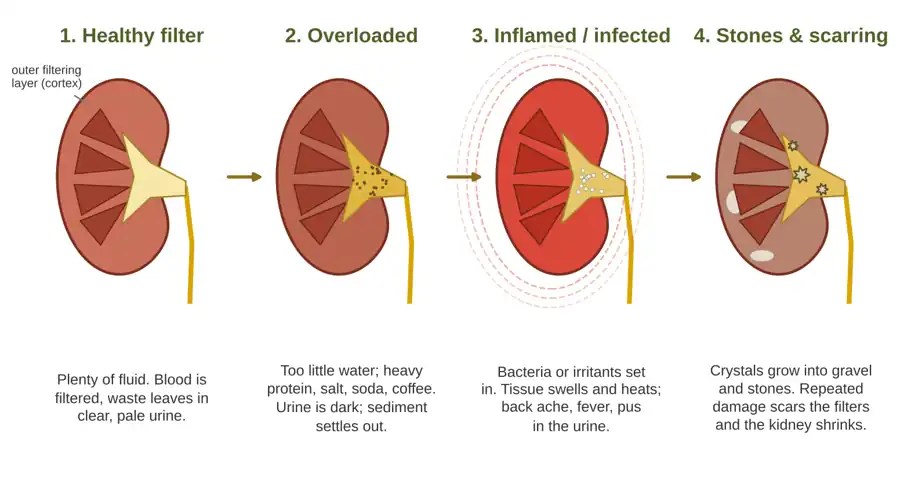
Herbal Healing, Herbs & How to Use Them, Infection, Colds & Flu

A Pure Essential Oil Air Freshener You Can Make Yourself

Herbal Air is one of those things members fall in love with. It is nothing but pure essential oils in a spray bottle: no water, no alcohol, no fillers. Fresh Eucalyptus leads, brightened with four citrus oils, and a few spritzes freshen a whole room.

We have made it for years, but five pure essential oils make it expensive to produce, and we have decided to stop making it. It is simple to put together at home, though, so here is the recipe for anyone who wants to make it for themselves.

What Goes Into It

A good batch of Herbal Air contains these five pure essential oils:

  • Eucalyptus (Eucalyptus globulus), 12 parts. The heart of the blend. Its clean, penetrating scent has long been used to clear the air and open the breathing passages.
  • Grapefruit, 4 parts. Bright and uplifting.
  • Lime, 3 parts. Fresh and sharp.
  • Lemon, 1 part. Clean and cheerful; a classic for freshening the home.
  • Sweet Orange, 1 part. Warm and sweet, rounding out the blend.

“Parts” can be any measure you like, as long as you use the same one for every oil. A handy batch is 12 teaspoons of Eucalyptus, 4 of Grapefruit, 3 of Lime, and 1 each of Lemon and Sweet Orange. That makes about 3½ ounces, just right for a 4-ounce spray bottle.

Putting It Together

Pour the oils into a glass spray bottle; amber or cobalt glass protects them from light. Pure oils can break down plastic, so glass is best. Cap it and give it a gentle shake, and that is all there is to it. Keep it tightly capped in a cool, dark place. Citrus oils fade with time, so mix a batch you will use within a year.

How I Use It

  • Spray a few times into the air, toward the middle of the room. Because it is pure oil, a little goes a long way.
  • In a sickroom during colds and flu, it clears the air and helps open a stuffed-up head.
  • At bedtime, give your pillow a light spritz. Members tell us they sleep amazingly well.
  • I like to spray it on the towels hanging in my bathroom. It keeps the whole room smelling comfortably fresh.

Use It with Care

These are pure oils, so treat them with respect. Spray into the air, never onto skin or toward the eyes. Keep it off polished wood, painted surfaces and plastics, since pure oils can mark them; a light spritz on cotton pillowcases and towels is fine. Keep it away from cats, who are especially sensitive to eucalyptus and citrus oils. And keep it out of reach of children and away from open flame.

This is shared for educational purposes, from my own study and experience. It is not medical advice.