
Reflections on 1 Corinthians 10:16–17
Two symbols, one Christ
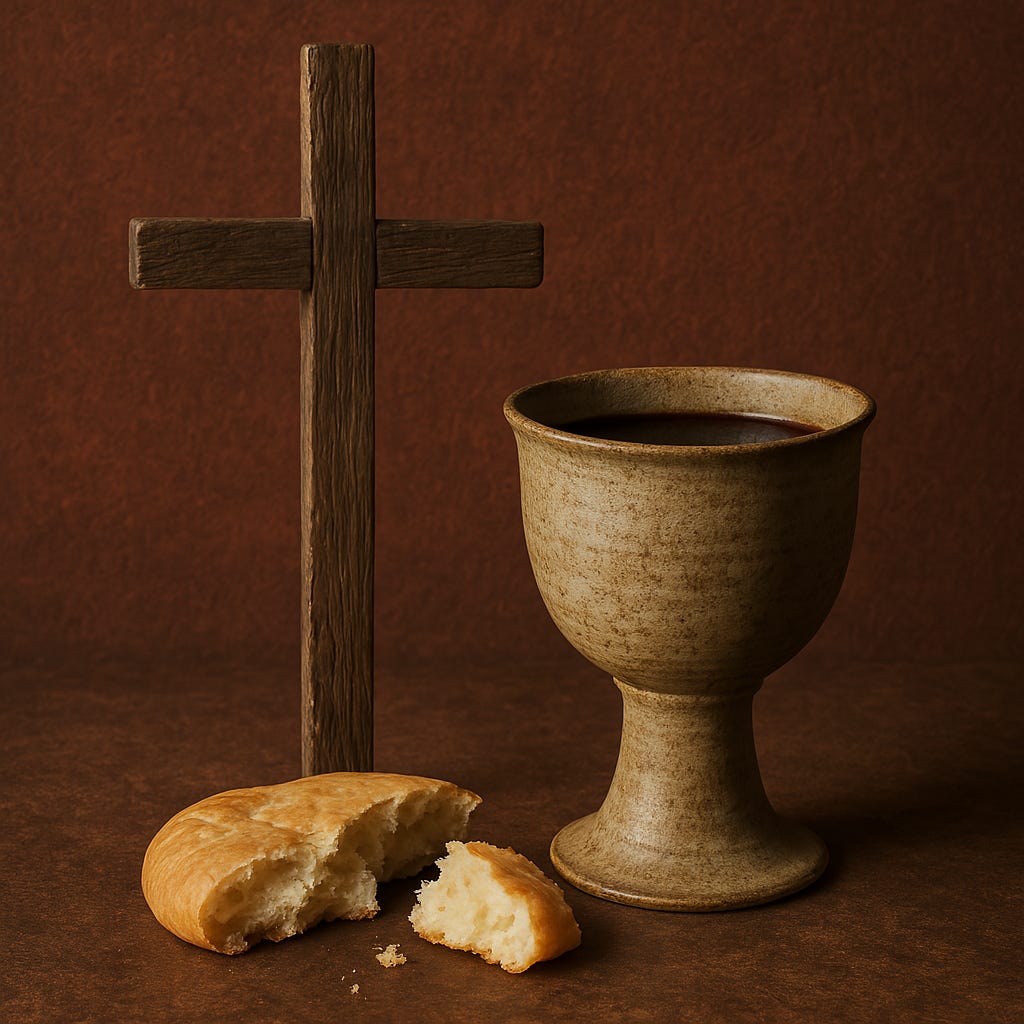
The cup of blessing which we bless, is it not the communion of the blood of Christ? The bread which we break, is it not the communion of the body of Christ? For we being many are one bread, and one body: for we are all partakers of that one bread. (1 Corinthians 10:16–17, KJV)
In one breath Paul gives us two symbols of Christ: the cup and the bread. Both point to him, yet they are not saying the same thing. The blood is his life poured out for us. The bread is his overcoming life given to us, and it is also the body we become when we eat it together.
The Remedy draws the line clearly. It calls the cup a symbolic ingestion of the life of Christ, and the bread a symbolic internalization of his character, methods and principles. Those two ideas carry this whole study.
The cup: Love poured out
Scripture tells us that “the life of the flesh is in the blood” (Leviticus 17:11). Blood poured out means a life given up. So the cup speaks first of Christ surrendering his life, and of the new covenant sealed in it (1 Corinthians 11:25).
Why did he pour it out? Love. “Greater love hath no man than this, that a man lay down his life for his friends” (John 15:13). God commends his love toward us in that Christ died for us while we were still sinners (Romans 5:8). The blood is his life, and Love is what moved him to pour it out. That is why I have always read the blood as the Love of Christ poured out freely for the benefit of fallen humanity.
When we drink the cup, we celebrate a staggering truth. Think of the God who created this entire universe, the vastness of all he is and all he has. Then look at our existence, no more lasting than a blade of grass that springs up for a moment, thrives a few hours in the sun, and gives way to the next. How could the God of eternity find this sinful, lost, hopelessly deluded little dot in the Milky Way worth his attention, much less his amazing Love?
Yet he knew our brokenness. He knew that many of this fallen race would choose eternal nonexistence over the Love-filled existence he offers. None of it discouraged his Love in the slightest. He remains constant, drawing us into his healing Love as quickly as our hearts can accept the truth about him. His Love was poured out so we could be made right and healed of our terminal, sin-sick condition.
The bread: the life that overcame
The bread is the body of Christ, and it points to the life he now has to give us. That is the life he lived and perfected in our humanity, carried all the way through Calvary.
This matters because the fix humanity needed was not complete until the cross. Adam broke faith with God when he believed a lie: that God did not have his best interest at heart. When you believe a lie about someone, your heart toward them changes, even if they are completely innocent. The circle of love and trust is broken. The serpent’s lie in Eden did exactly that, and Adam’s first response was fear and hiding (Genesis 3:10).
Christ came to heal that break. Every day he trusted his Father under pressure was part of building the remedy. At the cross he held onto that trust even while feeling forsaken, the very opposite of Adam’s choice. His earthly life was not wasted; it was unfinished until Calvary. We are reconciled by his death and saved by his life (Romans 5:10). And the bread is explicitly “broken for you” (1 Corinthians 11:24). It is the life that came through the cross.
Perfection is maturity
Hebrews says Christ was made “perfect through sufferings” (2:10) and, being made perfect, became the author of eternal salvation (5:8–9). The Greek word, teleios, means complete, mature, full-grown. Paul uses it for the mature as opposed to babes (1 Corinthians 2:6, 14:20).
For us, biblical perfection is maturity: knowing ourselves well enough to see a wrong turn, repent, and head the other way. Christ never took a wrong turn. His direction ran straight to the cross, and there he cried “It is finished” (John 19:30). That word, tetelestai, comes from the same root as teleios. His perfection and his finished mission are one idea: the work brought to its intended end.
So sharing in his body is sharing in his victory over the disease of sin. It is the only cure for our terminal sin condition, the only answer to our lost state of body, mind and spirit.
Communion means participation
The word Paul uses for “communion” is koinonia: sharing, fellowship, participation. The translations bring this out. NIV and Knox say “a participation in” the blood and body. NCV says “a sharing in.” Berkeley says “a fellowship in.” Goodspeed says that in drinking and eating “we share in” Christ. The Supper is not only remembering him; it is taking part in him.
That makes the Lord’s table all about community. It is a place and time to come together in our agreement to honor the faith we hold in what the Love of Christ secured for us. And it carries a responsibility: to keep showing this love to each other and to the larger society we affect.
When we love as Christ did, the cost of claiming another soul for him will never be beyond what we are willing to give of ourselves. That is our work: convincing a person, in the deepest part of their heart and mind, that this is truth and that this truth matters. This is not knowledge you can lightly handle. It will change the way you view your entire existence.
One loaf, many individuals
Verse 17 is Paul’s own application of the bread: because there is one loaf, we who are many are one body. The Remedy puts it this way: when we partake of Christ, we partake of the only genuine Bread that gives life, and so become united into one body, because we all assimilate the same character of Love.
Notice the order in verse 16. Paul names the cup first and the bread second, the reverse of the Supper itself. It seems deliberate, because it lets him move straight from the bread into the one body.
We who have accepted the gift of salvation all ingest the same life. But each of us, being an individual, will be affected differently. Christians are not cookie-cutter people, all thinking the same thoughts, doing the same things, wearing the same clothes. If you are part of a group that appears identical in every way, you are not looking at the body of Christ.
Christ encourages our individuality and our personal development into who we can be. Each one in the vast family of God will be a unique, one-of-a-kind person. Why? Because Christ will take you down paths where you will grow and become more. You will stretch your mind, spirit and physical body past all the limits of your past life. The truth of Christ is the truth of you as an individual, the truth that will expand you beyond the limits you have put on yourself.
So yes, eat!
So yes! Partake of the one loaf. It carries all the power flowing from the throne of the universe, the Fires of Truth and Love, the nutrients from the fruit of the tree of life. His body flows with every nutrient for our physical, emotional and spiritual being. So eat up; each day eat your fill. This is the food that truly nourishes and heals.
The healing for humanity was accomplished at Calvary. Christ overcame every last selfish, me-first tendency when he surrendered his life to his own created beings. He demonstrated as no other intelligence could that God is Love. He had created humanity free, able to choose what they would be. At the cross he overcame, healed humanity, and showed us who our God truly is, all at the same time.
Every question was answered there. Satan’s lies about God no longer hold any credibility; he was proven a liar, and Christ showed who God truly is. The universe has its answers. Only here do the questions remain, and only here are intelligent beings still deluded.
Through the valley
To take in that life, we must die to the old one: the selfish, self-serving habits and protections we learned over a lifetime of sinful living. This is the valley of the shadow of death, where Christ leads us down the path he had to walk alone. It is where you let go of all that is false and grab hold of the true with both hands.
It will take both hands to hold onto Christ as he draws us through the valley and up the steep, rugged path. At the peaks the view is beautiful, the air is pure, and we can see forever. Let it all go. Discover the true joy of reaching beyond the wildest dreams you ever had. You are more, and it is truly you, because you have surrendered the lies and are living the life of Christ within you.
The reward is worth any and every sacrifice.
Sep 30, 2026 · @Dara Dietz


