
Tenderness, Nursing, Plugged Ducts, Mastitis, Sore Nipples and Benign Lumps
This sheet covers the everyday care of the breasts: the tenderness of growing up and of the monthly cycle, the troubles that can come with nursing a baby, and the lumps that are not cancer. Breast cancer has its own sheet, and the Tumors & Lumps sheet explains the difference between a harmless lump and one that needs a closer look. Any new lump gets checked.
Understanding the Condition
How the Healthy Breast Works
The breast is a gland, not a muscle. Each breast has 15 to 20 lobes, arranged like the petals of a daisy, and each lobe holds many small lobules, the milk glands. Thin ducts carry the milk from the lobules to the nipple. Fat and connective tissue fill the spaces between and give the breast its shape.
Woven all through the breast are blood vessels and a fine network of lymph vessels. The lymph carries waste out of the breast to the lymph nodes, most of it to the nodes under the arm. The lymph has no heart to pump it; it depends on movement, breathing and loose clothing. When the lymph backs up, the breast becomes congested, tender and lumpy.
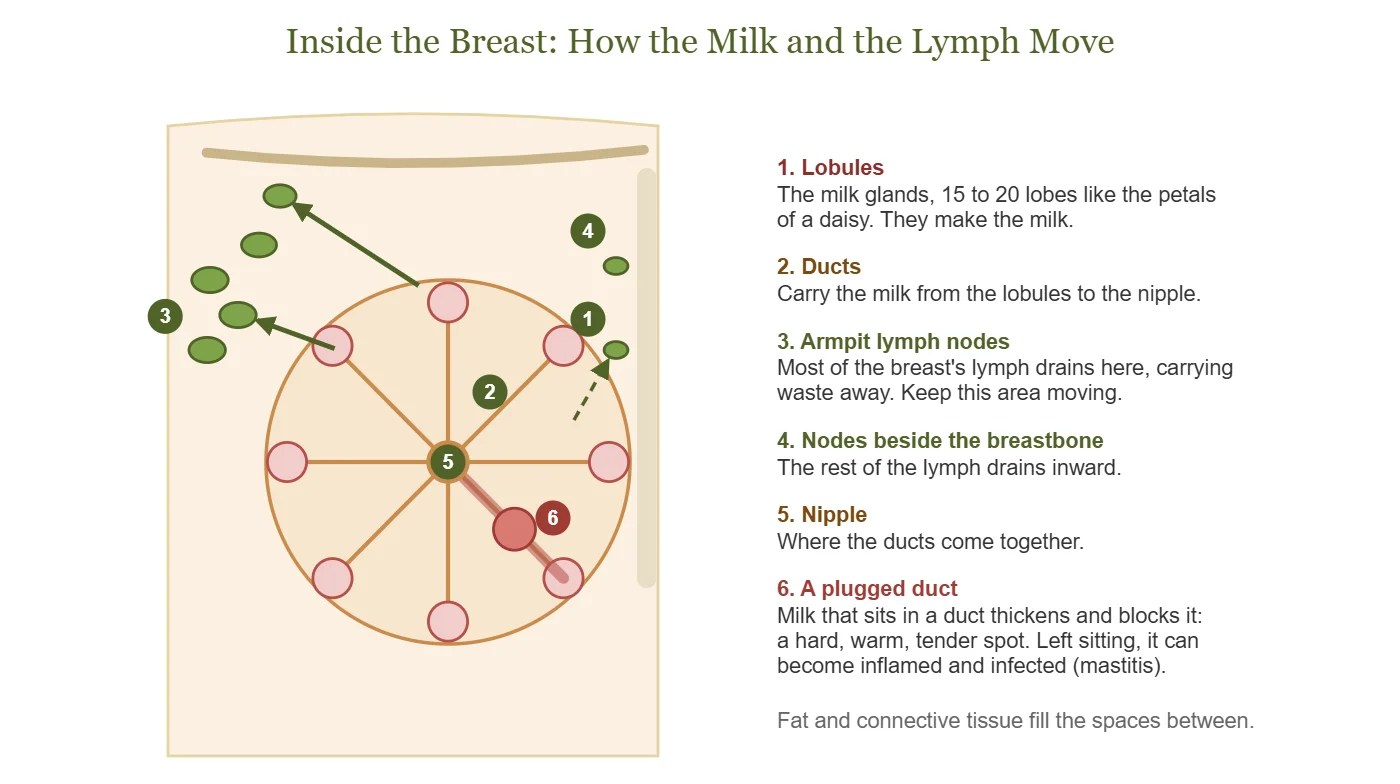
Inside the breast: the lobules make the milk, the ducts carry it to the nipple, and the lymph drains toward the armpit. Diagram drawn for H.E.A.L.
Tenderness in Girls and Women
A girl’s breasts begin with a small, tender “breast bud” under the nipple, and it is normal for that new tissue to ache as it grows. The same hormones keep working through the monthly cycle: in the days before a period the breast tissue holds extra water, and the stretching makes the breasts swollen and sore. This tenderness comes and goes with the cycle and is a sign of healthy development, not disease. What deserves attention at any age is a lump that is hard, stays on one side, or does not come and go with the cycle.
Nursing: When the Milk Does Not Move
A mother’s body makes milk on demand: the more the baby nurses, the more milk is made. Nearly every nursing trouble comes back to milk that is not moving out of the breast.
- Engorgement. In the first days after birth, as the milk comes in, the breasts can become full, hard and painful. A baby may have trouble latching onto a breast that is too full.
- A plugged duct. When milk sits in a duct, from a poor latch, missed feedings, a sleepy baby, or pressure from a tight bra or a baby carrier, it thickens and blocks the duct. It shows up as a hard, warm, tender spot.
- Mastitis. Left sitting, that stagnant milk can become inflamed and infected, especially when bacteria get in through a cracked nipple. Mastitis often comes on fast: a hot, red, swollen and painful area of the breast, sometimes with red streaks, along with fever, chills and flu-like aches.
Many breast infections come from an exhausted mother. Stress, little sleep and a run-down body leave the immune system too tired to keep up. A midwife’s observation from my old files is worth keeping too: a calcium imbalance in the body can be part of what sets up a breast infection.
Sore and Cracked Nipples
Tender nipples are common in the first days of nursing while mother and baby learn together. A poor latch, a baby who chews or pulls, or skin that stays wet can lead to soreness and cracks. A crack is more than a pain; it is an open door for infection to get into the breast.
Lumps That Are Not Cancer
Most breast lumps are not cancer. The most common are:
- Fibrocystic breasts. Lumpy, rope-like, tender breasts that change with the monthly cycle and are often worse just before a period. More than half of women have these changes at some point in their lives.
- Cysts. Round, fluid-filled sacs that can feel soft or firm and may come and go with the cycle.
- Fibroadenomas. Smooth, rubbery lumps that move easily under the fingers, most common in young women.
Dr. Christopher taught that when toxic waste builds up from a poor diet, a sluggish bloodstream and poor circulation, the glands become congested and swell. The breast is a gland, and a lumpy, tender breast is often a congested one. Opening the lymph and keeping the liver and bowel clear gives that waste a way out.
When to See a Doctor
Have a doctor check: a new lump that does not go away after your next period; a lump that is hard or fixed in place; dimpling, puckering or an orange-peel look to the skin; a nipple that pulls in; or discharge from one nipple, especially bloody discharge, when you are not nursing.
For a nursing mother: if mastitis is not clearly better within a day, if the fever is high or keeps climbing, if red streaks spread, if a hot, painful lump may be an abscess, or if you feel very ill. Antibiotics are sometimes needed, and you can keep nursing while you take them.
Herbs and these home routines are support alongside medical care, not a replacement for it.
The Emotional Side: the Energy Work
Healing the whole person. We are body, mind and spirit, and all three must heal together. When one part is neglected, the other two cannot find complete healing.
The breast represents the nurturing of the self. So many women pour themselves out for everyone else and leave nothing for their own care. Healing the breast often means learning to receive care as well as give it.
A new mother whose nursing is not going well can carry a heavy load of guilt and a sense of failure. I know that feeling well (see my story at the end of this sheet). Be gentle with yourself. Rest, ask for help, and let others care for you while you care for your baby.
Louise Hay, in her book Heal Your Body, describes these patterns:
- Breasts: represent mothering and nurturing and nourishment. Turn it around: “I take in and give out nourishment in perfect balance.”
- Breast problems (cysts, lumps, soreness, mastitis): “A refusal to nourish the self. Putting everyone else first.” Overmothering, overprotection, overbearing attitudes. Turn it around: “I am important. I count. I now care for and nourish myself with love and with joy. I allow others the freedom to be who they are.”
Emotional patterns quoted and paraphrased from Louise Hay, Heal Your Body (Hay House). These are not faults to blame anyone for; they are a reminder of how much the heart is carrying.
Areas Affected & Opening the Way to Healing
The breast depends on milk that keeps moving, lymph that keeps draining, and a liver and bowel that carry the waste away. Open those, keep the circulation flowing, and the breast can clear itself.
Opening the Way to Healing
1. Clear the blockage.
2. Get the healing nutrients into the area.
3. Let sunshine and fresh air cycle over and through the affected part.
4. Bathe regularly.
5. Move the area as much as you can.
6. Know which area is truly affected. With a plugged duct or mastitis, the blockage is the milk that is not moving; keep it moving. With lumps and tenderness, it is the lymph under the arm and the liver and bowel behind it.
Engorgement and Plugged Ducts
- Keep the milk moving. Nurse often, starting on the sore side, and empty the breast. If the baby can’t, express the milk by hand or with a pump.
- A hot shower with firm but gentle massage. Let the hot water run over the breast while you massage the hard area toward the nipple to open the duct and get the milk flowing. Firm, but not rough; too much pressure can leave the breast bruised and sore for days.
- A castor oil pack over the breast, with a hot water bottle, softens the hardness. Wipe the breast clean before the baby nurses.
- The Charcoal & Flaxseed Poultice, laid on hot, draws and comforts.
- Loose clothing. No tight bras or straps pressing on the breast.
Mastitis
We use salves, not fomentations; salves are what busy mothers will actually use.
- M&L Salve first. Spread it over the sore area and up toward the armpit to open the lymph so the waste can move out. It may be all you need.
- Healing Salve on top. Mastitis is a condition of inflammation, and the Healing Salve adds its anti-inflammatory support.
- No salves on hand? A hot Charcoal & Flaxseed Poultice (the Infection Poultice) brings support, and the wet heat alone is very comforting.
- Wipe the breast clean before nursing. The salves won’t make the baby sick, but the taste might keep the baby from wanting to eat.
- On the inside: the mother takes regular adult doses; the baby receives only a small amount through the milk, and it usually helps. Echinacea is always good. The Gland Formula (the same herbs as the M&L Salve, as a liquid extract) opens the glands from the inside. Add Herbal Aid 2 if the breast is hot and inflamed. Skip Herbal Aid 1 while nursing: its garlic can change the taste of the milk, and some babies object.
- Keep nursing on the sore side, or express the milk. Stopping makes it worse.
- Rest and plenty of liquids. Rest is part of the treatment, not an afterthought.
- The Calcium formula, taken through pregnancy and nursing, supports a mother who may be running low.
Sore and Cracked Nipples
- Healing Salve after each feeding.
- Infection Salve for a crack that looks like it may be getting infected. You would think it would taste bitter, but it really isn’t bad; we give the same herbs to small children and animals for their infections, and they take them easily.
- M&L Salve is soothing to the soreness.
- Keep the nipple clean, let it air dry, and wipe off any salve before the baby nurses.
- Leave off anything bitter. BF&C Salve and goldenseal are good for healing, but they are too bitter; the baby may refuse the breast.
Bringing In the Milk
- Fenugreek is the herb I reach for to increase a mother’s milk.
- Plenty of water, rest and good food. A tired, dry, underfed mother makes less milk.
- Nurse often. The more the baby nurses, the more milk is made.
Drying Up the Milk
From the mountains of North Carolina, shared by my longtime assistant, Kimala Snowden:
- Cover the breasts with Watkins Mentholated Salve.
- Wrap the breast area in a towel, pulled as tight as you can get it and pinned. As her mother said, “If you can breathe, it’s not tight enough.” It helps to have someone wrap it for you.
- When the towel loosens, reapply the salve and wrap it again, as tight as you can.
- Keep it wrapped, day and night, for as long as needed; most of the time it is only one to three days. Take it off only long enough to shower.
- Have someone else feed the baby. Just being around a hungry baby can bring the milk down again.
Lumps, Cysts and Fibrocystic Breasts
- Have every new lump checked so you know what you are working with.
- M&L Salve under a castor oil pack over the breast every night, to open the lymph and soften the lumps.
- The Poke Root Poultice is a blessing for women with a lot of lumps and bumps. The directions are on the Tumors & Lumps sheet.
- Keep the lymph moving: rebound or walk every day, and wear loose, natural-fiber bras, or none at home.
- Keep the bowel and liver clear with LBF and seasonal liver and kidney flushing, so the waste the breast lets go of has somewhere to go.
- Try cutting caffeine. Some women find their breasts are less tender and lumpy when they cut out coffee, black tea, cola and chocolate. The research is mixed, but it costs nothing to try: go without for two months and see what your own body tells you.
Use With Care: Poke Root
Poke root is a powerful lymphatic cleanser and should be used with respect. Used too freely it causes uncontrolled vomiting; internally, use it only in a blend with other herbs, never alone. On the skin it is strong enough to burn and blister if the body is not ready; if that happens, take the poultice off, use warm charcoal and flaxseed poultices, and let the skin heal before trying again. Not while nursing or pregnant. Keep the fresh root away from children and pets.
Teenage and Monthly Tenderness
- Reassurance first. It is a normal part of growing up and of the monthly cycle.
- A warm castor oil pack eases the ache during a tender week.
- Female Formula helps balance the cycle.
- Cut the junk food. The food program for some teens is horrid. If they want to feel their best, the junk food has to go.
Use distilled water for all teas, and when taking your extracts in hot water.
Level of Commitment
- Gentle support. For monthly or teenage tenderness, sore nipples, or an occasional plugged duct: the salves, castor oil packs, rest, good food, plenty of water, and loose clothing. Most nursing troubles clear in a few days.
- Focused cleansing. For mastitis that keeps coming back, or fibrocystic breasts and cysts: all of the above, plus bowel cleansing, a week of liver flushing followed by a week of kidney flushing, nightly M&L Salve under a castor oil pack, and the Poke Root Poultice for many lumps. Give it two or three months.
- Incurables Program. Not needed for the troubles on this sheet. For a diagnosed breast cancer, see the Breast Cancer sheet.
More Is Not Faster
These doses are set to what the body can clear. Taking more stirs up more than the bowels, liver and kidneys can carry out, and that is when cleansing starts to feel like poisoning. Healing the body requires steady, consistent nutrition and action, not a bigger dose.
People are different, and now and then someone reacts poorly to a particular herb. If that happens, stop it. What I offer here is a guideline. You are the one living in your body, so work with the Holy Spirit and the wisdom the Lord has given you to apply these supports in the best way for your life.
A Loose Healing Plan
- A plugged duct or engorgement (first hours): nurse often from the sore side; a hot shower with firm but gentle massage; a castor oil pack or hot Charcoal & Flaxseed Poultice between feedings; loose clothing. Most open within a day or two.
- Mastitis (day 1): M&L Salve, then Healing Salve, several times a day; Echinacea, the Gland Formula, and Herbal Aid 2 if hot and inflamed; keep nursing; rest and drink plenty. If it is not clearly better within a day, or the fever climbs, see a doctor.
- Sore or cracked nipples: Healing Salve or Infection Salve after every feeding; keep clean and dry; wipe clean before the next feeding.
- Low milk: fenugreek, plenty of water, rest, good food, and nurse often.
- Weaning: Kimala’s salve and tight towel wrap for one to three days, with someone else feeding the baby.
- Lumps and fibrocystic breasts: have it checked; nightly M&L Salve under a castor oil pack; move every day; cut caffeine for two months. After a month, see how the lumps change through your cycle; add liver and kidney flushing and the Poke Root Poultice if there are many.
- All along: rest, receive care, and nourish yourself as well as everyone else.
Stories from the Work
Dara’s Story: I Felt Like Such a Failure
When my daughter, my only child, was born in February 1982, I had a plugged duct. It was painful, but I got it open and the milk flowing with a hot shower and massage. I really applied the pressure to the breast.
I remember I felt like such a failure to not be able to nurse my daughter. She was hungry and could not get milk from me. It was a horrible feeling of failure. I think this was the worst part of it all. The pain from the breast massage was nothing compared to the feeling I might not be able to nurse her.
Looking back, I was likely a little rough on myself. I was sore for a few days, but the milk did finally start flowing.
From Dr. Christopher: A Cold Night and a Hard Breast
Dr. Christopher’s daughter was nursing her baby on a hot night and left the window open. A cold breeze blew in while she wasn’t well covered, and by morning her breast was so hard and sore that she could hardly nurse at all; she tried until she felt like screaming. She called her father, about eighty miles away, who came with his mullein and lobelia fomentation. She applied it as hot as she could stand it, covered it with plastic and a towel, and by morning she was nursing the baby again with no pain and no more hardness.
Credited to Dr. John R. Christopher’s writings. Our M&L Salve is made from these same two herbs.
From Dr. Christopher: Mastitis in Roy, Utah
A nursing mother developed mastitis so severe that her breast was double its normal size and streaked with red, with a fever and flu-like misery; she could not let her hungry, crying baby nurse on that side. Dr. Christopher had her put on a mullein and lobelia fomentation under plastic, and drink half a cup of the tea every half hour until bedtime. The next morning she called to say the swelling, soreness and flu symptoms were gone, and the baby was nursing happily on that side again.
Credited to Dr. John R. Christopher’s writings.
From Dr. Christopher: Milk for an Adopted Baby
On a snowy day a woman came into Dr. Christopher’s office with a baby nursing at her breast. She had been planning to adopt and wanted to nurse. She took blessed thistle tea for a few days before the baby came, then simply put the infant to her breast, and it nursed right away. She had adopted three other children, but she said this one felt like her very own, because it was receiving her own milk.
Credited to Dr. John R. Christopher’s writings.
These stories are shared to show what the work can look like, not as a promise of results. Every body and every life is different, and the physical, spiritual and emotional life rise and fall together.
More on Women’s Health
This information is provided for educational purposes and reflects traditional herbal practice. It is not intended to diagnose, treat, cure, or prevent any disease. Please consult a qualified health practitioner regarding any health concern.


