
This sheet is part of the cancer series. The Cancer sheet explains what allows cancer to form anywhere in the body and lays out the full Incurables Program. This sheet covers what is particular to the breast. Everyday breast care (tenderness, nursing, plugged ducts and mastitis) is on the Breast Health sheet.
Understanding the Condition
How the Healthy Breast Works
The breast is a gland, not a muscle. Each breast has three main parts: lobules, ducts and connective tissue (CDC). Each breast has 15 to 20 lobes, arranged like the petals of a daisy, and each lobe holds many small lobules, the milk glands. Thin ducts carry the milk from the lobules to the nipple. Fat and connective tissue fill the spaces between and give the breast its shape.
Woven all through the breast are blood vessels and a fine network of lymph vessels. The lymph carries waste out of the breast tissue to the lymph nodes. About 75 to 90 percent of the breast’s lymph drains to the nodes under the arm on the same side; the rest drains inward to nodes along the breastbone. That pathway matters a great deal: it is the road waste must travel to leave the breast, and it is the road cancer travels when it spreads.
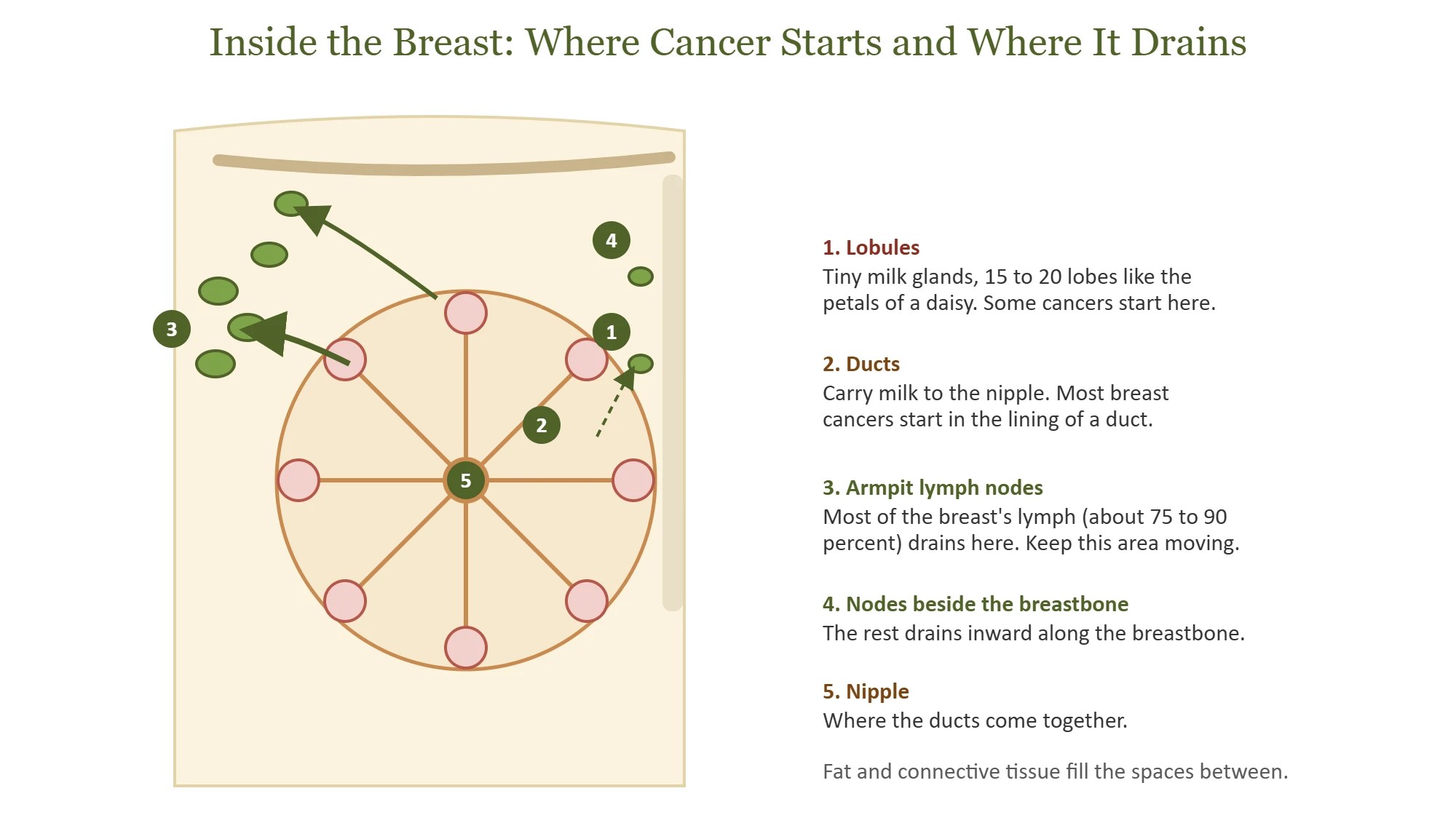
Inside the breast: the lobules and ducts where cancer starts, and the lymph nodes the breast drains into. Simplified diagram drawn for H.E.A.L.
How Breast Cancer Forms
Breast cancer follows the same road down that the Cancer sheet describes: years of waste coming in faster than the bowel, liver, kidneys and lymph can carry it out, until the tissue is starved, congested and changing from its designed structure. It settles in the breast because the breast is where that woman’s tissue is weakest and most burdened.
- Hormones. Breast tissue grows and changes with every monthly cycle, driven by estrogen and progesterone. Estrogen and progesterone are broken down mainly in the liver before they leave the body. A congested liver that cannot keep up leaves the breast bathed in old hormones longer.
- Stagnant lymph. When the lymph under the arm and around the breast backs up, waste sits in the breast tissue instead of moving out. The lymph has no heart to pump it; it depends heavily on movement and breathing, so little movement and shallow breathing slow it further.
- Lifestyle. The CDC lists these risk factors a woman can change: not being physically active, being overweight after menopause, certain menopausal hormone therapy and some birth control pills, a first pregnancy after 30, not breastfeeding, and drinking alcohol, with risk rising as intake rises. Smoking, chemical exposure and night-shift work may also raise risk.
- What can’t be changed. Getting older, inherited genes such as BRCA1 and BRCA2, early periods or late menopause, dense breasts, and a family history of breast or ovarian cancer (CDC). As Dr. Joel Robbins teaches, a tendency is only a weak spot, not a sentence. It shows itself when the laws of health are broken, and then the trouble shows up in the weakest tissue first.
- Breastfeeding protects. Across 47 studies in 30 countries, every 12 months of breastfeeding lowered a woman’s breast cancer risk by about 4.3 percent, on top of about 7 percent for each birth (Collaborative Group on Hormonal Factors in Breast Cancer, The Lancet, 2002).
About 1 in 8 women in the United States will be diagnosed with breast cancer in her lifetime (American Cancer Society, 2026).
How It Progresses
Most breast cancers begin in the ducts or the lobules (CDC). Invasive ductal carcinoma, starting in the lining of a milk duct, is by far the most common type, about 70 to 80 percent of cases; invasive lobular carcinoma, starting in the lobules, is the next most common.
- Cancer in place (DCIS). Abnormal cells sit inside the lining of a duct and have not broken through. This is the easiest stage to turn around.
- Invasive. The cells break through the duct or lobule wall into the breast tissue around it.
- Lymph nodes. Cells travel along the lymph, most often first to the nodes under the arm.
- Distant spread. In time, cells can travel to the bones, liver, lungs or brain.
Know Your Breasts, and Have Changes Checked
Have a doctor check any of these warning signs (CDC): a new lump in the breast or underarm; thickening or swelling of part of the breast; irritation or dimpling of the breast skin; redness or flaky skin in the nipple area or the breast; the nipple pulling in, or pain in the nipple area; nipple discharge other than breast milk, including blood; any change in the size or shape of the breast; or pain in any area of the breast. These can also be caused by conditions that are not cancer, but every one deserves a look.
Imaging (mammogram, ultrasound or MRI) can show where a lump is and how big it is. Only a biopsy can tell for certain whether it is cancer. My caution about biopsy is on the Tumors & Lumps sheet; talk it over with your doctor and weigh what you will gain from knowing. Breast cancer is a serious, life-threatening disease. Herbs and cleansing are support alongside medical care, not a replacement for it. If you are having surgery, radiation, chemotherapy or hormone-blocking drugs, tell your doctor what you are doing.
The Emotional Side: the Energy Work
Healing the whole person. We are body, mind and spirit, and all three must heal together. When one part is neglected, the other two cannot find complete healing.
The breast represents the nurturing of the self. I have seen this again and again: women who have done the perfect herbal program and still not healed, because they stayed in abusive or degrading marriages, or never learned to nurture themselves. So many women pour themselves out for everyone else and leave nothing for their own care. Healing the breast often means learning to receive care as well as give it.
Louise Hay, in her book Heal Your Body, describes these patterns:
- Breasts: represent mothering and nurturing and nourishment. Turn it around: “I take in and give out nourishment in perfect balance.”
- Breast problems (cysts, lumps, soreness): “A refusal to nourish the self. Putting everyone else first.” Overmothering, overprotection, overbearing attitudes. Turn it around: “I am important. I count. I now care for and nourish myself with love and with joy.”
- Cancer: “Deep hurt. Longstanding resentment. Deep secret or grief eating away at the self. Carrying hatreds. ‘What’s the use?’” Turn it around: “I lovingly forgive and release all of the past. I choose to fill my world with joy. I love and approve of myself.”
Emotional patterns quoted and paraphrased from Louise Hay, Heal Your Body (Hay House). These are not faults to blame anyone for; they are a reminder of how much the heart is carrying.
Areas Affected & Opening the Way to Healing
The breast is where the cancer shows, but the work starts with the whole body. First establish the full program on the Cancer sheet: the foundational programs (Echinacea, bowel cleansing and nutrition), liver and kidney flushing, the Blood Purifying or Detox Formula, Essiac, the food program and juicing, and the hydrotherapy. Then work on three areas: the liver, which must clear the hormones and the waste; the lymph under the arm and along the breastbone, which is the breast’s drain; and the breast itself.
Opening the Way to Healing
1. Clear the blockage.
2. Get the healing nutrients into the area.
3. Let sunshine and fresh air cycle over and through the affected part.
4. Bathe regularly.
5. Move the area as much as you can.
6. Know which area is truly affected. With breast cancer the lump is where you see it, but the liver, the bowel and the lymph under the arm are where it is held. Keep them open, or the breast has nowhere to send its waste.
Keep the Liver Clearing
- Castor oil pack over the liver every night, with a hot water bottle.
- Liver flushing on the schedule in the Cancer sheet, and an ELF (Emergency Liver Flush) each night for up to five nights in a row while the poultice is drawing.
- The bowels must move. If they begin to tighten, increase the Lower Bowel Formula (LBF #1) until they are moving well again. Waste drawn out of the breast has to leave through the bowel.
Keep the Lymph Moving
- M&L Salve over the breast and over any swollen lymph nodes, under the arm and along the breastbone, several times a day. It opens the area so the waste can move out through the lymph.
- Hot charcoal and flaxseed poultice over swollen lymph nodes and over the liver during the day, as hot as can be tolerated, changed every 3 or 4 hours, and again at bedtime for the whole night. It draws waste out and keeps the lymph from backing up. Never reuse a poultice.
- Mullein and lobelia fomentation. Dr. Christopher’s glandular fomentation: a tea of 3 parts mullein to 1 part lobelia, soaked into a natural-fiber cloth, laid over the swollen glands as warm as possible, covered with plastic and left on all night. He also had it taken as a tea, ½ cup three times a day.
- Rebound 10 to 15 minutes a couple of times a day. The lymph has no heart to pump it; it depends heavily on movement and breathing.
- Hot and cold showers, paying special attention to the breast and underarm, and dry skin brushing toward the armpit and the heart.
- Wear loose, natural-fiber clothing, and give the breasts time free of anything that binds the armpit, especially at night.
- The Prune Juice Flush is a good lymphatic flush to add while the poultice is drawing. Expect loose, watery stools: you are dumping old, stagnant lymph fluid, and that is what you want. Don’t worry about it; just stay well hydrated with distilled water and herbal teas. Directions are on its direction sheet.
Working on the Breast Itself
Two strong poultices draw the waste out of the breast through the skin. Both are powerful tools that belong with the Incurables Program, never on their own; the body needs clear, open channels to carry away what they draw out.
The Black Cancer Poultice has been a huge aid with breast tumors. Smear a generous amount onto flannel, lay it over the tumor and bandage it in place; leave it on overnight or 6 to 8 hours, alternating with the castor oil pack. The full recipe and directions are on the Tumors & Lumps sheet. It contains bloodroot, a strong herb: stop if the healthy skin around the area becomes raw, blistered or very painful. When bleeders begin, add cayenne to the poultice; if a bleed breaks through, pack it with cayenne powder and call your doctor that same day. Bleeding that does not slow with pressure, or signs of infection (fever, spreading redness or red streaks, foul-smelling pus with fever), need emergency care.
The Poke Root Poultice for the Breast
Dr. Christopher’s poke root and bayberry poultice for cancer of the breast, after Dr. Jethro Kloss. We developed the supporting program around it with a young woman who had been doing a faithful Incurables Program for over a month before she began. Read these directions carefully, and read them again.
- When to begin. Establish the foundational programs, then do a week of liver flushing followed by a week of kidney flushing. Begin the poultice during the second liver flushing week.
- Increase Echinacea to two ounces a day, six days a week, the whole time the poultice is being used. The poultice breaks down a great deal of tissue, and the immune system has to be strong enough to handle that much die-off.
- If you have an autoimmune condition, talk with Dara before starting. Echinacea can overstimulate an immune system that is already attacking the body. In its place we use astragalus and marshmallow root. This is much slower, and the whole program has to be done in a gentler way so the body can handle the detoxing. Some people are able to use Echinacea later, once their system has healed and cleared; others never can.
- You need: fresh poke root, ground fine; bayberry powder; and, only if the root is dry, poke root extract diluted to 1/16 strength. Use fresh root each time and grind only enough for one use. Wear gloves when handling it.
- Make it. Cut a piece of muslin or cheesecloth large enough to cover the breast, and cut a hole for the nipple before adding the root (it is much easier). Spread small spoonfuls of the ground root over the cloth and level it with a rolling pin, pressing it into the cloth, about ¼ to ½ inch deep (our member used ⅛ to ¼ inch).
- Apply it. Lie down while your support person places it on you, root against the skin. Cover the back with a piece of old cotton T-shirt, then plastic wrap, and tape it snug to hold in the moisture. Moisten it once a day with the diluted extract only if the root is dry. Never use the extract full strength.
- Change it every 2 to 3 days, depending on how much waste is coming from the breast. When the poultice is off, do hot and cold changes in the shower to open and drain the pustules. Fever, spreading redness or red streaks mean infection: see a doctor.
- What to expect. Within about two weeks, often much sooner, the breast breaks out in pustular sores as the waste comes out through the skin. Continue one to two weeks after the breakout begins. If the lymph nodes become painful and swollen, take a break and let the body catch up: rebound, flush, and use the warm charcoal and flaxseed poultice.
- Healing the skin. When the drainage stops, wash carefully with diluted apple cider vinegar, dust with bayberry powder and let the breast dry. The skin heals in about 7 to 10 days.

What to expect: a member’s poke root poultice, from left: the breakout of pustular sores as the waste comes out; the skin calming between rounds; the used poultice. Member photos, used with permission.
Use With Care: Poke Root
Poke root is a powerful lymphatic cleanser and should be used with respect. Used too freely it causes uncontrolled vomiting; internally, use it only in a blend with other herbs, never alone. On the skin it is strong enough to burn and blister if the extract is used full strength or the body is not ready. If that happens, take the poultice off, use warm charcoal and flaxseed poultices, and let the skin heal before trying again. If you feel weak, dizzy or faint, or begin vomiting, take the poultice off, wash the skin with soap and water, and call your doctor or Poison Control (1-800-222-1222). Keep the fresh root away from children and pets.
Rebuilding the Breast
- BF&C (Bone, Flesh & Cartilage) feeds and knits the tissue back together: the extract at 1 teaspoon three times a day, and the BF&C Salve as an overnight pack once the area has softened, leaving the skin open and clear of salves for at least 6 hours each day.
- Soothing. Once the drawing is done, aloe vera, slippery elm and comfrey are soothing and healing on the tissue. Dr. Richard Schulze taught that the same programs that remove a tumor also heal and regrow the breast, and that many women make the mistake of quitting as soon as the tumor is out.
- Nutrition is the big key: the juicer going every day, Superfood, and the rest of the food program on the Cancer sheet.
Use distilled water for all teas, and when taking your extracts in hot water.
Level of Commitment
- Gentle support. For keeping the breasts healthy, or for a woman with a family tendency who wants to stay ahead of it: an 80/20 food program, daily juice, seasonal cleansing, movement, loose clothing, and caring for herself as well as everyone else. Breastfeed your babies if you can.
- Focused cleansing. For a lump that has been checked and is not cancer, such as a cyst or fibroadenoma: bowel cleansing, liver and kidney flushing, castor oil packs and M&L Salve over the area, and the charcoal and flaxseed poultice. See the Tumors & Lumps and Breast Health sheets.
- Incurables Program. For any diagnosed breast cancer, including cancer still in place (DCIS). The full program on the Cancer sheet, full time, with the liver, lymph and breast work on this sheet. Plan on six months or longer, and don’t stop when the lump is gone.
More Is Not Faster
These doses are set to what the body can clear. Taking more stirs up more than the bowels, liver and kidneys can carry out, and that is when cleansing starts to feel like poisoning. Healing the body requires steady, consistent nutrition and action, not a bigger dose.
People are different, and now and then someone reacts poorly to a particular herb. If that happens, stop it. What I offer here is a guideline. You are the one living in your body, so work with the Holy Spirit and the wisdom the Lord has given you to apply these supports in the best way for your life.
A Loose Healing Plan
- First: know what you are working with. Have the lump checked and learn its type, size and stage. Tell your doctor what you are doing.
- Weeks 1 and 2: the foundation. The Cancer sheet’s program: food program or juice fast (at least 32 ounces of carrot juice a day), Superfood, Echinacea, LBF until the bowels move two or three times a day, castor oil packs over the liver nightly, hot and cold showers, rebounding. M&L Salve over the breast and underarm several times a day.
- Week 3: liver flushing. Then Week 4: kidney flushing.
- Week 5: the second liver flushing week. Begin the poke root poultice (or the Black Cancer Poultice), raise Echinacea, add nightly ELFs for up to five nights, and keep the charcoal and flaxseed poultice over the nodes and liver by day.
- As the breast drains: keep the lymph moving, take breaks when the nodes swell, and keep flushing on schedule.
- When the drawing is done: heal the skin with apple cider vinegar and bayberry, then rebuild with BF&C and soothing herbs.
- All along: the heart work. Rest. Receive care. Let go of what you have been carrying. Put yourself on your own list.
- Every month: take stock. Have the breast checked and measured. Keep going long after it looks clear.
Stories from the Work
A Member’s Story: Learning the Poke Root Poultice
A member in Michigan, diagnosed with invasive ductal carcinoma, sent in her pictures and her story so other women would know how to do this poultice. Her first attempt went badly because she misread the directions: she added undiluted extract to fresh root that was already moist, and it burned and blistered her skin and left her weak and dizzy. She healed within about a week. “Let me urge you to read and re-read these instructions carefully before doing this.”
Her second attempt, with no extract added, “produced amazing results.” Within a day the breast was covered in pustular sores: “It was amazing to see how much garbage was being pulled right out through my skin!” By the third day a sour-milk smell came from the sores, which she connected to her tumor being inside a milk duct. When her lymph nodes became painful and swollen, she took a break, did lymph cleansing, rebounding and liver flushing, and used warm charcoal and flaxseed poultices, and the pain quickly went away. Her advice: “Know that it isn’t pleasant, it isn’t comfortable, but it is powerful! Don’t be afraid of the sores and swelling.” A third try, after only a two-day break, burned and blistered her within an hour; her body needed more time. At the time she wrote, her tumor had not yet cleared: “My body is still working on that.”
Her story is shared to show what the poultice process looks like, not as a promise of results. Every body and every life is different, and healing asks for the whole person: diet, cleansing, emotions and faith together. The physical, spiritual and emotional life rise and fall together; if one is not being nurtured and healed, it will pull the others down or hold them back.
From Dr. Christopher: The Woman on the Airplane
On a flight to Toronto, Dr. Christopher sat beside a woman who told him her story. She had lost one breast to cancer, then the other six months later, and six months after that the doctors wanted to remove her reproductive organs and part of her bowel. She refused further surgery and chemotherapy, went home and prayed, and felt led to change her diet: fruits, vegetables, grains, nuts and seeds, as much as possible raw. A few months later her doctor found her amazingly improved, with only a little cancer showing on her Pap smear. After a few more months on natural foods, even that cleared. She spent years afterward traveling the country telling women what had helped her.
Credited to Dr. John R. Christopher’s writings.
More on Breast Cancer
- Cancer
- Tumors & Lumps
- A Strong Formula for Cleansing the Blood and Lymph
- Eleven Herbs for a Deep Blood Cleanse
- Echinacea: Telling the Immune System to Gear Up
- Mullein and Lobelia: Letting Locked Muscles Go
- A Simple Drawing Poultice: Charcoal and Flaxseed
- ELF; Liver Flushing Updates
- How to Do a High Enema
- “INCURABLES” Program: FIRST 30 Days
- Food for the Female System


