Photo: James Collington / Pexels
Underactive and Overactive Thyroid, Hashimoto’s and Graves’, Goiter, Nodules and Thyroid Cancer
Understanding the Condition
The thyroid is a small, butterfly-shaped gland at the base of the throat. Its two lobes sit on either side of the windpipe, joined by a narrow bridge, just below the voice box. When it is working properly, we are hardly aware it exists.
Small as it is, the thyroid sets the pace for the whole body. It stores practically all of the body’s iodine and uses it to make thyroid hormone (thyroxine, called T4, and its more active form, T3). That hormone tells every cell how fast to burn its fuel. It governs body temperature, energy, heart rate, digestion and the speed of the bowels, growth, the menstrual cycle and fertility, and, to a great degree, mental and emotional balance.
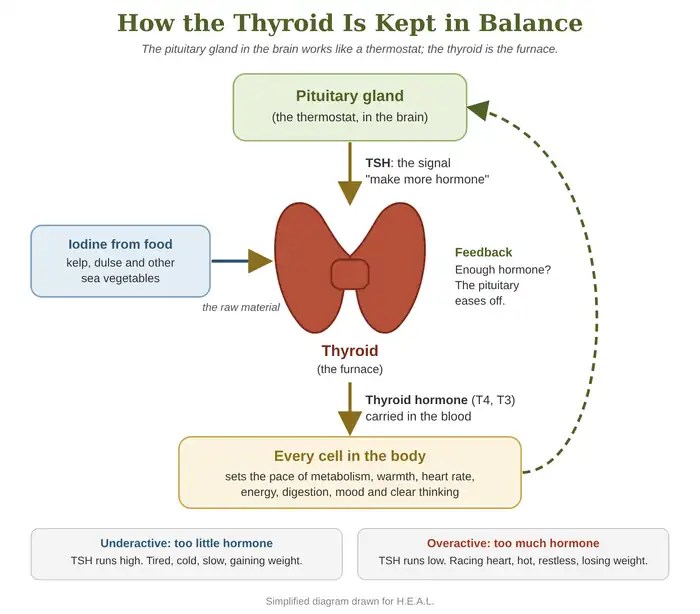
The thyroid does not work alone. The pituitary gland in the brain acts like a thermostat. When the body needs more hormone, the pituitary sends a signal called TSH, and the thyroid answers. When there is enough, the pituitary eases off (see the picture below). Iodine from food is the raw material the thyroid needs to answer that call.
How It Develops
Thyroid trouble usually creeps in slowly. Because the hormone touches everything, the early signs are easy to blame on something else for months or years. It tends to go in one of these directions:
- Short on raw material. Without enough iodine coming in, the thyroid has to work overtime to make its hormone. It often enlarges in the effort; this swelling in the neck is a goiter. Function slowly drifts low.
- Underactive (hypothyroidism). Too little hormone, so everything slows down: tired even after 12 hours of sleep, cold hands and feet, weight gain, constipation, dry skin and cracked heels, brain fog and poor memory, thinning hair and eyebrows, heavy periods, puffiness in the face, depression, and cholesterol that climbs. It has been called “the unsuspected illness” because it is so often missed. Today the most common cause is Hashimoto’s thyroiditis, where the body’s own immune system slowly attacks the gland.
- Overactive (hyperthyroidism). Too much hormone, so everything speeds up: a racing or pounding heart, trembling hands, feeling hot and sweaty, weight loss even while eating well, anxiety and irritability, trouble sleeping, loose bowels, and sometimes gritty or bulging eyes. The most common cause is Graves’ disease, where the immune system over-stimulates the gland.
- Nodules and lumps. One or more lumps can form in a gland that has struggled for years. The great majority are never cancerous. Some “hot” nodules start making hormone on their own, apart from the rest of the gland.
- Thyroid cancer. Most often it grows out of a nodule or a long-troubled gland rather than healthy tissue. The common types grow slowly, and caught early, while still inside the gland, the outlook is very good. It needs medical care (see the box below).
Women are affected far more often than men. Thyroid changes often first show up at turning points in a woman’s life: puberty, pregnancy, after childbirth and at menopause. The blood tests a doctor runs (TSH, free T4, and thyroid antibodies for Hashimoto’s) show which way the gland has gone and are the best way to measure your progress.
The Emotional Side: the Energy Work
Healing the whole person. We are body, mind and spirit, and all three must heal together. When one part is neglected, the other two cannot find complete healing. A person can follow a perfect herbal program, but if she stays in a life that keeps wearing her down, or never makes time to care for herself, the body will keep losing ground. Healing the body often means facing what is happening in the heart and spirit as well.
The body and the heart are not separate. Long-held feelings settle into the body, and the throat is where we speak up and express who we are. Louise Hay, in her book Heal Your Body, ties thyroid trouble to the sense that life keeps passing us by, that our own turn never comes. Healing the thyroid often means also giving ourselves permission to speak, to create and to live our own life.
- Thyroid in general: feeling humiliated, held down, always waiting for your turn. Turn it around: I move past old limits and let myself express who I am, freely and creatively.
- Underactive (hypothyroidism): giving up; feeling stifled with no way out. Turn it around: I build a new life on terms that truly support me.
- Overactive (hyperthyroidism): rage at being left out or overlooked. Turn it around: I am at the center of my own life, and I approve of myself and what I see.
- Goiter: resentment at having things forced on you; feeling like a victim, thwarted and unfulfilled. Turn it around: I am in charge of my own life, and I am free to be myself.
- Throat problems (a lump, hoarseness, trouble swallowing): not speaking up for yourself, swallowed anger, stifled creativity. Turn it around: It is safe for me to speak up. I express myself with ease and I am willing to change.
Emotional patterns paraphrased from Louise Hay, Heal Your Body (Hay House).
Areas Affected & Opening the Way to Healing
Look at the picture below and notice what the thyroid is wrapped around and pressed against. It hugs the front of the windpipe, with the food pipe just behind. The nerve that runs the voice box travels up behind it. Four tiny parathyroid glands, which manage the body’s calcium, sit on its back. The great blood vessels on either side carry its hormone to every part of the body, and the lymph nodes of the neck drain the area.
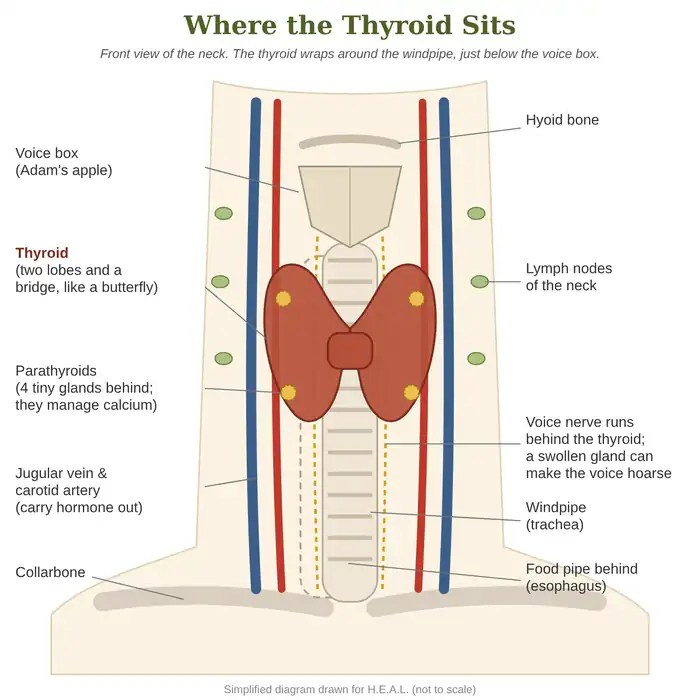
Why the neighbors matter. A swollen gland presses on its neighbors: a feeling of a lump in the throat, trouble swallowing, a hoarse voice or a tight, full neck. The rest of the body matters too. Much of the hormone the thyroid makes (T4) has to be turned into its active form (T3) in the liver and the gut, so a congested liver and a backed-up bowel leave the body short even when the gland is working. And a slow thyroid slows the bowel, which adds to the load. That is why bowel cleansing and liver flushing are part of every thyroid program.
The Parathyroids: the Calcium Regulators
The four parathyroid glands sit on the back of the thyroid, each about the size of a grain of rice. They share the neighborhood but not the job. The thyroid sets the pace of the body; the parathyroids guard the calcium in the blood, which the heart, nerves and muscles depend on. When blood calcium dips, they release parathyroid hormone (PTH), which draws calcium out of the bones, tells the kidneys to hold on to calcium, and turns on vitamin D so the gut absorbs more. When calcium is back up, they ease off.
- Overactive parathyroid (hyperparathyroidism). Most often one of the four glands has grown a small, non-cancerous lump and keeps making hormone even when calcium is already high. Calcium is pulled out of the bones and builds up in the blood. The old saying is “stones, bones, groans and moans”: kidney stones, thinning bones, aches and belly troubles (constipation, nausea, heartburn), and tiredness, low mood and foggy thinking, often with great thirst and frequent urination. Many people have few signs, and it is found when a routine blood test shows high calcium.
- When the glands are working overtime for a reason. Low vitamin D, poor calcium absorption or failing kidneys keep calcium low, so the parathyroids work harder to make up for it. Here the glands are answering a need, not causing the problem, and the healing is in feeding the body and caring for the kidneys.
- Underactive parathyroid. Uncommon, and usually follows surgery on the neck. Calcium runs low, bringing tingling around the mouth and fingers and muscle cramps. It needs medical care.
Not the same as an overactive thyroid. With an overactive parathyroid the thyroid labs are usually normal; the blood calcium and PTH tell the story. Bugleweed and the kelp guidance on this page are for the thyroid. For the parathyroids, Dr. Christopher used parsley root tea: the root brings calcium, B vitamins and iron that nourish these glands. Pour a quart of boiling water over a cup of firmly packed fresh parsley, steep 15 minutes, strain and refrigerate. Because high calcium so often ends in kidney stones, keep the water coming in and the kidneys flushing well. A true overactive gland is a medical matter: a doctor will confirm it with calcium and PTH tests, and it is usually treated by removing the one enlarged gland.
That is the short version on the parathyroids. For the full picture, see my Parathyroid Ailments sheet. Now, back to the thyroid.
Opening the Way: Fomentations and Warmth
- Gland Formula fomentation. Dr. Christopher’s glandular formula, mullein and lobelia, is the first support for a malfunctioning thyroid, whether it is underactive or overactive. Make a tea of three parts mullein to one part lobelia, soak a flannel in it as hot as can be tolerated, and lay it around the throat over the thyroid. Cover it with plastic and leave it on all night, six nights a week, until relief is obtained.
- M&L Salve pack. The same two herbs in a salve, without the mess. Spread the M&L Salve on flannel, lay it over the throat, cover with plastic wrap and a towel, and add gentle heat. The heat drives the herbs into the surrounding tissue so they can do their work more quickly.
- Gland Formula as a tea or extract. Alongside the fomentation, drink a cup of the mullein and lobelia tea two or three times a day, or take the Gland Formula extract, 2 to 4 droppers (½ to 1 teaspoon) three times a day.
- Gentle hot and cold. Alternating hot and cold compresses over the neck bring circulation to a sluggish gland. Be generous with the warmth and keep the cold brief, especially if the heart is racing from an overactive thyroid.
Feeding the Thyroid
- Super Kelp. Kelp is the master herb for the thyroid. It feeds the gland the iodine and trace minerals it is short on, and in Dara’s experience it helps whether the gland is over-producing or under-producing. Super Kelp is HEAL’s blend of Atlantic kelp, Irish moss and dulse. Dr. Christopher suggested 10 to 15 kelp tablets a day if there is any sign of a thyroid problem, or 2 or more a day to keep the gland in good condition. Dara takes 10 capsules in the morning and another 5 later in the day.
- Kelp in the kitchen. Use kelp powder in place of table salt, on salads and in cooking. A money-saving tip from Dara: buy Super Kelp powder by the pound and blend it with coconut oil into small chunks, so you get your kelp and coconut oil at the same time.
- Thyroid greens. Dr. Christopher fed the thyroid with parsley, watercress, romaine lettuce, turnip tops, Irish moss and Iceland moss. Put the greens on your plate and in your juices every day.
- Bugleweed for a racing heart. With an overactive thyroid, bugleweed is the traditional herb for calming the gland and the racing, pounding heart that goes with it. Dr. Christopher’s sources call it a superior sedative: it lowers the pulse without bad side effects, steadies heart palpitations, calms the nerves, and helps with the insomnia and worry that so often come with an overactive thyroid. Use bugleweed tincture on its own: ½ teaspoon stirred into a glass of juice, or into a cup of hot water as a tea with a touch of cayenne for more heart support. It is a support herb: take it as needed when the heart races or the nerves are on edge, and keep using it until the need for it clears. It is meant to quiet an overactive gland, so it is not for an underactive thyroid or Hashimoto’s, during pregnancy or nursing, or alongside thyroid medication without someone watching the labs.
- Rest. The pull toward sleep with an underactive thyroid is real. Honor it rather than pushing through with coffee or other stimulants; rest gives the gland room to rebuild.
Using Kelp With Care
Kelp is a food, and for most people it can be used freely. Because it brings real iodine, a few situations call for starting low, going slowly and having the labs checked:
On thyroid medication. As kelp feeds the gland, it may start making more of its own hormone, and the medication dose can become too much. Dara’s own story below shows this: palpitations one morning once her thyroid had healed. Keep taking your medication and have your levels checked every few months, so your doctor can lower the dose as you need less. Don’t stop or change it on your own.
Hashimoto’s, Graves’ or an overactive thyroid, or a thyroid nodule. Start with a small amount and build slowly, with your labs checked along the way.
Before a radioactive iodine scan or treatment, stop kelp and other sea vegetables for one to two weeks.
Kidney disease, pregnancy and nursing: use food-level amounts only.
For the full story on kelp, see Kelp: Food from the Sea for the Thyroid.
When to Get Medical Care
Herbs are support alongside medical care, not a replacement for it. Get prompt care for: a lump in the neck that is growing, hard or fixed in place; hoarseness that lasts more than a few weeks; trouble swallowing or breathing; chest pain or a racing, irregular heartbeat; or eyes that become painful, red or bulging. Have a high blood calcium followed up, since it points to the parathyroids.
Emergencies. A very high fever with a racing heart, agitation or confusion (an overactive thyroid out of control), or extreme cold, drowsiness and confusion (a severely underactive thyroid) need emergency care right away, as do signs of very high calcium: confusion, vomiting, extreme thirst or an irregular heartbeat.
Thyroid cancer needs a medical team. The supports on this page can be used alongside their care.
Level of Commitment
How much work the thyroid takes depends on how long it has been struggling and which way it has gone. Be honest about where you are:
- Gentle support. For a tired, cold, sluggish body with labs on the low side of normal, a family history of thyroid trouble, or simply keeping the gland strong. Super Kelp daily, kelp in place of salt, thyroid greens, and real rest. Most people can live on this for good; Dara has for over 40 years.
- Focused cleansing. For a diagnosed underactive or overactive thyroid, Hashimoto’s, Graves’ or a goiter. Add the Gland Formula fomentation or M&L Salve pack six nights a week and the Gland Formula tea or extract by day; bowel cleansing; and weeks of liver flushing alternated with weeks of kidney flushing, so the body stays on top of the healing. Bugleweed for a racing heart. Have your labs rechecked as you go.
- Incurables Program. For thyroid cancer or a long-standing, serious thyroid condition. The thyroid supports on this page (fomentations, salve packs, the Gland Formula and Super Kelp) continue, while the full Incurables Program, which includes cleansing the bloodstream with HEAL’s Blood Purifying formula, is done hand in hand with your medical team. Blood Purifying contains chaparral, which has long been regarded as one of the strongest blood purifiers in herbal use. It has had years of bad press, but used wisely it supports the body in clearing cancer, and over the years many members have used it to eliminate tumors. Use with care: take Blood Purifying in courses, not continuously: two dropperfuls 4 to 6 times a day for a week at a time, in a few ounces of grape juice, while drinking 64 to 128 oz. of liquid a day. Avoid it during pregnancy or nursing and with existing liver disease. If the skin or the whites of the eyes turn yellow, the urine turns dark, or there is pain under the right ribs, stop and have the liver checked.
More Is Not Faster
These doses are set to what the body can clear. Taking more stirs up more than the bowels, liver and kidneys can carry out, and that is when cleansing starts to feel like poisoning. Healing the body requires steady, consistent nutrition and action, not a bigger dose.
People are different, and now and then someone reacts poorly to a particular herb. If that happens, stop it. What I offer here is a guideline. You are the one living in your body, so work with the Holy Spirit and the wisdom the Lord has given you to apply these supports in the best way for your life.
A Loose Healing Plan
- Weeks 1–2: Build the foundation. Start your Foundational Program (Superfood, Echinacea, Vitamin C, and bowel cleansing with LBF). Have your thyroid labs done so you know where you are starting.
- Start feeding the gland. Begin Super Kelp. If you have Hashimoto’s, an overactive thyroid or a nodule, or take thyroid medication, start with a small amount and build up slowly. Use kelp in place of salt and add the thyroid greens.
- Open the way. A Gland Formula fomentation or M&L Salve pack over the throat at bedtime, six nights a week, with the Gland Formula tea or extract two or three times a day.
- If the thyroid is overactive: add bugleweed for the racing heart, keep kelp modest, and work with someone who is watching your labs.
- Weeks 4 onward: Alternate. A week of liver flushing, then a week of kidney flushing, for as many rounds as your level of commitment calls for, with gentle-support weeks in between.
- About 3 months: Check your progress. Have your labs rechecked. If you take thyroid medication, check sooner and more often, since the dose may need to come down as the gland heals. Then keep kelp as part of your daily food for life.
Stories from the Work
Dara: A sleepy fifth-grader
My mother used to joke that when puberty hit it knocked me out. She was right. It seemed I could not get enough sleep. I’d drag myself out of bed in the morning, somehow get through school without falling asleep, come home and sleep on the couch until dinner, then crawl back to bed and sleep until morning. Sometime during the fifth grade a pediatrician discovered my low-functioning thyroid and prescribed thyroid medication, which she said I’d need for the rest of my life. I faithfully took my little pill every day. Even one day without it would bring on a brain fog along with the urge to sleep the day away. After my daughter was born, missing a dose meant I could not keep up with my active toddler. It began to bother me that I was only me when I took my pill.
Dara: Twenty-five and off the pill for good
Kelp came into my life through the suggestion of a trusted friend, who said it would safely give me natural energy. I began taking four or five kelp pills a couple of times a day, and right away I had more energy, without the crash that always followed caffeine. After using kelp freely for over a year, I had heart palpitations one morning after taking my normal thyroid medication. The emergency room doctor checked my blood and found my thyroid working in the normal range. This was shocking; I had understood there was no healing my thyroid condition. At twenty-five years old I had taken my last thyroid pill. Kelp has been an important part of my daily food ever since. After founding HEAL I experimented with combining different sea plants until I found the blend that suited me, our Super Kelp. Kelp is God’s gift, His master herb for the thyroid gland.
More on the Thyroid
- My Thyroid Story
- Parathyroid Ailments
- Kelp: Food from the Sea for the Thyroid
- Food for the Glands
- Natural Support for the Glands
- Mullein & Lobelia
- Doing a Simple Salve Pack
This information is for education only. It is not meant to diagnose, treat or replace care from a qualified health professional.


