Herbal Healing, Organs & Glands

The Eyes

Tired Eyes, Floaters, Eyesight, Cataracts, Glaucoma, Macular Degeneration and Fuchs Dystrophy

One sheet for the whole eye. Pink eye and styes are on the Infection: Ears, Sinuses & Eyes sheet. Everything here comes back to one thing: keeping circulation flowing in and out of the eye.

Understanding the Condition

How the Eye Is Fed

Light comes in through the cornea, the clear window at the front of the eye, passes through the pupil and the lens, and lands on the retina, the light-sensing layer at the back. The retina turns light into nerve signals, and the optic nerve carries them to the brain. At the center of the retina is the macula, a spot about the size of a pencil eraser that gives us our sharp, detailed sight.

Some of the most important parts of the eye have no blood vessels at all. The cornea and the lens must stay perfectly clear, so they are fed by a clear, watery fluid (the aqueous fluid) that fills the front of the eye. This fluid is made all the time behind the iris, flows forward through the pupil, and drains out where the iris meets the cornea, carrying waste away with it. The retina is fed from behind by a rich bed of blood vessels, the choroid.

So every part of the eye depends on circulation: nourishment flowing in and waste flowing out. When that flow slows or clogs, waste builds up and tissue starves. That is the story behind every condition on this sheet.
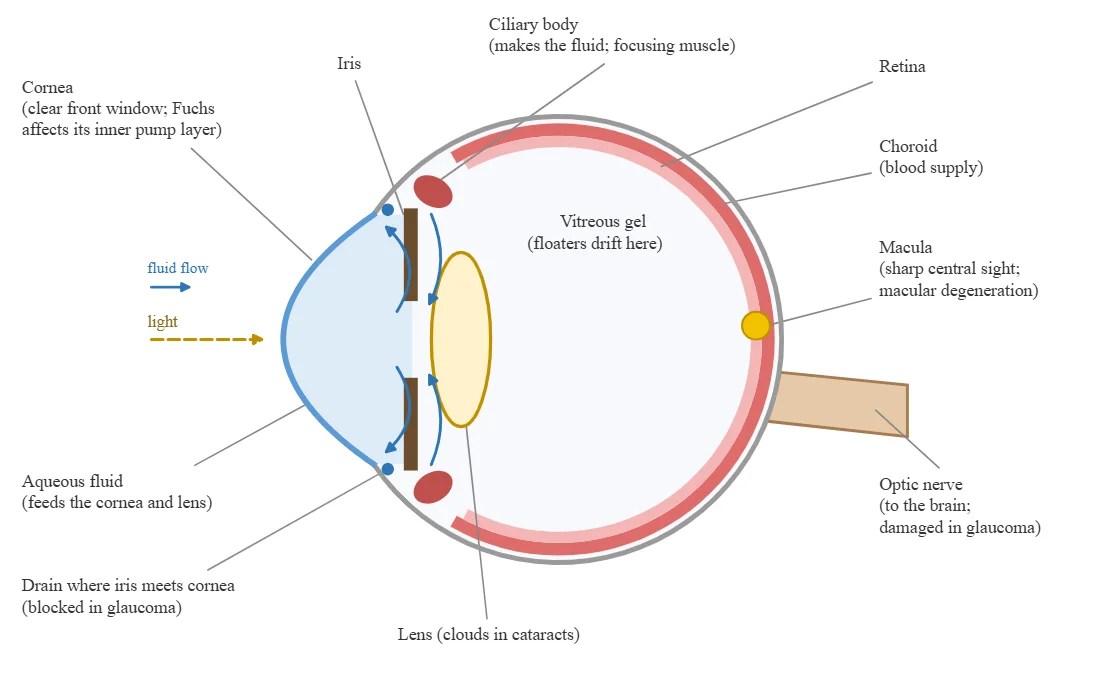
Diagram of the eye: cornea, aqueous fluid and its drain, iris, ciliary body, lens, vitreous gel, retina, choroid, macula and optic nerve.
The parts of the eye, and where each condition on this sheet takes hold. Diagram drawn for H.E.A.L.

Tired Eyes and Changing Eyesight

Inside the eye, a small ring of muscle changes the shape of the lens so we can focus. Looking up close, it tightens and the eyes turn in toward the nose; looking far away, it relaxes. Hours of close work, reading and screens keep these muscles tight all day, and like any muscle held tight too long, they tire, stiffen and lose their range. That is a large part of why focusing gets harder as the years go by. Muscles that are exercised and fed stay stronger.

Floaters

The large back chamber of the eye is filled with a clear gel, the vitreous. Floaters are small bits of debris drifting in that gel, and their shadows fall on the retina, so we see them as specks, threads or cobwebs that drift when the eye moves. When the eye cannot clear its waste, the specks can build into larger strands, like ropes across the field of vision.

Dry Eyes

Every blink spreads a thin film of tears over the eye: water from the tear glands, mucus to hold it in place, and oil from tiny glands along the edge of the eyelids to keep it from drying out. When the glands are clogged or the film breaks down, the eyes feel gritty, burning and tired, and may water too much as they try to make up for it. Staring at screens cuts our blinking nearly in half, which makes it worse.

Cataracts

The lens is made of tightly packed proteins, arranged so precisely that light passes straight through. The cells at the center of the lens are never replaced, so some of those proteins are as old as we are. Over the years, with waste and wear, the proteins begin to clump together and the lens clouds, like a frosted window. Sight becomes dim and blurred, colors fade, and lights at night grow halos and glare.

There are three main kinds, depending on where the clouding forms:

  • Nuclear: the center of the lens slowly hardens and yellows. The most common kind; it usually comes on over years.
  • Cortical: cloudy streaks like the spokes of a wheel start at the outer edge of the lens and work inward.
  • Posterior subcapsular: forms at the back of the lens, just under the thin capsule that wraps it. This is the fast-growing kind, and it can go from mild to serious in a few months.

Why Some Cataracts Clear and Others Don’t

Most people who flush faithfully see their cataracts dissolve. A few don’t. Dr. Christopher said he could not understand why some did not respond while others had fantastic healings, and I have seen the same results here. No one fully knows why.

What science can tell us is that cataracts are not all one thing. The fast-growing kind at the back of the lens is the one most often linked to long-term steroid use, diabetes, eye injury or inflammation, radiation, strong nearsightedness, smoking and heavy sun exposure. If one of these is behind your cataract, it needs to be dealt with too.

When no physical cause can be found, look at the heart. Hurts that have never healed can show up in the body, sometimes as the very thing that won’t respond to anything else.

My husband was one who did not respond. His story is in Stories from the Work below.

Glaucoma

Glaucoma is a problem of pressure. The aqueous fluid is made all the time, and it must drain out as fast as it is made. In glaucoma, the drain where the iris meets the cornea slows or becomes blocked, the fluid builds up, and the pressure inside the eye rises.

The pressure presses everywhere inside the eye, but the weakest spot is at the back, where the optic nerve leaves the eye. Over time the pressure squeezes the nerve and the tiny blood vessels that feed it. Starved and crushed, the nerve fibers begin to die, and once they are lost they do not come back. Sight lost to glaucoma does not return.

The most common form, open-angle glaucoma, comes on so slowly and quietly that it is called the “silent thief of sight”:

  • Early: the pressure is up, but there is no pain and no change you can notice. Only an eye exam finds it.
  • Moderate: small blind spots appear at the edges of your side vision. The brain fills in the gaps, so most people still don’t notice.
  • Advanced: the side vision closes in until you are looking through a tunnel.
  • End stage: the last of the central vision goes, and blindness follows.

Angle-closure glaucoma is different: the iris itself pushes forward and blocks the drain, and it can happen suddenly, with severe eye pain, a red eye, blurred vision with halos around lights, headache, and nausea or vomiting. That is an emergency; sight can be lost within hours. Normal-tension glaucoma damages the optic nerve even though the pressure reads normal, and poor blood flow to the nerve is believed to play a part.

Those most at risk are people over 60, anyone with a parent or sibling who has glaucoma, people of African or Hispanic descent, and those with diabetes, high or very low blood pressure, strong nearsightedness, or long-term steroid use, including steroid eye drops. Because early glaucoma has no symptoms, a pressure check and an exam of the optic nerve are the only way to catch it before sight is lost.

Macular Degeneration

The light-sensing cells of the macula work hard and use a great deal of energy. Each day they shed their worn-out tips, and a layer of cleanup cells just beneath them digests that waste and carries it away. Beneath the cleanup layer is a thin filter, and beneath that the choroid, the bed of blood vessels that brings in oxygen and nourishment and carries waste off into the blood. Everything passes through that filter in both directions.

Over the years, if the waste is not cleared as fast as it is made, it builds up. Yellow deposits of fat and protein, called drusen, collect beneath the cleanup layer, and the filter thickens and clogs. Less nourishment gets in, less waste gets out, and the cells begin to starve. That is the beginning of macular degeneration.

Dry macular degeneration is the most common form, about 8 or 9 of every 10 cases:

  • Early: a few small or medium drusen. No symptoms; it is found only on an eye exam.
  • Intermediate: many medium drusen or some large ones. Some people notice a slight blur in the center, or need more light to read.
  • Advanced: the starved cells die off in patches, and a blurry or dark spot grows in the center of your vision. Faces and print become hard to make out, while the side vision stays.

Wet macular degeneration is the fast and dangerous turn. The starved tissue cries out for blood, and the body answers by growing new vessels up through the filter and under the macula. These new vessels are fragile; they leak fluid and blood that lift and scar the macula, and central sight can be lost within weeks or even days. The first warning is often that straight lines suddenly look wavy or bent.

Macular degeneration rarely causes total blindness, because the side vision remains, but losing the center of your sight takes away reading, driving and seeing the faces of the people you love. The risk rises after 50 and especially after 60. Smoking is the strongest risk you can change, doubling the risk or more; family history, high blood pressure, heart disease, a diet low in greens and much bright sunlight add to it.

Fuchs Dystrophy

The cornea must stay fairly dry to stay clear. When it soaks up too much water, it swells and turns cloudy, like frosted glass. The back of the cornea is lined with a single layer of tiny pump cells whose whole job is to pump water out of the cornea, all day and all night. They work hard and use a great deal of energy, and in adults they do not grow back. When one dies, its neighbors stretch to cover the gap.

In Fuchs dystrophy these pump cells wear out and die faster than they should. Small bumps called guttae form on the back of the cornea, and fewer and fewer pumps are left to do the work. When too few remain, water builds up, the cornea swells, and vision clouds. It usually affects both eyes and moves slowly, over 20 to 30 years; many people never get past the early stages.

  • Early: a few bumps on the back of the cornea. No symptoms; found at a routine eye exam.
  • Middle: the pumps fall behind. Vision is blurry on waking and clears as the day goes on, because the eyes are closed all night and the cornea can’t dry out. Glare and halos around lights at night.
  • Later: the swelling stays all day. Small blisters can form on the front surface of the cornea; when they break, they are painful and feel like something is in the eye.
  • Advanced: the cornea becomes hazy and scarred, and sight is seriously lost.

Fuchs often runs in families, and women are affected two to three times as often as men, especially after menopause. Symptoms usually begin in the 50s or 60s. Smoking, diabetes and heavy sun exposure add to the wear on the pump cells.

Get to the ER Right Away

If you have any of these signs, get emergency care now, and keep your herbal work going alongside it:

  • Sudden loss of vision
  • A curtain or shadow across your sight, or a sudden shower of floaters or flashes of light
  • Straight lines suddenly looking wavy or bent
  • Sudden severe eye pain with halos around lights, a red eye, headache or nausea

See the Infection: Ears, Sinuses & Eyes sheet for the warning signs of an eye infection.

The Emotional Side: the Energy Work

Healing the whole person. We are body, mind and spirit, and all three must heal together.

Louise Hay, in her book Heal Your Body, describes these patterns:

  • Eyes: represent the capacity to see clearly, past, present and future. Turn it around: I see with love and joy.
  • Eye problems: not liking what you see in your own life. Turn it around: I now create a life I love to look at.
  • Cataracts: inability to see ahead with joy; a dark future. Turn it around: Life is eternal and filled with joy.
  • Glaucoma: stony unforgiveness; pressure from longstanding hurts; overwhelmed by it all. Turn it around: I see with love and tenderness.
  • Dry eye: angry eyes; refusing to see with love; would rather die than forgive; being spiteful. Turn it around: I willingly forgive. I breathe life into my vision and see with compassion and understanding.
  • Nearsighted: fear of the future. Turn it around: I accept Divine guidance and am always safe.
  • Farsighted: fear of the present. Turn it around: I am safe in the here and now. I see that clearly.
  • Astigmatism: “I” trouble; fear of really seeing the self. Turn it around: I am now willing to see my own beauty and magnificence.
  • Crossed eyes: not wanting to see what’s out there; crossed purposes. Turn it around: It is safe for me to see. I am at peace.
  • Wall eyes: fear of looking at the present, right here. Turn it around: I love and approve of myself right now.
  • Eye problems in children: not wanting to see what is going on in the family. Turn it around: Harmony and joy and beauty and safety now surround this child.

Emotional patterns paraphrased from Louise Hay, Heal Your Body (Hay House). These are not faults to blame anyone for; they are places to look and let go.

Areas Affected & Opening the Way to Healing

The eyes are fed by the blood, so the eyes are only as clean as the body behind them. Keep the bowels moving with LBF, and keep the liver and kidneys clearing, so the waste the eyes let go of has a way out of the body. Then work on the eyes themselves.

When It Stops Working, Flush the Liver

My rule of thumb: when what should work doesn’t work, or what was working stops working, it is time to flush the liver. The vacuum bag is full.

The eyes are such tiny vessels. The liver really needs help in every way to get the waste out and the good stuff in. If you have been flushing your eyes faithfully and nothing is changing, don’t give up on the eyes; clear the liver. See Cleansing the Liver and Gallbladder for the liver flush and the ELF.

The Eyebright Flush

The Eyebright flush is the heart of this sheet. The small amount of African bird pepper in the formula draws the eye’s circulation in and then lets it recede, carrying waste out with it, while the other herbs soothe, tone and cleanse.

  • Set up both eyecups first, and have a cold, wet washcloth ready, wrung out from a small bowl of ice water.
  • Add 1 to 3 drops of Eyebright to the eyecup, then pour room-temperature distilled water on top, so the drops mix in.
  • Always flush both eyes, even if only one is troubled, and alternate which eye you start with. Fit the cup over the eye, tip your head back and open the eye into the wash. If the eye wants to shut the first time, that is normal; rest the cold cloth over it and try again.
  • Expect a minute or two of sensation, more the more irritated the eye is. That is the circulation flooding in and receding. Once it settles, the eye feels noticeably better.
  • How often: floaters and tired eyes often clear in one flush. For cataracts and macular degeneration, flush at least twice a day, faithfully.
  • Eyebright by mouth: Dr. Christopher also had people drink the formula: ½ teaspoon (two dropperfuls) in a cup of hot distilled water, morning and evening, along with the flush.
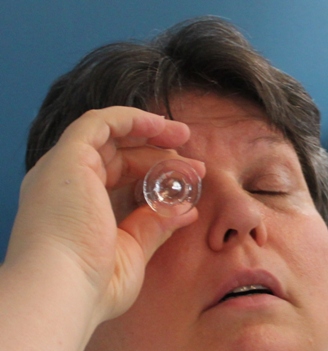
Dara flushing her eye with an eyecup of Eyebright.
Flushing the eye with an eyecup of Eyebright. Photo: Dara Dietz.

See An Herbal Eyewash for Tired, Irritated Eyes for full directions, and my video of the flush at daradietz.me.

Hot and Cold over the Eyes

Hot and cold water over the eyes pumps circulation in and out of them, and it helps every condition on this sheet. In the shower, hold a washcloth over your closed eyes so the force of the spray doesn’t hurt the tender tissue on and around the eye. Use one washcloth for the hot water and one for the cold, and go back and forth.

Hot and Cold: Keep It Gentle

  • Comfortably hot, never scalding. The skin of the eyelids is the thinnest on the body.
  • Keep the eyes closed, and don’t press on the eyeball itself, especially with glaucoma.
  • Not right after eye surgery. Wait until your surgeon says water near the eye is fine, usually a couple of weeks.
  • Use a clean washcloth each time.

The Eye Exerciser: Lifting Weights with Your Eyes

My father, a doctor of biochemistry, used this string exercise in his practice when I was a teenager. There was always one hanging somewhere in his home, tied to a ceiling fan or a curtain rod. He read his novels without glasses into his late 80s. Eye doctors use a similar tool, called a Brock string, to train the eyes to work together.

Making it. Use about 10 feet of string; twine is great. Tie on or press in place 4 or 5 beads, buttons or other small objects, about 18 inches apart. Tie the far end to a ceiling fan, a bed post, or the top of a curtain rod next to your favorite chair, anywhere it can hang out of sight and be easy to use.

Using it.

  • Hold the end of the string, with the first bead, right at your nose, or as close as you can get and still focus on it.
  • Focus on that first bead. Make it as clear as you can and hold for a few seconds. The string behind it will split into a V: that is both eyes working together. If one side of the V fades, that eye isn’t doing its share.
  • Jump your focus out to the third or fourth bead, letting the eye muscles relax there.
  • Jump back to the first bead and hold it clear again.
  • Then go out to the farthest bead, and play back and forth between the distances, focusing for a few moments on each, always coming back to the bead by your nose.
  • How often: at least once a day, and sometimes more.

Up close, the muscles in the eyes tighten; at a distance they relax. Moving between them is lifting weights with your eyes. No string handy? Use two pens, one at your nose and one at arm’s length, with something across the room as the third point.
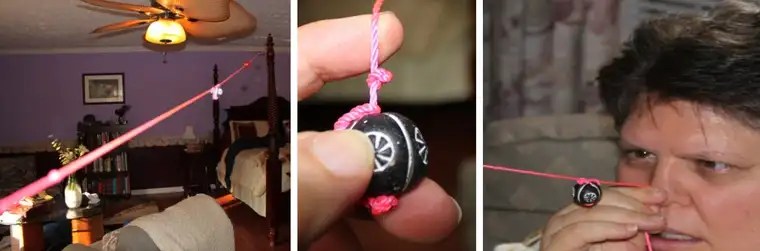
The eye exerciser: a string tied to a ceiling fan, a bead tied in place, and the first bead held at the nose.
The string tied to a ceiling fan; a bead tied in place; the first bead at the nose. Photos: Dara Dietz.

Feeding the Eyes

  • Dark leafy greens. The macula has its own yellow pigment, made from lutein and zeaxanthin. The body cannot make these; they come only from food, especially kale, spinach and collards, along with egg yolks, corn and orange peppers. This pigment acts like built-in sunglasses, filtering harsh light and protecting the cells.
  • Carrot juice. For poor eyesight, Dr. Christopher had people clean the bowels and drink a quart or more of freshly made carrot juice a day, six days a week. His story of the young pilot is below.
  • Rest the eyes. Look up from close work and screens often, and look into the distance.

Cataracts

Flush faithfully, at least twice a day. It can take a few months of flushing to completely clear the buildup that is a cataract, and for many the results are lasting.

When the Flush Isn’t Working

Give it three months of faithful flushing, then have your eyes checked again. There should be progress. If there is none, schedule surgery. A cataract left on the lens too long can damage the eye.

Glaucoma

I have not personally supported a glaucoma case, so what follows is Dr. Christopher’s teaching. Glaucoma is a problem of pressure. Treating the eyes alone would be a foolish, inexperienced step. Something like this needs the whole body supported: the full flushing programs and liver cleansing, along with the Eyebright flush.

Understanding how glaucoma progresses, I can see how the Eyebright would be helpful. It supports circulation in and out of the eye and keeps the eye clean of debris, supporting all the small pumps and drains so they keep working well.

Keep having your eye pressure checked while you do the work. Early glaucoma has no symptoms, and only a pressure check will tell you how you are doing.

Macular Degeneration

I have worked with macular degeneration, and the Eyebright is very helpful. I have yet to see it fail to clear this issue. Flush at least twice a day, eat your greens, and support the whole body. If straight lines suddenly look wavy, see the eye doctor right away; that is the warning of the wet kind.

If you have been flushing for a few months without results, it is time to flush the liver (see When It Stops Working, Flush the Liver, above).

Fuchs Dystrophy

  • While the surface of the eye is whole, in the early and middle stages, the Eyebright flush supports circulation in and out of the eye as it does for any other eye condition.
  • If blisters form. If the eye becomes painful, feels like something is in it, or you are told blisters have formed, stop flushing that eye until it heals, and see your eye doctor.
  • Infection Salve for the blisters. Apply it over the closed lid, a little back from the lash line, never in the eye itself. Cover with a gauze pad and an eye patch. It speeds the healing of the blisters and helps clear any infection.
  • Watch for infection. A broken blister that becomes infected can turn into an ulcer on the cornea, which can scar quickly. If the eye grows redder, has discharge, becomes more painful, or can’t stand light, see the eye doctor the same day, and keep the salve going alongside.
  • Before any eye surgery, including cataract surgery, tell your surgeon you have Fuchs, so they can protect the pump cells.

Use distilled water for all teas and eye washes, and when taking your extracts in hot water.

Level of Commitment

  • Gentle support. Tired eyes, floaters, dry eyes and changing eyesight: the Eyebright flush as needed, the eye exerciser daily, and hot and cold over the eyes.
  • Focused cleansing. Cataracts and dry macular degeneration: the flush at least twice a day, the exerciser and hot and cold, greens and carrot juice, with liver flushing and kidney flushing so the body stays on top of the waste the eyes let go of. Have your eyes checked after three months. If the eyes aren’t responding, flush the liver.
  • Incurables Program. Glaucoma, wet macular degeneration and advanced Fuchs: the whole-body work of the Incurables Program alongside the eye work, with your eye doctor keeping watch on the pressure and the retina.

A Loose Healing Plan

  • Start the flush: Eyebright in both eyes, once for tired eyes or floaters, at least twice a day for cataracts or macular degeneration, with Eyebright in hot water morning and evening.
  • Every day: the eye exerciser at least once, and hot and cold over the closed eyes in the shower.
  • Feed the eyes: dark leafy greens every day, and fresh carrot juice.
  • Clear the body: keep the bowels moving with LBF, and add liver and kidney flushing for cataracts, glaucoma and macular degeneration.
  • Not moving? when what should work doesn’t, or what was working stops, flush the liver.
  • Look at the heart: the energy work above, especially when nothing else seems to move.
  • Check in: for cataracts, have your eyes checked after three months; for glaucoma, keep your pressure checks; for any of the emergency signs, go now.

Stories from the Work

Dara’s Story: Back to the Daily Flush

For about two years I had been waking up with blurred vision and a gritty feeling in my eyes. I get up in the dark, and I could not bring the clock into focus until I rubbed my eyes awake. When a friend came asking about Fuchs dystrophy, I decided to start using the flushes again seriously. The morning blur is gone, and the gritty feeling has ended. I just have to remember to keep up the daily flush, because it is obvious I am benefiting from it.

Dara’s Story: Floaters in My Glass of Water

Floaters have always been an issue for me. When I find myself trying to pick floaters out of my glass of water, I know it is time to flush my eyes. I’ve been told floaters can become so big that they are like ropes in the field of vision; for me it has always been specks floating around. The Eyebright flush normally clears them in one application. Quick, easy and very refreshing to tired eyes.

Dara’s Story: Allergy Eyes in the Humid South

Since moving to the wet, humid South from the dry climate of Southern California in 1996, I began to experience itching and burning in my eyes during the spring and summer months. Allergy eyes from the high pollen, added to the eye strain from long hours working in front of a computer screen, would leave my eyes feeling like sandpaper. Flushing my eyes using the eyecup with the Eyebright drops mixed in distilled water completely cleared the watery, gritty and tired feeling after a long day of overuse.

A Story From the Work: “But I Don’t Want to Go Blind!”

A long-time member couple were caring for the wife’s mother, a lively, dramatic lady who was always entertaining. At an eye exam, her doctor found that her dry macular degeneration had turned wet, and told her she would likely go blind in time. “But I don’t want to go blind!” she cried. Her daughter answered, “Then do the eyewash Miss Dara sent.” She began flushing every day, at least twice a day. At her next visit, the wet macular degeneration had reversed and the dry was greatly improved.

Dara’s Story: My Husband’s Cataracts

My husband was one who had to have his cataracts removed. His were fast growing and under the lens. He used the flush faithfully for a year or more with only slight results. It was obvious he was falling into the group Dr. Christopher talked about: the few who do not respond to the eyewash. He had surgery on both eyes at the end of 2025. Most people who flush dissolve their cataracts, but for the few who don’t, it needs to be taken care of.

Dara’s Story: Two Pens Before Bible Study

I use two pens in the morning before I start on my Bible study: one on my nose and the other at arm’s length, with the chair across the table as my third focus point. I’ve had mornings when I had a hard time focusing even with my reading glasses on. After stretching out my eye muscles, I was able to focus fine. It isn’t as good as the string, but it works.

From Dr. Christopher’s Files

These stories come from Dr. John R. Christopher’s books and newsletters, used with his original eyewash formula. They are his, not mine.

Carrot Juice and the Air Force Pilot

A young man wanted to become an Air Force pilot but was turned down because of bad eyesight, though he had passed everything else with high grades. When he asked if he could try again later, he was laughed at and told the condition could not be changed. He persisted and was given a three-month return date. We had him clean his bowels, go on the mucusless diet after the three-day cleanse, and drink one quart or more of freshly made carrot juice each day, six days a week, with nothing but distilled water on the seventh. In three months he returned for another eye examination and was approved with a clean bill of health and good eyesight.

Blind for Ten Years

An elderly, white-haired woman came into Dr. Christopher’s office in Evanston, Wyoming, led by a little child. She had been completely blind for over ten years. He could not promise her anything, but said the eyebright formula had done much good and never any harm. She began the mucusless diet and the eyewash, and kept visiting for adjustments and other therapies. One day she walked into his office without a child or a seeing-eye dog, smiled and said, “Hello, Doctor.” It was the first time she knew what he looked like. She picked up a book from his desk, read the title, opened it and read several verses.

Eighty-Two and a Driver’s License

“I began using Dr. Christopher’s herbal eyewash. In a few weeks I could read fine print without glasses, even though two years ago I had been told I had cataracts in both eyes. I had them tested again in January, and the cataract in my right eye was gone. The doctor OK’d the paper for my driver’s license. I am eighty-two.”

Glasses Off After Forty Years

“On December 23rd, 1978, after using the eyewash since October 10th, five to eight times daily and enjoying it burning and running down my face, I took off my glasses after 40-plus years, never to put them on again. When I looked in the telephone book and realized I could see names and numbers, I started calling friends. They had said that if I was not blind, with a white stick and a lead dog, within four months of starting the eyewash with cayenne, they would consider using it too. Already, five have started.”

Glaucoma Disappears

“I have a friend who had eight major surgeries and lived in constant pain. She went on Dr. Christopher’s three-day cleanse and mucusless diet, and started on herbs to cleanse the colon and the blood, cayenne, and Herbal Eyebright. In about three weeks her pain was gone. She had had glaucoma for 13 years, and her glaucoma medicine was making her ill. Her eye specialist tested her and said there was not even a trace of glaucoma left. He told her, whatever it is, don’t stop it, and took her off her glaucoma medication. She can now watch TV without glasses, which she had never done before.”

Cataracts, Glaucoma and Bad Vision

“I was diagnosed with a fast-growing cataract in my right eye and a build-up of pressure in both eyes causing glaucoma. I started the eyewash and capsules three times a day. Within three days I could see through my new bifocals, which I hadn’t been able to do. Within two weeks I realized I could see much farther with the eye with the cataract, when I could not see with it at all before. All along, small pieces of mucus came out of my eyes many times a day. Before the eyewash, car headlights, taillights and streetlights all had huge, flashing halos around them at night. Now the halos have disappeared.”

Cayenne in the Eye

Dr. Christopher told of a fine student of his who had begun teaching herb classes, and who happened to speak just before him one evening in Arizona. The young man said, “Dr. Christopher has always made me gasp. I’ve seen him drink two or three tablespoons of cayenne in water, and I’d just shudder. But tonight I’m going to do something he may never have done himself.” With that, he reached into a container of cayenne and threw a pinch right into his eye. Dr. Christopher thought he must have gone crazy, though he knew cayenne can never hurt the cell structure, no matter how delicate. The tears ran down the man’s cheek as he kept talking, and when he finished, he opened his eye and invited everyone to look. It sparkled; it was by far the brighter of the two. Dr. Christopher said he never saw the antic performed again, and never dared to try it himself!

Watch

Flushing the Eyes with Eyebright
Eye Health Class: Flushing the Eyes
Eye Health Class

More on the Eyes

This information is for education only. It is not meant to diagnose, treat or replace care from a qualified health professional.
Sunlight filtering through a golden underwater kelp forest.
Herbal Healing, Organs & Glands

Parathyroid Ailments

Photo: James Collington / Pexels

Overactive and Underactive Parathyroid, High and Low Blood Calcium, and Healing After Neck Surgery

Understanding the Condition

Tucked against the back of the thyroid, at the base of the throat, sit four tiny glands, each about the size of a grain of rice. These are the parathyroids. They share the thyroid’s neighborhood but not its job. The thyroid sets the pace of the body; the parathyroids guard one thing above all: the calcium in the blood.

Calcium is far more than bone. Every heartbeat, every nerve signal and every muscle that tightens and relaxes depends on just the right amount of calcium in the blood, and so does clotting. The bones are the body’s calcium bank, holding nearly all of it in reserve. The parathyroids decide when to make a withdrawal.

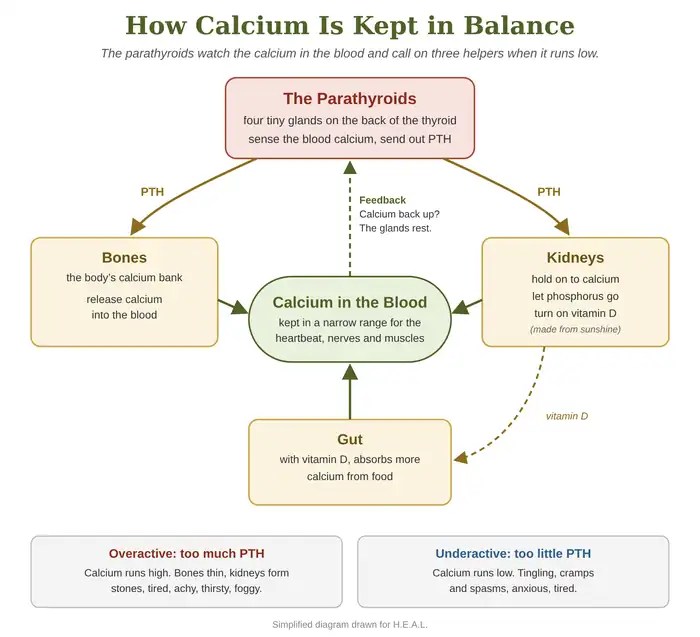
They work like a careful banker (see the picture below). When blood calcium dips even a little, they release parathyroid hormone (PTH). PTH draws calcium out of the bones, tells the kidneys to hold on to calcium and let phosphorus go, and has the kidneys turn on vitamin D, the vitamin we make from sunshine, so the gut can absorb more calcium from food. When calcium is back where it belongs, the glands rest. Dr. Christopher noted that the thyroid works in cooperation with the parathyroids in regulating the mineral salts of the body, especially calcium.

Diagram: the parathyroids send PTH to the bones and kidneys; bones release calcium, kidneys hold calcium and turn on vitamin D so the gut absorbs more; when blood calcium is back up, the glands rest.
How calcium is kept in balance. Simplified diagram drawn for H.E.A.L.

How It Develops

Parathyroid trouble is quiet. Many people feel only tired, achy and foggy, and the first real clue is a calcium number on a routine blood test. It tends to go one of three ways:

  • Overactive parathyroid (hyperparathyroidism). Most often one of the four glands grows a small lump that is not cancerous (an adenoma) and keeps sending out PTH even when calcium is already high. Less often several glands enlarge together. The bones are drained to keep the blood loaded, and the extra calcium has to go somewhere. The old saying is “stones, bones, groans and moans”: kidney stones and calcium settling in the kidneys; thinning bones and fractures; belly troubles (constipation, nausea, heartburn, ulcers); and tiredness, weakness, low mood, poor memory and foggy thinking. Great thirst, frequent urination, aching joints and a rise in blood pressure often come with it. It is most common in women after menopause. Radiation to the neck earlier in life, long use of lithium, and family history can play a part, but often no cause is found.
  • Glands working overtime for a reason. Sometimes the parathyroids are healthy but are being pushed. Low vitamin D (too little sun), poor absorption from a troubled gut, a diet that robs calcium, or weakened kidneys keep blood calcium low, and the glands work harder and harder to make up the difference. Blood calcium may look normal while PTH runs high, and the bones quietly pay the bill. Here the glands are answering a need, not causing the problem, and the healing is in meeting that need.
  • Underactive parathyroid (hypoparathyroidism). The glands make too little PTH, and calcium runs low. By far the most common cause is surgery on the neck, most often removal of the thyroid. The tiny glands can be bruised, lose part of their blood supply, or be removed along with the thyroid. Often they recover over weeks to months as the tissue heals; sometimes the damage lasts. Less often it comes from the immune system or from very low magnesium, which the glands need to work. Low calcium brings tingling around the mouth and in the fingers and toes, muscle cramps and spasms (especially the hands and feet), twitching, tiredness, anxiety, brain fog, dry skin and brittle nails. Severe drops can cause throat spasm, seizures or heart rhythm trouble, which is an emergency.

The blood tests tell the story: calcium, PTH and vitamin D, along with phosphorus, magnesium and kidney function. A bone density scan shows what the bones have lost. These are the best way to know which direction the glands have gone and to measure your progress.

The Emotional Side: the Energy Work

Healing the whole person. We are body, mind and spirit, and all three must heal together. When one part is neglected, the other two cannot find complete healing. A person can follow a perfect herbal program, but if she stays in a life that keeps wearing her down, or never makes time to care for herself, the body will keep losing ground. Healing the body often means facing what is happening in the heart and spirit as well.

The body and the heart are not separate. Long-held feelings settle into the body, and the throat is where we speak up and express who we are. Louise Hay, in her book Heal Your Body, does not single out the parathyroids; they share the throat with the thyroid, and the same patterns apply to both.

  • The thyroid and its neighbors: feeling humiliated, held down, always waiting for your turn. Turn it around: I move past old limits and let myself express who I am, freely and creatively.
  • Throat problems (a lump, hoarseness, trouble swallowing): not speaking up for yourself, swallowed anger, stifled creativity. Turn it around: It is safe for me to speak up. I express myself with ease and I am willing to change.

Emotional patterns paraphrased from Louise Hay, Heal Your Body (Hay House).

Areas Affected & Opening the Way to Healing

Look at the picture below. The parathyroids sit on the back of the thyroid, close beside the windpipe, the food pipe and the nerve that runs the voice box. Anything done to the thyroid, a swelling, an inflammation or an operation, reaches them too. But their work reaches far beyond the neck: into the bones they draw from, the kidneys that must carry the extra calcium out or hold it in, the gut that absorbs it, and the nerves and muscles that need it to fire and relax.

Diagram of the front of the neck showing the thyroid with the four parathyroid glands behind it, the windpipe, food pipe, voice nerve, blood vessels and lymph nodes.
Where the thyroid and parathyroids sit, and their neighbors. Simplified diagram drawn for H.E.A.L. (not to scale).

Why the neighbors matter. When calcium runs high, the kidneys take the brunt: they are flooded with calcium they must carry out, and stones form. A constipated bowel holds waste the kidneys and liver then have to clear. When calcium runs low, the nerves and muscles complain first. So caring for the parathyroids always means caring for the kidneys, the bowels and the bones along with the glands themselves.

Opening the Way: Packs and Warmth

  • M&L Salve pack or Gland Formula fomentation. Dr. Christopher’s glandular formula, mullein and lobelia, is food for the glands, and a pack over the front of the throat reaches the parathyroids as well as the thyroid. Spread M&L Salve on flannel, lay it over the throat, cover with plastic wrap and a towel, and add gentle heat. Or soak a flannel in a hot tea of three parts mullein to one part lobelia, lay it over the throat, cover it and leave it on overnight. Six nights a week.
  • Gentle hot and cold. Alternating hot and cold compresses over the neck bring fresh circulation and nutrients into the area. Be generous with the warmth and keep the cold brief.
  • Keep the bowels moving. Constipation is common when calcium runs high. Bowel cleansing with LBF keeps the waste moving out so the rest of the body can do its work.
  • Keep the kidneys clear. With an overactive gland, drink plenty of water every day so the extra calcium is carried out instead of settling into stones, and include kidney flushing in your program. If stones have already formed, see Kidney Disease.

After Neck Surgery: Calming and Rebuilding

When the parathyroids have been bruised or their blood supply disturbed during an operation, the work is to calm the area first and then rebuild the tissue. Begin only once the incision has fully closed, and keep taking any calcium and vitamin D your doctor has prescribed while the glands recover.

  • First, calm the inflammation: Healing Salve. Comfrey root, marshmallow root and marigold with rosemary, lavender, frankincense and helichrysum oils, soothing and healing to inflamed tissue and a salve Dara uses over incision and biopsy sites. Make a salve pack over the front of the neck and leave it on overnight.
  • Then, rebuild the tissue: BF&C Salve packs. Once the soreness and swelling have settled, switch to Dr. Christopher’s Bone, Flesh and Cartilage formula, led by white oak bark and comfrey root, traditionally used wherever bone, flesh and cartilage need to be restored. Spread it on flannel over the neck, add gentle heat for 30 minutes to an hour, and leave the pack on overnight. Steady, ongoing use is what rebuilds.
  • Let the skin breathe. With any salve pack, leave the area open and clear of salves for at least 6 hours each day.
  • Rebuild from the inside as well: BF&C extract. The adult dose is 1 teaspoon three times a day, so the tissue is fed from within while the salve works from without.

Feeding the Body

  • Calcium the body can use. Dr. Christopher’s Calcium formula (horsetail grass, comfrey root, oat straw and lobelia) gives calcium that has already passed through plant life, so the body can assimilate it without leaving mineral residue for the kidneys. Dara regards ordinary calcium pills as ground-up rock. 1 teaspoon three times a day, taken with a good whole-food blend such as Superfood; it is a food formula and can be used freely. This is the first support when calcium runs low: after neck surgery, when the glands are working overtime, and for the cramps and twitching of low calcium. It is safe with an overactive gland too. The body builds its calcium from these herbs after they are taken in, so the formula does not dump a load of calcium into the blood; when the blood runs high but the bones are still lacking, it feeds the bones.
  • For cramps and spasms. While calcium is being rebuilt, the M&L Salve or Lobelia eases any kind of cramping. Rub the M&L Salve into the cramping muscle or lay a salve pack over it; the lobelia in it is the antispasmodic that lets a locked muscle go. Lobelia extract can also be taken by mouth: usually one good dropperful does the job; take up to two, depending on the size of the person and how bad the cramps are. Cramping that will not let go, or tightness in the throat, is an emergency (see the box below).
  • Parsley root tea. Dr. Christopher’s food for the parathyroids: the root brings calcium, B vitamins and iron that nourish the glands. Pour a quart of boiling water over a cup of firmly packed fresh parsley, steep 15 minutes, strain and refrigerate. Drink it through the day. Parsley also keeps the urine flowing, a help to the kidneys when calcium runs high.
  • BF&C for the bones. When an overactive gland has been draining the bones, the BF&C extract (1 teaspoon three times a day for an adult) helps rebuild them, and it has long been used to help move calcium deposits along.
  • Super Kelp and the greens. Super Kelp (Atlantic kelp, Irish moss and dulse) and daily dark greens bring the magnesium and trace minerals the glands need to do their work.
  • Sunshine. Vitamin D is made in the skin from sunlight, and without it the gut cannot take in calcium. Get out in the sun regularly, and have your vitamin D checked; if it tests low, ask your doctor how best to bring it up, since calcium cannot be put to use without it.
  • Stop the calcium robbers. Soft drinks, coffee, chocolate and junk foods draw on the body’s calcium and leave the glands working harder. Fresh fruits, vegetables, whole grains, nuts and seeds feed the body instead.

Using Comfrey With Care

Comfrey root, the great tissue rebuilder, is at the heart of the BF&C extract and salve on this sheet. Modern guidance cautions against long, heavy use of comfrey by mouth because of its natural alkaloids; the BF&C formula uses it in traditional proportions, as part of a blend.

  • BF&C extract: the adult dose is 1 teaspoon three times a day. More is not faster.
  • During pregnancy: in Dara’s experience the BF&C formula is beneficial, its nutrients helping the baby knit together well.
  • BF&C Salve: use it as an overnight salve pack, and leave the area open and clear of salves for at least 6 hours each day.

When to Get Medical Care

Herbs are support alongside medical care, not a replacement for it. Have a high blood calcium followed up with calcium, PTH and vitamin D tests. A truly overactive gland with a growth on it is a medical matter; it is usually treated by removing the one enlarged gland, and the supports on this sheet can be used before and after. After neck surgery, keep taking any calcium and vitamin D prescribed and keep your lab appointments; don’t stop or change them on your own.

Emergencies. Very high calcium: confusion, vomiting, extreme thirst, great weakness or an irregular heartbeat. Very low calcium: cramping of the hands or feet that won’t let go, tightness in the throat or trouble breathing, a seizure, or an irregular heartbeat. Either needs emergency care right away.

Level of Commitment

How much work the parathyroids take depends on which way they have gone and why. Be honest about where you are:

  • Gentle support. For glands working overtime because of low vitamin D or a calcium-poor diet, borderline labs, or a mild, temporary drop in calcium after surgery. The Calcium formula with Superfood, parsley root tea, greens and Super Kelp, sunshine, and an end to the calcium robbers.
  • Focused cleansing. For a diagnosed overactive or underactive parathyroid, or tissue damaged by neck surgery. Add the M&L Salve pack or Gland Formula fomentation six nights a week; after surgery, the Healing Salve and then BF&C packs with the BF&C extract; bowel cleansing; and weeks of liver flushing alternated with weeks of kidney flushing, so the body stays on top of the healing. Plenty of water when calcium runs high. Have your labs rechecked as you go.
  • Incurables Program. For parathyroid cancer, which is rare, or a long-standing, serious case that has already damaged the kidneys or bones. The supports on this sheet continue, while the full Incurables Program, which includes cleansing the bloodstream with HEAL’s Blood Purifying formula, is done hand in hand with your medical team. Blood Purifying contains chaparral, which has long been regarded as one of the strongest blood purifiers in herbal use. It has had years of bad press, but used wisely it supports the body in clearing cancer, and over the years many members have used it to eliminate tumors. Use with care: take Blood Purifying in courses, not continuously: two dropperfuls 4 to 6 times a day for a week at a time, in a few ounces of grape juice, while drinking 64 to 128 oz. of liquid a day. Avoid it during pregnancy or nursing and with existing liver disease. If the skin or the whites of the eyes turn yellow, the urine turns dark, or there is pain under the right ribs, stop and have the liver checked.

More Is Not Faster

These doses are set to what the body can clear. Taking more stirs up more than the bowels, liver and kidneys can carry out, and that is when cleansing starts to feel like poisoning. Healing the body requires steady, consistent nutrition and action, not a bigger dose.

People are different, and now and then someone reacts poorly to a particular herb. If that happens, stop it. What I offer here is a guideline. You are the one living in your body, so work with the Holy Spirit and the wisdom the Lord has given you to apply these supports in the best way for your life.

A Loose Healing Plan

  1. First: know which way the glands have gone. Have calcium, PTH and vitamin D checked, along with phosphorus, magnesium and kidney function, and a bone density scan if calcium has been high. The plan depends on the answer.
  2. Weeks 1–2: Build the foundation. Start your Foundational Program (Superfood, Echinacea, Vitamin C, and bowel cleansing with LBF).
  3. Feed the body. Begin the Calcium formula with Superfood, whether calcium runs low or high; it feeds the bones without loading the blood. If calcium is high, drink plenty of water. Either way: parsley root tea, greens, Super Kelp, sunshine, and no calcium robbers.
  4. Open the way. An M&L Salve pack or Gland Formula fomentation over the throat at bedtime, six nights a week, with gentle hot and cold over the neck.
  5. After neck surgery: once the incision has closed, Healing Salve packs to calm the area; when it has settled, BF&C Salve packs overnight with the BF&C extract by day (1 teaspoon three times a day), leaving the area open and clear of salves at least 6 hours each day. Keep taking what your doctor prescribed while the glands recover.
  6. Weeks 4 onward: Alternate. A week of liver flushing, then a week of kidney flushing, for as many rounds as your level of commitment calls for, with gentle-support weeks in between. The kidneys matter most when calcium has been high.
  7. About 3 months: Check your progress. Have your labs rechecked. If an overactive gland is still pushing calcium up, talk with your doctor about removing it, and keep the supports going before and after. After surgery, recheck as often as your doctor advises, since prescriptions may come down as the glands heal.

More on the Parathyroids

This information is for education only. It is not meant to diagnose, treat or replace care from a qualified health professional.
Sunlight filtering through a golden underwater kelp forest.
Herbal Healing, Organs & Glands

My Thyroid Story

Photo: James Collington / Pexels

Childhood Thyroid Issues

Dara Dietz age 16

My mother used to joke that when puberty hit it knocked me out. She was right. It seemed I could not get enough sleep. On a typical day I’d drag myself out of bed in the morning. Somehow I’d manage to get through school without falling asleep, come home, sleep on the couch until dinner, take a bath, and crawl back to bed, where I’d sleep until morning when I’d do it all again. Sometime during the fifth grade my parents took me to a pediatrician and discovered my low-functioning thyroid. The doctor prescribed thyroid medication, which she said I’d need for the rest of my life.

Life began to get interesting after I woke up. I faithfully took my little pill every day. I noticed even one day without my medication would bring on a brain fog along with the urge to sleep the day away. After giving birth to my daughter the brain fog was more dangerous. If I missed a dose I noticed I did not have the mental ability to keep up with my active toddler. She could wander away from me and I would not even know she had gone until a crash or some other heart-stopping noise made me aware of her whereabouts. It began to bother me that I was only me when I took my pill.

Discovering the Power of Kelp

Kelp came into my life through the suggestion of a trusted friend. She said kelp would safely provide me natural energy. I was very interested. Several years earlier I had experienced the consequences that follow overdosing on caffeine. The energy needed to maintain life as a single parent and full-time student was enormous. I would have done anything short of taking illegal drugs for more energy. My friend shared that she had used kelp pills freely for years. This sounded too good to be true, but also too good not to check out. I began taking four or five kelp pills a couple of times a day. Right away I noticed I did have more energy. This was great! I also did not experience the crash that usually followed after hopping myself up on caffeine.

After using kelp freely for over a year I experienced heart palpitations one morning after taking my normal thyroid medication. The emergency room doctor checked my blood levels and found my thyroid functioning within the normal range. This was shocking information; I had understood there was no healing my thyroid condition. At twenty-five years old I had taken my last thyroid pill.

Kelp has continued to be an important part of my daily food program. After founding HEAL Marketplace I experimented with combining the different kelps until I found a combination that suited me well. We call this our Super Kelp Blend, a mix of Atlantic Kelp, Irish Moss and Dulse. These herbs are excellent food for a malfunctioning thyroid; it does not matter if the thyroid is over producing or under producing. Kelp is God’s gift, His master herb for the thyroid gland.

More on the Thyroid

This is shared for educational purposes, from my own study and experience. It is not medical advice.

Sunlight filtering through a golden underwater kelp forest.
Herbal Healing, Organs & Glands

Thyroid Ailments

Photo: James Collington / Pexels

Underactive and Overactive Thyroid, Hashimoto’s and Graves’, Goiter, Nodules and Thyroid Cancer

Understanding the Condition

The thyroid is a small, butterfly-shaped gland at the base of the throat. Its two lobes sit on either side of the windpipe, joined by a narrow bridge, just below the voice box. When it is working properly, we are hardly aware it exists.

Small as it is, the thyroid sets the pace for the whole body. It stores practically all of the body’s iodine and uses it to make thyroid hormone (thyroxine, called T4, and its more active form, T3). That hormone tells every cell how fast to burn its fuel. It governs body temperature, energy, heart rate, digestion and the speed of the bowels, growth, the menstrual cycle and fertility, and, to a great degree, mental and emotional balance.

The thyroid does not work alone. The pituitary gland in the brain acts like a thermostat. When the body needs more hormone, the pituitary sends a signal called TSH, and the thyroid answers. When there is enough, the pituitary eases off (see the picture below). Iodine from food is the raw material the thyroid needs to answer that call.

Diagram: the pituitary gland sends TSH to the thyroid, which uses iodine from food to make thyroid hormone for every cell; feedback tells the pituitary to ease off.
How the thyroid is kept in balance. Simplified diagram drawn for H.E.A.L.

How It Develops

Thyroid trouble usually creeps in slowly. Because the hormone touches everything, the early signs are easy to blame on something else for months or years. It tends to go in one of these directions:

  • Short on raw material. Without enough iodine coming in, the thyroid has to work overtime to make its hormone. It often enlarges in the effort; this swelling in the neck is a goiter. Function slowly drifts low.
  • Underactive (hypothyroidism). Too little hormone, so everything slows down: tired even after 12 hours of sleep, cold hands and feet, weight gain, constipation, dry skin and cracked heels, brain fog and poor memory, thinning hair and eyebrows, heavy periods, puffiness in the face, depression, and cholesterol that climbs. It has been called “the unsuspected illness” because it is so often missed. Today the most common cause is Hashimoto’s thyroiditis, where the body’s own immune system slowly attacks the gland.
  • Overactive (hyperthyroidism). Too much hormone, so everything speeds up: a racing or pounding heart, trembling hands, feeling hot and sweaty, weight loss even while eating well, anxiety and irritability, trouble sleeping, loose bowels, and sometimes gritty or bulging eyes. The most common cause is Graves’ disease, where the immune system over-stimulates the gland.
  • Nodules and lumps. One or more lumps can form in a gland that has struggled for years. The great majority are never cancerous. Some “hot” nodules start making hormone on their own, apart from the rest of the gland.
  • Thyroid cancer. Most often it grows out of a nodule or a long-troubled gland rather than healthy tissue. The common types grow slowly, and caught early, while still inside the gland, the outlook is very good. It needs medical care (see the box below).

Women are affected far more often than men. Thyroid changes often first show up at turning points in a woman’s life: puberty, pregnancy, after childbirth and at menopause. The blood tests a doctor runs (TSH, free T4, and thyroid antibodies for Hashimoto’s) show which way the gland has gone and are the best way to measure your progress.

The Emotional Side: the Energy Work

Healing the whole person. We are body, mind and spirit, and all three must heal together. When one part is neglected, the other two cannot find complete healing. A person can follow a perfect herbal program, but if she stays in a life that keeps wearing her down, or never makes time to care for herself, the body will keep losing ground. Healing the body often means facing what is happening in the heart and spirit as well.

The body and the heart are not separate. Long-held feelings settle into the body, and the throat is where we speak up and express who we are. Louise Hay, in her book Heal Your Body, ties thyroid trouble to the sense that life keeps passing us by, that our own turn never comes. Healing the thyroid often means also giving ourselves permission to speak, to create and to live our own life.

  • Thyroid in general: feeling humiliated, held down, always waiting for your turn. Turn it around: I move past old limits and let myself express who I am, freely and creatively.
  • Underactive (hypothyroidism): giving up; feeling stifled with no way out. Turn it around: I build a new life on terms that truly support me.
  • Overactive (hyperthyroidism): rage at being left out or overlooked. Turn it around: I am at the center of my own life, and I approve of myself and what I see.
  • Goiter: resentment at having things forced on you; feeling like a victim, thwarted and unfulfilled. Turn it around: I am in charge of my own life, and I am free to be myself.
  • Throat problems (a lump, hoarseness, trouble swallowing): not speaking up for yourself, swallowed anger, stifled creativity. Turn it around: It is safe for me to speak up. I express myself with ease and I am willing to change.

Emotional patterns paraphrased from Louise Hay, Heal Your Body (Hay House).

Areas Affected & Opening the Way to Healing

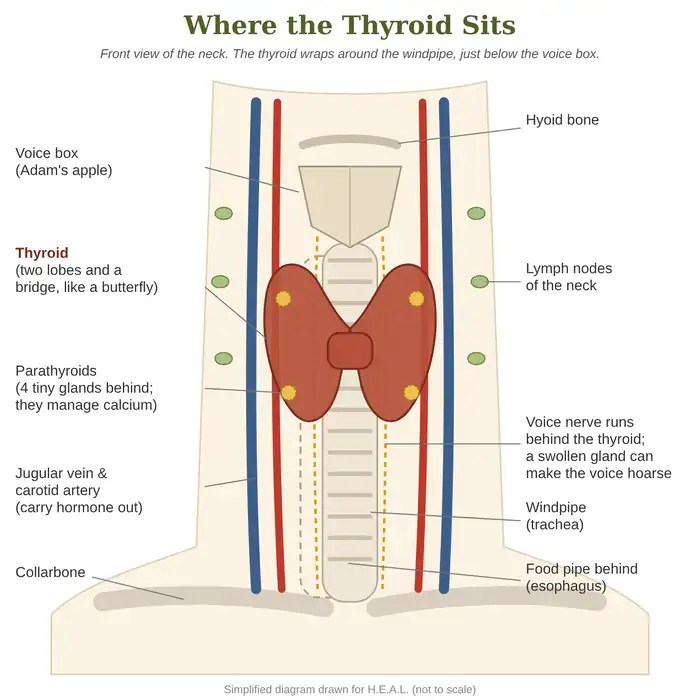
Look at the picture below and notice what the thyroid is wrapped around and pressed against. It hugs the front of the windpipe, with the food pipe just behind. The nerve that runs the voice box travels up behind it. Four tiny parathyroid glands, which manage the body’s calcium, sit on its back. The great blood vessels on either side carry its hormone to every part of the body, and the lymph nodes of the neck drain the area.

Diagram of the front of the neck: the butterfly-shaped thyroid wraps the windpipe below the voice box, with the parathyroids behind it, the voice nerve, food pipe, jugular vein, carotid artery and lymph nodes nearby.
Where the thyroid sits, and its neighbors. Simplified diagram drawn for H.E.A.L. (not to scale).

Why the neighbors matter. A swollen gland presses on its neighbors: a feeling of a lump in the throat, trouble swallowing, a hoarse voice or a tight, full neck. The rest of the body matters too. Much of the hormone the thyroid makes (T4) has to be turned into its active form (T3) in the liver and the gut, so a congested liver and a backed-up bowel leave the body short even when the gland is working. And a slow thyroid slows the bowel, which adds to the load. That is why bowel cleansing and liver flushing are part of every thyroid program.

The Parathyroids: the Calcium Regulators

The four parathyroid glands sit on the back of the thyroid, each about the size of a grain of rice. They share the neighborhood but not the job. The thyroid sets the pace of the body; the parathyroids guard the calcium in the blood, which the heart, nerves and muscles depend on. When blood calcium dips, they release parathyroid hormone (PTH), which draws calcium out of the bones, tells the kidneys to hold on to calcium, and turns on vitamin D so the gut absorbs more. When calcium is back up, they ease off.

  • Overactive parathyroid (hyperparathyroidism). Most often one of the four glands has grown a small, non-cancerous lump and keeps making hormone even when calcium is already high. Calcium is pulled out of the bones and builds up in the blood. The old saying is “stones, bones, groans and moans”: kidney stones, thinning bones, aches and belly troubles (constipation, nausea, heartburn), and tiredness, low mood and foggy thinking, often with great thirst and frequent urination. Many people have few signs, and it is found when a routine blood test shows high calcium.
  • When the glands are working overtime for a reason. Low vitamin D, poor calcium absorption or failing kidneys keep calcium low, so the parathyroids work harder to make up for it. Here the glands are answering a need, not causing the problem, and the healing is in feeding the body and caring for the kidneys.
  • Underactive parathyroid. Uncommon, and usually follows surgery on the neck. Calcium runs low, bringing tingling around the mouth and fingers and muscle cramps. It needs medical care.

Not the same as an overactive thyroid. With an overactive parathyroid the thyroid labs are usually normal; the blood calcium and PTH tell the story. Bugleweed and the kelp guidance on this page are for the thyroid. For the parathyroids, Dr. Christopher used parsley root tea: the root brings calcium, B vitamins and iron that nourish these glands. Pour a quart of boiling water over a cup of firmly packed fresh parsley, steep 15 minutes, strain and refrigerate. Because high calcium so often ends in kidney stones, keep the water coming in and the kidneys flushing well. A true overactive gland is a medical matter: a doctor will confirm it with calcium and PTH tests, and it is usually treated by removing the one enlarged gland.


That is the short version on the parathyroids. For the full picture, see my Parathyroid Ailments sheet. Now, back to the thyroid.


Opening the Way: Fomentations and Warmth

  • Gland Formula fomentation. Dr. Christopher’s glandular formula, mullein and lobelia, is the first support for a malfunctioning thyroid, whether it is underactive or overactive. Make a tea of three parts mullein to one part lobelia, soak a flannel in it as hot as can be tolerated, and lay it around the throat over the thyroid. Cover it with plastic and leave it on all night, six nights a week, until relief is obtained.
  • M&L Salve pack. The same two herbs in a salve, without the mess. Spread the M&L Salve on flannel, lay it over the throat, cover with plastic wrap and a towel, and add gentle heat. The heat drives the herbs into the surrounding tissue so they can do their work more quickly.
  • Gland Formula as a tea or extract. Alongside the fomentation, drink a cup of the mullein and lobelia tea two or three times a day, or take the Gland Formula extract, 2 to 4 droppers (½ to 1 teaspoon) three times a day.
  • Gentle hot and cold. Alternating hot and cold compresses over the neck bring circulation to a sluggish gland. Be generous with the warmth and keep the cold brief, especially if the heart is racing from an overactive thyroid.

Feeding the Thyroid

  • Super Kelp. Kelp is the master herb for the thyroid. It feeds the gland the iodine and trace minerals it is short on, and in Dara’s experience it helps whether the gland is over-producing or under-producing. Super Kelp is HEAL’s blend of Atlantic kelp, Irish moss and dulse. Dr. Christopher suggested 10 to 15 kelp tablets a day if there is any sign of a thyroid problem, or 2 or more a day to keep the gland in good condition. Dara takes 10 capsules in the morning and another 5 later in the day.
  • Kelp in the kitchen. Use kelp powder in place of table salt, on salads and in cooking. A money-saving tip from Dara: buy Super Kelp powder by the pound and blend it with coconut oil into small chunks, so you get your kelp and coconut oil at the same time.
  • Thyroid greens. Dr. Christopher fed the thyroid with parsley, watercress, romaine lettuce, turnip tops, Irish moss and Iceland moss. Put the greens on your plate and in your juices every day.
  • Bugleweed for a racing heart. With an overactive thyroid, bugleweed is the traditional herb for calming the gland and the racing, pounding heart that goes with it. Dr. Christopher’s sources call it a superior sedative: it lowers the pulse without bad side effects, steadies heart palpitations, calms the nerves, and helps with the insomnia and worry that so often come with an overactive thyroid. Use bugleweed tincture on its own: ½ teaspoon stirred into a glass of juice, or into a cup of hot water as a tea with a touch of cayenne for more heart support. It is a support herb: take it as needed when the heart races or the nerves are on edge, and keep using it until the need for it clears. It is meant to quiet an overactive gland, so it is not for an underactive thyroid or Hashimoto’s, during pregnancy or nursing, or alongside thyroid medication without someone watching the labs.
  • Rest. The pull toward sleep with an underactive thyroid is real. Honor it rather than pushing through with coffee or other stimulants; rest gives the gland room to rebuild.

Using Kelp With Care

Kelp is a food, and for most people it can be used freely. Because it brings real iodine, a few situations call for starting low, going slowly and having the labs checked:

On thyroid medication. As kelp feeds the gland, it may start making more of its own hormone, and the medication dose can become too much. Dara’s own story below shows this: palpitations one morning once her thyroid had healed. Keep taking your medication and have your levels checked every few months, so your doctor can lower the dose as you need less. Don’t stop or change it on your own.

Hashimoto’s, Graves’ or an overactive thyroid, or a thyroid nodule. Start with a small amount and build slowly, with your labs checked along the way.

Before a radioactive iodine scan or treatment, stop kelp and other sea vegetables for one to two weeks.

Kidney disease, pregnancy and nursing: use food-level amounts only.

For the full story on kelp, see Kelp: Food from the Sea for the Thyroid.

When to Get Medical Care

Herbs are support alongside medical care, not a replacement for it. Get prompt care for: a lump in the neck that is growing, hard or fixed in place; hoarseness that lasts more than a few weeks; trouble swallowing or breathing; chest pain or a racing, irregular heartbeat; or eyes that become painful, red or bulging. Have a high blood calcium followed up, since it points to the parathyroids.

Emergencies. A very high fever with a racing heart, agitation or confusion (an overactive thyroid out of control), or extreme cold, drowsiness and confusion (a severely underactive thyroid) need emergency care right away, as do signs of very high calcium: confusion, vomiting, extreme thirst or an irregular heartbeat.

Thyroid cancer needs a medical team. The supports on this page can be used alongside their care.

Level of Commitment

How much work the thyroid takes depends on how long it has been struggling and which way it has gone. Be honest about where you are:

  • Gentle support. For a tired, cold, sluggish body with labs on the low side of normal, a family history of thyroid trouble, or simply keeping the gland strong. Super Kelp daily, kelp in place of salt, thyroid greens, and real rest. Most people can live on this for good; Dara has for over 40 years.
  • Focused cleansing. For a diagnosed underactive or overactive thyroid, Hashimoto’s, Graves’ or a goiter. Add the Gland Formula fomentation or M&L Salve pack six nights a week and the Gland Formula tea or extract by day; bowel cleansing; and weeks of liver flushing alternated with weeks of kidney flushing, so the body stays on top of the healing. Bugleweed for a racing heart. Have your labs rechecked as you go.
  • Incurables Program. For thyroid cancer or a long-standing, serious thyroid condition. The thyroid supports on this page (fomentations, salve packs, the Gland Formula and Super Kelp) continue, while the full Incurables Program, which includes cleansing the bloodstream with HEAL’s Blood Purifying formula, is done hand in hand with your medical team. Blood Purifying contains chaparral, which has long been regarded as one of the strongest blood purifiers in herbal use. It has had years of bad press, but used wisely it supports the body in clearing cancer, and over the years many members have used it to eliminate tumors. Use with care: take Blood Purifying in courses, not continuously: two dropperfuls 4 to 6 times a day for a week at a time, in a few ounces of grape juice, while drinking 64 to 128 oz. of liquid a day. Avoid it during pregnancy or nursing and with existing liver disease. If the skin or the whites of the eyes turn yellow, the urine turns dark, or there is pain under the right ribs, stop and have the liver checked.

More Is Not Faster

These doses are set to what the body can clear. Taking more stirs up more than the bowels, liver and kidneys can carry out, and that is when cleansing starts to feel like poisoning. Healing the body requires steady, consistent nutrition and action, not a bigger dose.

People are different, and now and then someone reacts poorly to a particular herb. If that happens, stop it. What I offer here is a guideline. You are the one living in your body, so work with the Holy Spirit and the wisdom the Lord has given you to apply these supports in the best way for your life.

A Loose Healing Plan

  1. Weeks 1–2: Build the foundation. Start your Foundational Program (Superfood, Echinacea, Vitamin C, and bowel cleansing with LBF). Have your thyroid labs done so you know where you are starting.
  2. Start feeding the gland. Begin Super Kelp. If you have Hashimoto’s, an overactive thyroid or a nodule, or take thyroid medication, start with a small amount and build up slowly. Use kelp in place of salt and add the thyroid greens.
  3. Open the way. A Gland Formula fomentation or M&L Salve pack over the throat at bedtime, six nights a week, with the Gland Formula tea or extract two or three times a day.
  4. If the thyroid is overactive: add bugleweed for the racing heart, keep kelp modest, and work with someone who is watching your labs.
  5. Weeks 4 onward: Alternate. A week of liver flushing, then a week of kidney flushing, for as many rounds as your level of commitment calls for, with gentle-support weeks in between.
  6. About 3 months: Check your progress. Have your labs rechecked. If you take thyroid medication, check sooner and more often, since the dose may need to come down as the gland heals. Then keep kelp as part of your daily food for life.

Stories from the Work

Dara: A sleepy fifth-grader

My mother used to joke that when puberty hit it knocked me out. She was right. It seemed I could not get enough sleep. I’d drag myself out of bed in the morning, somehow get through school without falling asleep, come home and sleep on the couch until dinner, then crawl back to bed and sleep until morning. Sometime during the fifth grade a pediatrician discovered my low-functioning thyroid and prescribed thyroid medication, which she said I’d need for the rest of my life. I faithfully took my little pill every day. Even one day without it would bring on a brain fog along with the urge to sleep the day away. After my daughter was born, missing a dose meant I could not keep up with my active toddler. It began to bother me that I was only me when I took my pill.

Dara: Twenty-five and off the pill for good

Kelp came into my life through the suggestion of a trusted friend, who said it would safely give me natural energy. I began taking four or five kelp pills a couple of times a day, and right away I had more energy, without the crash that always followed caffeine. After using kelp freely for over a year, I had heart palpitations one morning after taking my normal thyroid medication. The emergency room doctor checked my blood and found my thyroid working in the normal range. This was shocking; I had understood there was no healing my thyroid condition. At twenty-five years old I had taken my last thyroid pill. Kelp has been an important part of my daily food ever since. After founding HEAL I experimented with combining different sea plants until I found the blend that suited me, our Super Kelp. Kelp is God’s gift, His master herb for the thyroid gland.

More on the Thyroid

This information is for education only. It is not meant to diagnose, treat or replace care from a qualified health professional.
Sliced grapefruit, oranges, limes and green apples on fresh green leaves
Herbal Healing, My Opinion, Organs & Glands

My Kidney Stories

Photo: Julia Filirovska / Pexels

These are my own kidney stories, gathered from over the years. For the full information sheet, see Kidney Disease, and for the flushing routines and videos, see Kidney Flushing: From Light to Intense.

A Lifetime with Weak Kidneys

Kidney issues seem to have always been a part of my life. Kidney infections started in my childhood, and by sixteen an infection and high fevers put me in the emergency room in convulsions. Until I was introduced to herbs and natural healing in the early 1990s, prescribed antibiotics were a regular part of my life; I lived on them for fifteen years.

Since discovering the healing power of herbs, I have taken no prescribed drugs for infection. Combining the infection-fighting herbs into herbal extracts for my infections has proven effective every time I have used them. Kidney Support in my Kidney/Bladder Tea, along with my Hot Lemonade, have been my daily supports ever since, and I haven’t had a kidney attack or kidney pain in over 20 years. I know my kidneys are a weak spot, so I keep animal proteins very low, and I have no soda, sugary drinks or junk food. The body just doesn’t need that stuff.

Care and Feeding of the Kidneys

Kidneys or My Back?

During this time of my life, when my back began to ache there were three possible reasons. One was my cycle, which was easy to rule in or out. The other two were trickier. In 1985 I was in a car accident that fractured my lower back. I could go long periods without any discomfort, then out of the blue it would begin to spasm. Since the fracture was in my lower back, right at the same level as my kidneys, I needed to figure out which one was talking to me. When my back began hurting I would do the three kidney drinks. Within an hour, if it was my kidneys, the discomfort would be gone. If it did not go away, I knew it was my back, and I began using the BF&C formula for my back along with Lobelia for the spasm. We were not yet making salves, so my only relief was hydrotherapy and the extracts.

Ground-Up Rocks and My Kidneys

Regular calcium supplements are nothing but ground-up rocks, and my kidneys cannot take that at all. A friend told me about a high-quality calcium supplement that would never affect my kidneys. Within four hours of taking only one capsule, I could not even walk straight; my kidneys were completely spasmed. I had to drink emergency kidney teas and Hot Lemonade to clear the congestion and calm it down. I never touched those capsules again. Then I discovered Dr. Christopher’s Calcium extract. My mentor at the time talked me into making it, as I was very leery. It has been amazing: no kidney issues.

Michael’s Kidney Stone on the Road

My husband, Michael, and I made a weekend trip to Dr. Tim Jennings’ class in Collegedale, Tennessee. While we were there, Michael had a kidney stone attack. He admitted to feeling a little discomfort before we left but did not think it would become a problem over the weekend. The lack of proper fluids during the four-and-a-half-hour car trip likely set the active stones off.

One of the worst things you can do with a kidney stone is let yourself become dehydrated. The walls of the vessels in the kidneys are lined with nerve tissue. When the fluid in the kidneys falls off, the vessels collapse around the stones, and all the rough edges rip and tear into the nerve tissue as they pass through. Staying hydrated fills the vessels with fluid, keeping the stones buoyant and floating in the center, with much less ripping and tearing.

I learned a lot over two days in a hotel with a husband passing a kidney stone. First, hot fomentations can be done very effectively in a hotel room. I wet and wrung out two small hand towels and put them in the microwave for a minute and a half. That made them steaming hot, and by the time they made it across the room to the bed they were the perfect heat to lay over his kidneys. The stone began in the back and moved to the front over the next few hours. The wet heat kept the kidney calm and the pain all but gone. He also took some Advil, an over-the-counter pain reliever, which was an added help with the pain. I massaged the area with our Anti-Spasmodic Salve too. Our M&L Salve is normally perfect for muscle spasms, but the Anti-Spasmodic Salve is a bit stronger and proved helpful that weekend.

Friday night into Saturday morning he slept well, but the pain began to build again in the morning, likely because he had not kept up his fluids while he slept. The hot fomentations were what really eased it. He has said they were the only thing that truly helped.

Michael’s pain routine. Michael has given birth to many, many stone children over the years, and he has worked out his own routine for the pain. When a stone starts moving, he takes a nighttime pain reliever, either ibuprofen or Aleve. If there’s no relief in an hour, he takes two gel Tylenol and waits another hour or so. All the while I’m keeping hot fomentations over his kidneys, or he’s soaking in a very hot bath. He usually only needs to go through the routine once or twice per stone attack, and between the heat and his routine he can get the pain under control without breaking into the heavy-duty pain pills. Those save us trips to the ER and those awful bills.

This is what works for Michael, whose kidneys are otherwise healthy. Ibuprofen and Aleve are hard on weak kidneys, so anyone with kidney disease should ask their doctor what is safe for them.

A jagged kidney stone about 3/8 inch across beside a dime and a ruler
One of Michael’s “stone children,” passed in 2013, beside a dime and a ruler. Photo: Dara Dietz, H.E.A.L.

The Night at the Cabin Door

One night my husband’s boss showed up at our cabin door in severe kidney stone pain. His nephew was on the way to take him to the emergency room, but it would be over an hour before he arrived. I was setting him up for hot fomentations when he threw up blood all over my bathroom. I gave him an ounce of fresh-squeezed ginger root juice and an ounce of Cayenne extract. His stomach settled and the bleeding stopped. I left the mess, got him into bed and put the hot fomentations on his kidneys. About 15 minutes later he had fallen asleep, relaxed and exhausted from the pain. When his nephew arrived, he drove him, now comfortable, to the emergency room, where they could find no hole in his stomach lining and no internal bleeding at all. He later told me there was no way he had thrown up blood in my bathroom; I assured him I’d had to scrub the proof off the walls and floor. For as long as I knew him, he joked that I had tried to kill him with that ounce of Cayenne. It was the only part of the whole night he remembered. It worked.

I have had people rolling on the floor in agony from a kidney stone who were comfortable in 15 minutes or less with hot fomentations over the kidneys. They are so helpful.

A Member’s Bright Idea

So many of the healing truths I have learned have come from our members. A member called to order a Kidney Stone Dissolve Kit. When I asked if her stones were coming back, she said no: her blood pressure was ticking up without a real reason, and she knew that clogged kidneys full of sediment make the heart work harder to push the blood through. She wanted an intense kidney flush. What a brilliant thought, an ELF for the kidneys! That is how the Ultimate Kidney Flush was born.

More on the Kidneys

This information is for education only. It is not meant to diagnose, treat or replace care from a qualified health professional.
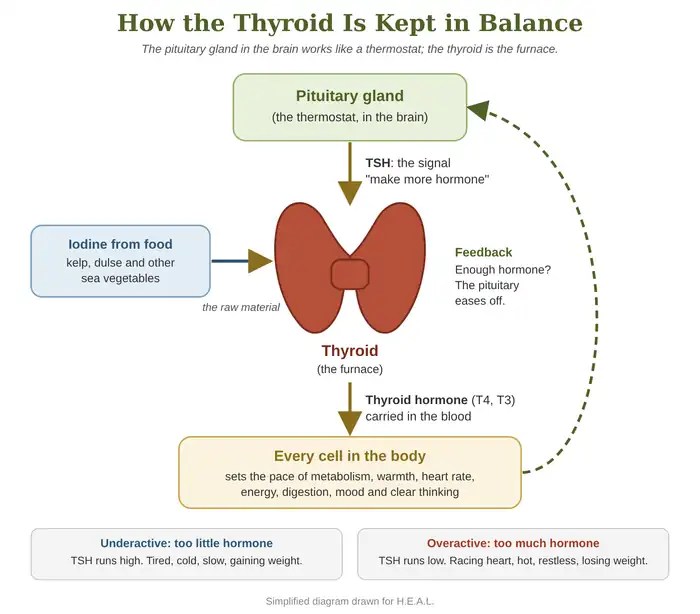
Sliced grapefruit, oranges, limes and green apples on fresh green leaves
Cleansing & Flushing, Herbal Healing, Organs & Glands

Kidney Flushing: From Light to Intense

Photo: Julia Filirovska / Pexels

This post gathers my kidney flushing routines and class videos in one place. For the full picture of what is happening in the kidneys and a loose healing plan, start with my Kidney Disease information sheet.

From Light to Intense

Kidney flushing runs from a light daily or seasonal flush all the way to an intense flush used to lower rising blood pressure, dissolve kidney stones, and help the renal system clear edema. It is part three of the Incurables Routines, and it goes hand in hand with liver flushing: every week of liver flushing should be followed by a week of kidney flushing, so the body can stay on top of the healing.

  • Light: Hot Lemonade every day, Kidney/Bladder Tea with Kidney Support, and plenty of distilled water.
  • Moderate: a full Kidney Flushing week, alternated with liver flushing weeks.
  • Intense: the Ultimate Kidney Flush, also known as the Stone Dissolve Routine, below.
Kidney Flush Class

Download the handout from the Kidney Flushing Class here:

The Daily Flush: Hot Lemonade

Using the Hot Lemonade as a daily kidney flush is an excellent idea. Those who have suffered through kidney stones will want to keep up with this routine to keep new stones from forming. In a 16-ounce glass of hot water: 1 teaspoon cayenne, 1 tablespoon apple cider vinegar, and fresh lemon juice and maple syrup to taste.

Learning to Use Cayenne: Hot Lemonade

The Ultimate Kidney Flush & Stone Dissolve Routine

So many of the great healing truths I have discovered have come from our members. The idea of using the Kidney Stone Dissolve Routine as an extreme kidney flush came from one of our brightest members, whose blood pressure was ticking up without a real reason. She understood that clogged kidneys, full of pus or sediment, make the heart work harder to force the blood through, and she wanted an intense flush. What a brilliant thought: an ELF* for the kidneys! (*ELF = Emergency Liver Flush.) It quickly clears excess sediment from the filters, and when the kidneys are free and clear the heart does not need to work as hard. All flows more freely.

This routine does not take the place of the daily Hot Lemonade for preventing new stones, but it quickly flushes the kidneys so they can filter better. Uric acid crystals dissolve quickly. Small calcium gravel and plaque dissolve faster than one large stone. Whatever the size of your crystal and rock collection, if you have or even suspect sediment, gravel or stones in your kidneys or bladder, it is time to get to work.

Ultimate Kidney Flush & Stone Dissolve Routine

What you need (the Kidney Stone Dissolve Kit):

  • Kidney Support: uva ursi leaves, juniper berries, corn silk, horsetail herb, pipsissewa leaf, burdock root and seed, goldenrod flower and parsley root.
  • Kidney/Bladder Tea: juniper berries, corn silk, uva ursi leaves, parsley root and leaf, dandelion leaf, horsetail herb, goldenrod flower, hydrangea root, gravel root, marshmallow root, orange peel and peppermint leaf.

In a gallon jug, combine:

  • 98 ounces organic, freshly juiced apples (use the tartest available, such as Granny Smith)
  • 10 ounces organic, fresh-squeezed lemon juice
  • 10 ounces organic, fresh-squeezed lime juice
  • 10 ounces organic, raw, unfiltered apple cider vinegar
  • 8 ounces of dry Kidney/Bladder Tea (unbrewed)
  • A 2-ounce bottle of Kidney Support (added after the dry herbs are strained out)

The routine takes 3 days and can be repeated.

  1. Day One: Combine everything except the Kidney Support in the gallon jug. For a stronger brew, run it all through a blender to break down the herbs. Let it steep at room temperature for 24 hours, shaking for a minute or two every couple of hours.
  2. Strain through a stainless steel strainer, or squeeze it through a clean cotton T-shirt. Add the 2-ounce bottle of Kidney Support. Keep the strained brew in the refrigerator until it is gone.
  3. Days Two and Three: Drink 4 ounces every waking hour, each followed by a glass of distilled water (or an ounce every 15 minutes). At 4 ounces an hour over a 16-hour day, you will drink about 64 ounces a day, so the gallon lasts almost two days.

Drink up to 64 ounces of distilled water a day along with it. Only distilled water, the emptiest water, is allowed. It acts like a vacuum, the universal solvent for unwanted mineral deposits. Just drinking distilled water regularly helps dissolve stones and keep new ones from forming; added to this routine, you have a real winner. Repeat at one-week intervals if needed; one large stone dissolves more slowly than many small ones.

Hydrangea, the gravel remover. There is much disagreement about hydrangea’s stone-dissolving properties. Most authorities agree it removes stones, but not all consider it a solvent. Dr. Butler affirmed that it relieves the pain of passing stones. Dr. Shook explained that the sharp pain of gravel comes from the crystal’s sharp points piercing the kidney or ureter; when those points are even partly dissolved, the pain, bleeding and inflammation subside and the stones often pass with just a stretching of the tubes. He asked how else to account for stones that x-rays showed with sharp points, yet passed smooth and round after hydrangea. His clinical evidence, he said, proved hydrangea a true stone solvent.

Kidney Infections

If you have back pain and are not sure whether it is your kidneys, try my three drinks (Echinacea, Herbal Aid 1 and Hot Lemonade), explained on the Kidney Disease sheet. If you determine you have a kidney infection, the Infection Program has proven very helpful in aiding the body to clear it.

Infection Program: Light to Intense

Feeding the Kidneys and Salve Packs

Care and Feeding of the Kidneys

A hot herbal fomentation brings healing herbs right into a struggling kidney, but it is messy and time-consuming, and few people will set one up. A salve pack does the same work without the hassle: spread the salve on flannel, lay it over the kidneys, and cover it with plastic wrap, a towel and a moist heating pad. For the Kidney Salve herbs, proportions and how to make it, see A Salve Pack for Struggling Kidneys.

Topical Application: Herbal Salve Overview

When to Get Medical Care

Herbs are support alongside medical care, not a replacement for it. Get prompt care for fever and chills with back or side pain, blood in the urine, being unable to pass urine, stone pain that is severe or comes with vomiting, or swelling with shortness of breath. These routines are not for anyone on dialysis or with kidney failure.

More on the Kidneys

This information is for education only. It is not meant to diagnose, treat or replace care from a qualified health professional.
Sliced grapefruit, oranges, limes and green apples on fresh green leaves
Cleansing & Flushing, Herbal Healing, Infection, Colds & Flu, Organs & Glands

Kidney Disease

Photo: Julia Filirovska / Pexels

Infection, Inflammation, Gravel & Stones, and Failing Kidney Function

Understanding the Condition

Dr. Christopher called the kidneys “the filters of the blood,” and that is exactly what they are. Every drop of blood in the body passes through them many times a day, roughly 45 to 50 gallons of blood filtered every 24 hours. Each kidney holds about a million tiny filtering units called nephrons. In each one, a little knot of blood vessels (the glomerulus) strains the blood, and a long, thin tubule then takes back the water, minerals and nutrients the body needs to keep. What is left, the waste, acids and excess fluid, becomes one to two quarts of urine a day.

The kidneys do more than make urine. They keep the body’s water, salt, potassium and acid balance steady; they help set the blood pressure; they make the hormone that tells the bone marrow to build red blood cells; and they turn vitamin D into the form the body uses for strong bones. When the kidneys struggle, all of these jobs slip, which is why kidney trouble can show up as tiredness, anemia, high blood pressure, swelling, cramps and weak bones long before anyone thinks of the kidneys.

How It Develops

Kidney disease is seldom one sudden event. It is usually a slow wearing-down of the filters, and it tends to move through stages (see the picture below):

  • Overload. The most common beginning is simply not drinking enough water, combined with a heavy load for the filters to handle: lots of animal protein, salt, soda, coffee, alcohol and processed food. Urine becomes dark and concentrated, and minerals and uric acid begin to settle out as fine sediment.
  • Irritation and infection. Sediment and concentrated urine irritate the delicate tubules. Bacteria, most often climbing up from the bladder, find a home there. The tissue swells and heats, bringing the deep back ache, fever and burning that go with a kidney infection (pyelonephritis). Inflammation of the filters themselves is called nephritis; the old books call long-standing nephritis Bright’s disease.
  • Gravel and stones. Left in place, crystals grow into gravel and stones. Their sharp points tear at the lining of the kidney and ureter, which is where the terrible pain and the blood in the urine come from. A stone can also block the flow of urine, backing pressure up into the kidney.
  • Scarring and lost function. Each round of infection, inflammation or blockage leaves some nephrons scarred. Nephrons do not grow back, so the ones that remain have to work harder. Over years the kidney can shrink and lose function. This is chronic kidney disease (CKD). The two biggest causes today are diabetes and high blood pressure, both of which damage the tiny blood vessels of the filters; long-term use of some pain relievers and other drugs is another.

The hard part is that, as Dr. Christopher said, “our kidneys cannot talk.” Chronic kidney disease is usually quiet until much of the function is gone. Early signs are easy to brush off: tiredness, a dull ache across the lower back, restless legs and night cramps, puffy eyes or ankles, foamy or very dark urine, getting up often at night, itching, and blood pressure that creeps up for no clear reason. The simple blood and urine tests a doctor runs (eGFR, creatinine and urine protein) show how well the filters are working, and they are the best way to measure your progress.

Diagram of four kidneys showing how kidney trouble builds: healthy filter, overloaded, inflamed or infected, and stones and scarring
How kidney trouble builds. Simplified diagram drawn for H.E.A.L.
A jagged kidney stone about 3/8 inch across beside a dime and a ruler
A real kidney stone, passed by Dara’s husband in 2013, beside a dime and a ruler: about 3/8 inch across, with rough, jagged edges. Photo: Dara Dietz, H.E.A.L.

The Emotional Side: the Energy Work

Healing the whole person. We are body, mind and spirit, and all three must heal together. When one part is neglected, the other two cannot find complete healing. A person can follow a perfect herbal program, but if she stays in a life that keeps wearing her down, or never makes time to care for herself, the body will keep losing ground. Healing the body often means facing what is happening in the heart and spirit as well.

The body and the heart are not separate. The kidneys sort what we keep from what we let go, and feelings we hold on to instead of releasing can settle here too. Louise Hay, in her book Heal Your Body, ties kidney trouble to old hurts, disappointment and anger that never got cleared out. Letting those go is part of the flush.

  • Kidney problems: criticism, disappointment and a sense of failure; shame; reacting to life like a hurt child. Turn it around: Everything happening in my life is working toward good, and good comes from every experience. It is safe for me to grow up.
  • Kidney stones: hard lumps of anger that were never dissolved. Turn it around: I let go of past problems easily.

Emotional patterns paraphrased from Louise Hay, Heal Your Body (Hay House).

Areas Affected & Opening the Way to Healing

The kidneys sit high in the back, tucked under the lower ribs on either side of the spine, with the adrenal glands resting on top of each one. Two thin tubes, the ureters, carry urine down to the bladder. Look at the picture below and notice what sits around them: the liver over the right kidney, and the colon lying in front of both.

Diagram showing where the kidneys sit, with the liver, adrenal glands, colon, ureters and bladder around them
Where the kidneys sit, and their neighbors. Simplified diagram drawn for H.E.A.L. (not to scale).

Why the neighbors matter. The kidneys never work alone. The liver breaks down poisons and hands much of that waste to the kidneys to carry out, so when the liver is cleansed, the kidneys get extra work. That is why every week of liver flushing should be followed by a week of kidney flushing, so the body can stay on top of the healing. The bowel matters just as much. A backed-up colon sends its waste back into the blood the kidneys must filter, and a full, heavy bowel presses on the ureters and bladder. Keeping the bowels moving is part of every kidney program.

Opening the Way: Flow, Circulation and Warmth

  • Water first. Fluid is what keeps the filters open and keeps sediment floating so it can pass. Steam-distilled water was Dr. Christopher’s choice, and HEAL’s; it is “empty” and picks up mineral deposits on its way through. A common guideline is at least half your body weight in ounces each day; Dr. Christopher recommended up to an ounce per pound. Let Kidney/Bladder Tea carry much of that amount. (This sheet is not written for anyone on dialysis or with kidney failure; see the box below.)
  • Kidney Salve pack. Parsley root, juniper, marshmallow, ginger and burdock in a salve, spread on doubled flannel, laid over the kidneys on the back, covered, and warmed with a heating pad for 45 minutes to an hour at bedtime, then left on all night. It does the work of a fomentation without the mess. Alternatives: a hot fomentation of strong Kidney/Bladder Tea, or fresh cabbage leaves laid over the kidneys overnight.
  • Hot and cold. Hot and cold showers two or three times a day bring circulation through the back and pelvis. For the pain of a moving stone, hot fomentations over the kidneys (wet hand towels heated in the microwave, wrung out, laid over the kidneys and changed as they cool) give the most relief. It needs nothing special; you can put it together in a motel room that has a microwave. In Dara’s practice, people rolling on the floor in agony from a stone have been comfortable within 15 minutes. When urine is held back, alternating hot and cold fomentations over the kidneys and groin can help break up the blockage.
  • Keep the bowels moving. Lower Bowel Formula (LBF) and plenty of fiber, so the colon is not adding to the load.

Feeding the Kidneys and Helping Them Clear

  • Kidney Support and Kidney/Bladder Tea. The foundation. Kidney Support (juniper, uva ursi, parsley root, corn silk, goldenrod, horsetail, pipsissewa, burdock root and seed) is food for the whole renal system. Add ½ teaspoon to each 8 ounces of Kidney/Bladder Tea, hot or iced, and drink freely. The tea adds hydrangea and gravel root to discourage stones, and marshmallow to soothe.
  • Hot Lemonade. In a 16-ounce glass of hot water: 1 teaspoon cayenne, 1 tablespoon apple cider vinegar, and fresh lemon juice and maple syrup to taste. Once or more a day. It keeps the urine from becoming a breeding ground for stones and gets circulation moving.
  • Parsley. Fresh parsley, parsley tea and parsley in green juices; one of Dr. Christopher’s greatest kidney herbs.
  • Marshmallow root. Soothing and coating for raw, burning or inflamed tissue, and it helps gravel pass smoothly. Slippery elm does the same job.
  • For active infection. Herbal Aid 1 is the formula Dara uses for kidney infections; it works best for clearing them. Use it on the schedule from the HEAL Infection Program: 1 teaspoon in hot water every three waking hours for a mild infection, every two hours for a moderate one, and every hour for a serious one. Add 1 ounce of Echinacea in a mug of hot water once a day (once or twice for a serious infection), garlic paste on the feet as needed, and an ELF every few days, or five nights in a row for a serious infection. Keep Kidney Support and the tea going alongside. If you have taken antibiotics again and again for the same infection, expect the clearing to take anywhere from two weeks to three months.
  • For gravel and stones. Hydrangea root and gravel root, used in HEAL’s Stone Dissolve Routine (Ultimate Kidney Flush). Fresh juices: carrot and cucumber, celery and parsley, or watermelon.

For a Kidney Pain Attack: Dara’s Three Drinks

Kidney pain often feels like a stiff, aching back, so bad you hold onto the furniture to get around. But the kidneys sit at the same level as the lower back, so an ache there can be hard to place: is it the kidneys, or the back itself (or, for a woman, her monthly cycle)? These three drinks answer the question. Drink them one right after the other. As the fluid filters through, it calms spastic kidneys: if the kidneys are the trouble, the ache will be gone within about an hour. If it does not let go, the trouble is most likely in the back, and you can turn to back support instead.

  1. Echinacea: 1 ounce of Echinacea in 16 ounces of hot water.
  2. Herbal Aid 1: 1 tablespoon in 16 ounces of hot water, with honey.
  3. Hot Lemonade: a 16-ounce glass, made as above.

Pain with fever, blood in the urine, or pain that won’t let up still needs medical care (see the box below).

Taking Away the Burden

Careful with rock-based minerals. Most ordinary calcium supplements are ground-up rock (limestone, oyster shell) that weak kidneys cannot handle. Dara’s kidneys went into spasm within four hours of a single capsule. Dr. Christopher’s herbal Calcium extract has given her the calcium she needs with no kidney trouble.

Keep animal protein low, cut out soda, sugary drinks and junk food, go easy on salt and coffee, and avoid alcohol. Ask your doctor about long-term use of over-the-counter pain relievers, which are hard on the kidneys.

When to Get Medical Care

Kidney disease can become serious quickly. Herbs are support alongside medical care, not a replacement for it. Get prompt care for: fever and chills with back or side pain; blood in the urine; being unable to pass urine; stone pain that is severe, does not let up, or comes with vomiting; a sudden drop in how much urine you make; or swelling with shortness of breath.

Not for dialysis or kidney failure. This sheet is not written for anyone on dialysis or with kidney failure. Their care is managed by their medical team.

Level of Commitment

How much work kidney healing takes depends on how long the trouble has been building and how much function has been lost. Be honest about where you are:

  • Gentle support. For a tired, achy back, dark or cloudy urine, a history of bladder and kidney infections, or simply keeping weak kidneys strong. Daily Kidney/Bladder Tea with Kidney Support, Hot Lemonade, plenty of distilled water, a salve pack when the back aches, and taking away the burden foods. Most people can live on this for good; Dara has for over 30 years.
  • Focused cleansing. For gravel and stones, recurring infections, swelling, or blood pressure creeping up. Add a full Kidney Flushing week (the Kidney Flushing Schedule: the Kidney Flush Drink three times a day, Detox Formula, and 16 ounces of Kidney/Bladder Tea with Kidney Support every three hours, on fresh juices). Alternate it with liver flushing weeks so the body stays on top of the healing. For stones, add the 3-day Stone Dissolve Routine.
  • Incurables Program. For diagnosed chronic kidney disease, nephritis, or kidneys that are failing. The full program: a flush every morning for the first 30 days, alternating a week of liver flushing with a week of kidney flushing; up to six cups a day of Kidney/Bladder Tea with Kidney Support; the cold sheet treatment at least weekly; salve packs nightly; and a clean, plant-based diet. This level is done hand in hand with your doctor and your lab work.

More Is Not Faster

These doses are set to what the body can clear. Taking more stirs up more than the bowels, liver and kidneys can carry out, and that is when cleansing starts to feel like poisoning. Healing the body requires steady, consistent nutrition and action, not a bigger dose.

People are different, and now and then someone reacts poorly to a particular herb. If that happens, stop it. What I offer here is a guideline. You are the one living in your body, so work with the Holy Spirit and the wisdom the Lord has given you to apply these supports in the best way for your life.

A Loose Healing Plan

  1. Weeks 1–2: Build the foundation. Start your Foundational Program (Superfood, Echinacea, Vitamin C, bowel cleansing with LBF). Begin Kidney/Bladder Tea with Kidney Support every day and work up to your fluid goal. Hot Lemonade each morning. Drop soda, junk food and most animal protein. Kidney Salve pack at bedtime if the back aches.
  2. If there is infection: start Herbal Aid 1 right away on the Infection Program schedule, with Echinacea and garlic paste on the feet; use the three drinks for a pain attack, add marshmallow root tea for burning, and keep the fluids up. If there is fever with back pain, get medical care the same day.
  3. Week 3: Kidney Flushing week. Five days on the Kidney Flushing Schedule, on fresh juices if you can, with hot and cold showers two or three times a day.
  4. Weeks 4 onward: Alternate. A week of liver flushing, then a week of kidney flushing, for as many rounds as your level of commitment calls for, with gentle-support weeks in between.
  5. For stones: do the 3-day Stone Dissolve Routine. Repeat at one-week intervals if needed; one large stone dissolves more slowly than many small ones, and some cases take two or three rounds.
  6. About 3 months: Check your progress. Have your kidney labs and blood pressure rechecked so you can see what has changed, then settle into gentle support for life.

Stories from the Work

Dara: A lifetime with weak kidneys

Kidney infections were part of my life from childhood. By sixteen, an infection and high fevers put me in the emergency room in convulsions, and I lived on antibiotics for the next fifteen years. When I discovered herbs, I finally began to clear the infections from my renal system completely. Kidney Support in my Kidney/Bladder Tea, along with my hot lemonade, have been my daily supports ever since. I haven’t had a kidney attack or kidney pain in over 20 years. I know my kidneys are a weak spot, so I keep animal proteins very low, and I have no soda, sugary drinks or junk food. The body just doesn’t need that stuff.

Dara: Ground-up rocks and my kidneys

Regular calcium supplements are nothing but ground-up rocks, and my kidneys cannot take that at all. A friend told me about a high-quality calcium supplement that would never affect my kidneys. Within four hours of taking only one capsule, I could not even walk straight; my kidneys were completely spasmed. I had to drink emergency kidney teas and hot lemonade to clear the congestion and calm it down. I never touched those capsules again. Then I discovered Dr. Christopher’s Calcium extract. My mentor at the time talked me into making it, as I was very leery. It has been amazing: no kidney issues.

Dara: My husband’s kidney stone on the road

On a weekend trip to a class in Tennessee, my husband had a kidney stone attack. He had felt a little discomfort before we left, and the lack of fluids on the four-and-a-half-hour drive likely set the stones off. One of the worst things you can do with kidney stones is let yourself get dehydrated. The vessels in the kidneys are lined with nerve tissue; when the fluid falls off, the vessels collapse around the stones and the rough edges rip and tear as they pass. Staying hydrated keeps the stones floating in the center, with much less tearing. Hot fomentations over his kidneys were what really eased the pain. He said they were the only thing that truly helped. He has given birth to many, many stone children over the years, and the stone pictured on this sheet is one of them.

Dara: Kidneys or my back?

During this time of my life, when my back began to ache there were three possible reasons. One was my cycle, which was easy to rule in or out. The other two were trickier. In 1985 I was in a car accident that fractured my lower back. I could go long periods without any discomfort, then out of the blue it would begin to spasm. Since the fracture was in my lower back, right at the same level as my kidneys, I needed to figure out which one was talking to me. When my back began hurting I would do the three kidney drinks. Within an hour, if it was my kidneys, the discomfort would be gone. If it did not go away, I knew it was my back, and I began using the BF&C formula for my back along with Lobelia for the spasm. We were not yet making salves, so my only relief was hydrotherapy and the extracts.

Dara: Hot fomentations for stone pain

I have had people rolling on the floor in agony from a kidney stone who were comfortable in 15 minutes or less with hot fomentations over the kidneys. They are so helpful.

Dara: The night at the cabin door

One night my husband’s boss showed up at our cabin door in severe kidney stone pain. His nephew was on the way to take him to the emergency room, but it would be over an hour before he arrived. I was setting him up for hot fomentations when he threw up blood all over my bathroom. I gave him an ounce of fresh-squeezed ginger root juice and an ounce of Cayenne extract. His stomach settled and the bleeding stopped. I left the mess, got him into bed and put the hot fomentations on his kidneys. About 15 minutes later he had fallen asleep, relaxed and exhausted from the pain. When his nephew arrived, he drove him, now comfortable, to the emergency room, where they could find no hole in his stomach lining and no internal bleeding at all. He later told me there was no way he had thrown up blood in my bathroom; I assured him I’d had to scrub the proof off the walls and floor. For as long as I knew him, he joked that I had tried to kill him with that ounce of Cayenne. It was the only part of the whole night he remembered. It worked.

Dara: A member’s bright idea, the Ultimate Kidney Flush

So many of the healing truths I have learned have come from our members. A member called to order a Kidney Stone Dissolve Kit. When I asked if her stones were coming back, she said no: her blood pressure was ticking up without a real reason, and she knew that clogged kidneys full of sediment make the heart work harder to push the blood through. She wanted an intense kidney flush. What a brilliant thought, an ELF for the kidneys! The stone routine quickly clears sediment from the filters. When the kidneys are free and clear, the heart doesn’t need to work as hard, and everything flows more freely.

From Dr. Christopher’s files: The marshmallow root

One of Dr. Christopher’s students had a teenage son who teased her for studying herbs. One day he was brought home from football practice doubled over in pain, unable to pass his urine. She ran out to the irrigated field and pulled up marshmallow plants, root and all. Too desperate to wait for tea, he asked for a washed root and began chewing it. Within seconds he straightened up, went to the bathroom, and was relieved. He never teased her about herbs again.

More on the Kidneys

This information is for education only. It is not meant to diagnose, treat or replace care from a qualified health professional.
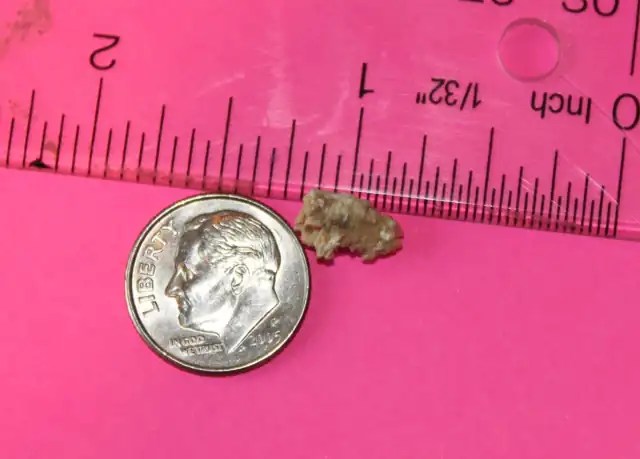
Herbal Healing, Herbs & How to Use Them, Organs & Glands, Women's & Men's Health

A Bitter Tea Worth Making: Support for the Prostate and Urinary Tract

Some formulas earn their place by how well they work, not by how pleasant they are. This is one of them. Dr. Christopher put it together in response to a patient in real distress, to help with kidney stones, infection and sediment in the prostate gland. It brings together seven herbs for the whole urinary tract: kidneys, bladder and prostate.

It is also one of the most bitter teas you will ever drink, and one of the most expensive to make. That is exactly why you won’t find it on many shelves, and why I want you to know how to make it yourself.

What a Good Formula Contains

A good formula for the prostate and urinary tract might contain these seven herbs, all powdered:

  • Goldenseal Root, 3 parts. The backbone of the formula. A powerful, very bitter herb, long used to support the mucous membranes and the body against infection.
  • Gravel Root, 1 part. Its name tells you its traditional use: helping the body clear gravel and stones from the urinary tract.
  • Marshmallow Root, 1 part. Soothing mucilage that coats and protects irritated tissue and eases the passage of whatever needs to leave.
  • Parsley Root, 1 part. Gets the fluids moving and flushes the kidneys.
  • Juniper Berries, 1 part. A traditional urinary antiseptic that wakes up sluggish kidneys.
  • Lobelia, 1 part. Relaxes spasm and tension so the passages can open.
  • Cayenne, 1 part. Drives circulation and carries the other herbs where they are needed.

“Parts” can be any measure you like, as long as you use the same one for every herb. A handy batch is 3 tablespoons of Goldenseal and 1 tablespoon each of the other six, a little over half a cup in all.

Putting It Together

Stir the powders together until they are evenly blended, and keep them in a tightly closed glass jar. For a cup of tea, stir 1 teaspoon of the powder into a cup of hot water, let it steep a few minutes, and drink it, powder and all. If the bitterness is more than you can face, fill #00 capsules with the powder instead.

How to Take It

For daily support, take 2 capsules in the morning and 2 at night. When the need is urgent, drink half a cup of the tea frequently throughout the day.

Why It’s Worth Making Yourself

Goldenseal is one of the most expensive herbs there is, and this formula uses a lot of it. Most people only need it now and then, so a large batch sits for years before it is used up. It makes far more sense to mix a small batch yourself when you need it. Don’t let the cost or the bitterness talk you out of it. This is a valuable formula, and it does help.

Keep the Whole System Supported

For ongoing prostate care, see Keeping the Prostate Clear. To feed and flush the kidneys, see Food for the Kidneys: A Daily Formula and Tea. And drink plenty of pure water; whatever these herbs loosen has to have a way out.

This is shared for educational purposes, from my own study and experience. It is not medical advice.

Herbal Healing, Infection, Colds & Flu, Organs & Glands

Soothing and Strengthening the Lungs

The lungs take a beating. Smoke, pollution, colds that settle in and won’t leave, old congestion that never fully cleared: over time the tissue of the airways becomes raw and irritated, and mucus collects where it shouldn’t. This is a formula for the whole respiratory tract. It soothes that irritation, helps the body bring the old mucus up and out, and strengthens the lungs and bronchial tubes so they can do their work.

It has long been used for every kind of lung and bronchial congestion, including bronchitis, asthma and emphysema, and it is a formula to take steadily over time rather than only in an emergency.

What a Good Lung Formula Contains

A good formula for the lungs might contain these five herbs, in equal parts:

  • Comfrey Root, 1 part. Soothes irritated tissue faster than almost anything I know, and helps loosen old, stubborn mucus so it can come up.
  • Mullein, 1 part. Has a special affinity for the respiratory organs and the glands, calming inflamed, irritated tissue in the lungs and bronchial tubes.
  • Chickweed, 1 part. A cooling, soothing herb used to calm irritated lungs and help dissolve congestion.
  • Marshmallow Root, 1 part. Coats and soothes raw membranes and helps the body move mucus out of the airways.
  • Lobelia, 1 part. An antispasmodic that relaxes tight airways and helps open the lungs and move material out of them.

“Parts” can be any measure you like, as long as you use the same one for every herb. By weight, that’s simply equal ounces of all five.

Putting It Together

Put the dry herbs in a glass jar and pour in 80-proof vodka. Once the herbs have settled, you want about 60% herb sediment on the bottom and 40% liquid on top. Shake the jar every day. The traditional timing follows the moon, from the new moon to the full moon, about two weeks. I prefer to let my extracts sit a full three months, which makes them good and strong. Then strain and bottle the liquid.

How Much and How Often

2 to 4 droppersful, three to five times a day.

For a cough that hangs on, see Clearing a Cough That Won’t Let Go, and for the bigger picture, Lungs & Respiratory System Class.

This is shared for educational purposes, from my own study and experience. It is not medical advice.

Herbal Healing, Organs & Glands

Food for the Glands

Mullein and Lobelia together were what Dr. Christopher called his glandular formula. It was built to support the glandular system as a whole. It has long been used to ease the congestion and swelling that can come with an over- or under-active thyroid, and to bring comfort to mastitis and other glands that aren’t working as they should.

This is the formula taken by mouth, as food for the glands. The same two herbs also make a topical, which does a good deal more as a relaxant for locked muscles and joints; see Mullein and Lobelia: Letting Locked Muscles Go.

What a Good Gland Formula Contains

Just two herbs:

  • Mullein, 3 parts. A gentle, deeply calming herb with a special affinity for both the respiratory system and the glands. It eases pain and quiets irritated, inflamed nerves, and it is counted among the most important herbs for healthy glandular function.
  • Lobelia, 1 part. An antispasmodic and mild sedative, valued for easing pain and calming irritation throughout the body. Its great strength is removing obstruction and congestion.

“Parts” can be any measure you like, as long as you use the same one for both. By weight, that’s 3 ounces of Mullein to 1 ounce of Lobelia.

Putting It Together

Put the dry herbs in a glass jar and pour in 80-proof vodka. Once the herbs have settled, you want about 60% herb sediment on the bottom and 40% liquid on top. Shake the jar every day. The traditional timing follows the moon, from the new moon to the full moon, about two weeks. I prefer to let my extracts sit a full three months, which makes them good and strong. Then strain and bottle the liquid.

How Much and How Often

2 to 4 droppersful (½ to 1 teaspoon), three times a day.

For the thyroid in particular, see Kelp: Food from the Sea for the Thyroid, and for worn-out adrenals, where Mullein and Lobelia also play a part, Rebuilding Tired Adrenals.

This is shared for educational purposes, from my own study and experience. It is not medical advice.