

Tired Eyes, Floaters, Eyesight, Cataracts, Glaucoma, Macular Degeneration and Fuchs Dystrophy
One sheet for the whole eye. Pink eye and styes are on the Infection: Ears, Sinuses & Eyes sheet. Everything here comes back to one thing: keeping circulation flowing in and out of the eye.
Understanding the Condition
How the Eye Is Fed
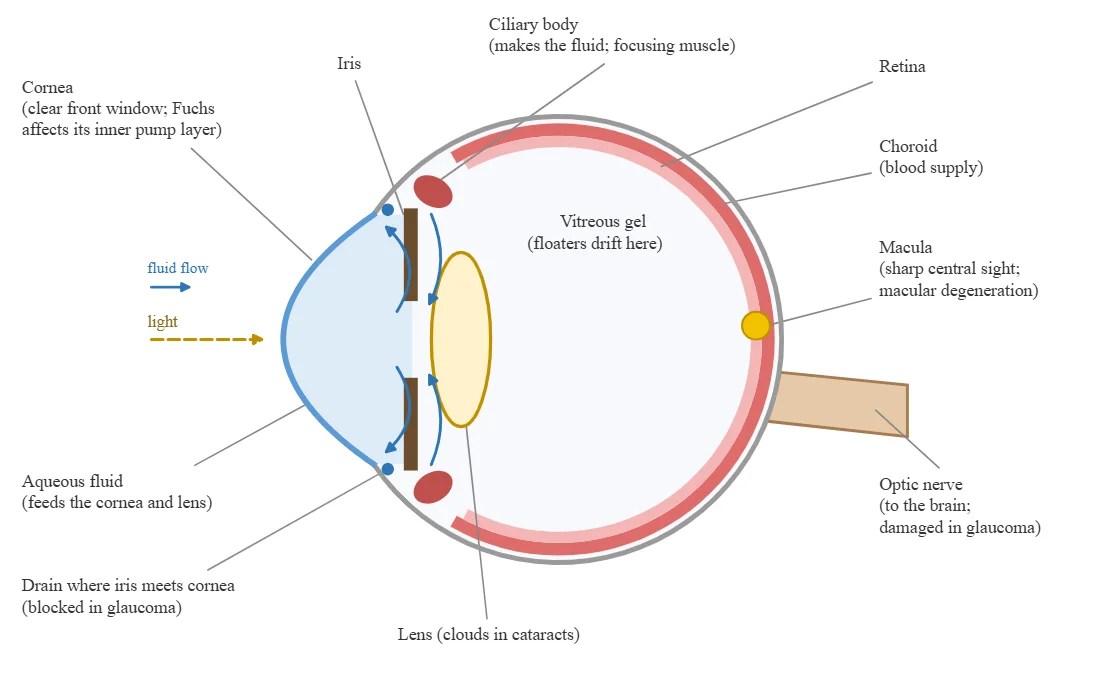
Light comes in through the cornea, the clear window at the front of the eye, passes through the pupil and the lens, and lands on the retina, the light-sensing layer at the back. The retina turns light into nerve signals, and the optic nerve carries them to the brain. At the center of the retina is the macula, a spot about the size of a pencil eraser that gives us our sharp, detailed sight.
Some of the most important parts of the eye have no blood vessels at all. The cornea and the lens must stay perfectly clear, so they are fed by a clear, watery fluid (the aqueous fluid) that fills the front of the eye. This fluid is made all the time behind the iris, flows forward through the pupil, and drains out where the iris meets the cornea, carrying waste away with it. The retina is fed from behind by a rich bed of blood vessels, the choroid.
So every part of the eye depends on circulation: nourishment flowing in and waste flowing out. When that flow slows or clogs, waste builds up and tissue starves. That is the story behind every condition on this sheet.
Tired Eyes and Changing Eyesight
Inside the eye, a small ring of muscle changes the shape of the lens so we can focus. Looking up close, it tightens and the eyes turn in toward the nose; looking far away, it relaxes. Hours of close work, reading and screens keep these muscles tight all day, and like any muscle held tight too long, they tire, stiffen and lose their range. That is a large part of why focusing gets harder as the years go by. Muscles that are exercised and fed stay stronger.
Floaters
The large back chamber of the eye is filled with a clear gel, the vitreous. Floaters are small bits of debris drifting in that gel, and their shadows fall on the retina, so we see them as specks, threads or cobwebs that drift when the eye moves. When the eye cannot clear its waste, the specks can build into larger strands, like ropes across the field of vision.
Dry Eyes
Every blink spreads a thin film of tears over the eye: water from the tear glands, mucus to hold it in place, and oil from tiny glands along the edge of the eyelids to keep it from drying out. When the glands are clogged or the film breaks down, the eyes feel gritty, burning and tired, and may water too much as they try to make up for it. Staring at screens cuts our blinking nearly in half, which makes it worse.
Cataracts
The lens is made of tightly packed proteins, arranged so precisely that light passes straight through. The cells at the center of the lens are never replaced, so some of those proteins are as old as we are. Over the years, with waste and wear, the proteins begin to clump together and the lens clouds, like a frosted window. Sight becomes dim and blurred, colors fade, and lights at night grow halos and glare.
There are three main kinds, depending on where the clouding forms:
- Nuclear: the center of the lens slowly hardens and yellows. The most common kind; it usually comes on over years.
- Cortical: cloudy streaks like the spokes of a wheel start at the outer edge of the lens and work inward.
- Posterior subcapsular: forms at the back of the lens, just under the thin capsule that wraps it. This is the fast-growing kind, and it can go from mild to serious in a few months.
Why Some Cataracts Clear and Others Don’t
Most people who flush faithfully see their cataracts dissolve. A few don’t. Dr. Christopher said he could not understand why some did not respond while others had fantastic healings, and I have seen the same results here. No one fully knows why.
What science can tell us is that cataracts are not all one thing. The fast-growing kind at the back of the lens is the one most often linked to long-term steroid use, diabetes, eye injury or inflammation, radiation, strong nearsightedness, smoking and heavy sun exposure. If one of these is behind your cataract, it needs to be dealt with too.
When no physical cause can be found, look at the heart. Hurts that have never healed can show up in the body, sometimes as the very thing that won’t respond to anything else.
My husband was one who did not respond. His story is in Stories from the Work below.
Glaucoma
Glaucoma is a problem of pressure. The aqueous fluid is made all the time, and it must drain out as fast as it is made. In glaucoma, the drain where the iris meets the cornea slows or becomes blocked, the fluid builds up, and the pressure inside the eye rises.
The pressure presses everywhere inside the eye, but the weakest spot is at the back, where the optic nerve leaves the eye. Over time the pressure squeezes the nerve and the tiny blood vessels that feed it. Starved and crushed, the nerve fibers begin to die, and once they are lost they do not come back. Sight lost to glaucoma does not return.
The most common form, open-angle glaucoma, comes on so slowly and quietly that it is called the “silent thief of sight”:
- Early: the pressure is up, but there is no pain and no change you can notice. Only an eye exam finds it.
- Moderate: small blind spots appear at the edges of your side vision. The brain fills in the gaps, so most people still don’t notice.
- Advanced: the side vision closes in until you are looking through a tunnel.
- End stage: the last of the central vision goes, and blindness follows.
Angle-closure glaucoma is different: the iris itself pushes forward and blocks the drain, and it can happen suddenly, with severe eye pain, a red eye, blurred vision with halos around lights, headache, and nausea or vomiting. That is an emergency; sight can be lost within hours. Normal-tension glaucoma damages the optic nerve even though the pressure reads normal, and poor blood flow to the nerve is believed to play a part.
Those most at risk are people over 60, anyone with a parent or sibling who has glaucoma, people of African or Hispanic descent, and those with diabetes, high or very low blood pressure, strong nearsightedness, or long-term steroid use, including steroid eye drops. Because early glaucoma has no symptoms, a pressure check and an exam of the optic nerve are the only way to catch it before sight is lost.
Macular Degeneration
The light-sensing cells of the macula work hard and use a great deal of energy. Each day they shed their worn-out tips, and a layer of cleanup cells just beneath them digests that waste and carries it away. Beneath the cleanup layer is a thin filter, and beneath that the choroid, the bed of blood vessels that brings in oxygen and nourishment and carries waste off into the blood. Everything passes through that filter in both directions.
Over the years, if the waste is not cleared as fast as it is made, it builds up. Yellow deposits of fat and protein, called drusen, collect beneath the cleanup layer, and the filter thickens and clogs. Less nourishment gets in, less waste gets out, and the cells begin to starve. That is the beginning of macular degeneration.
Dry macular degeneration is the most common form, about 8 or 9 of every 10 cases:
- Early: a few small or medium drusen. No symptoms; it is found only on an eye exam.
- Intermediate: many medium drusen or some large ones. Some people notice a slight blur in the center, or need more light to read.
- Advanced: the starved cells die off in patches, and a blurry or dark spot grows in the center of your vision. Faces and print become hard to make out, while the side vision stays.
Wet macular degeneration is the fast and dangerous turn. The starved tissue cries out for blood, and the body answers by growing new vessels up through the filter and under the macula. These new vessels are fragile; they leak fluid and blood that lift and scar the macula, and central sight can be lost within weeks or even days. The first warning is often that straight lines suddenly look wavy or bent.
Macular degeneration rarely causes total blindness, because the side vision remains, but losing the center of your sight takes away reading, driving and seeing the faces of the people you love. The risk rises after 50 and especially after 60. Smoking is the strongest risk you can change, doubling the risk or more; family history, high blood pressure, heart disease, a diet low in greens and much bright sunlight add to it.
Fuchs Dystrophy
The cornea must stay fairly dry to stay clear. When it soaks up too much water, it swells and turns cloudy, like frosted glass. The back of the cornea is lined with a single layer of tiny pump cells whose whole job is to pump water out of the cornea, all day and all night. They work hard and use a great deal of energy, and in adults they do not grow back. When one dies, its neighbors stretch to cover the gap.
In Fuchs dystrophy these pump cells wear out and die faster than they should. Small bumps called guttae form on the back of the cornea, and fewer and fewer pumps are left to do the work. When too few remain, water builds up, the cornea swells, and vision clouds. It usually affects both eyes and moves slowly, over 20 to 30 years; many people never get past the early stages.
- Early: a few bumps on the back of the cornea. No symptoms; found at a routine eye exam.
- Middle: the pumps fall behind. Vision is blurry on waking and clears as the day goes on, because the eyes are closed all night and the cornea can’t dry out. Glare and halos around lights at night.
- Later: the swelling stays all day. Small blisters can form on the front surface of the cornea; when they break, they are painful and feel like something is in the eye.
- Advanced: the cornea becomes hazy and scarred, and sight is seriously lost.
Fuchs often runs in families, and women are affected two to three times as often as men, especially after menopause. Symptoms usually begin in the 50s or 60s. Smoking, diabetes and heavy sun exposure add to the wear on the pump cells.
Get to the ER Right Away
If you have any of these signs, get emergency care now, and keep your herbal work going alongside it:
- Sudden loss of vision
- A curtain or shadow across your sight, or a sudden shower of floaters or flashes of light
- Straight lines suddenly looking wavy or bent
- Sudden severe eye pain with halos around lights, a red eye, headache or nausea
See the Infection: Ears, Sinuses & Eyes sheet for the warning signs of an eye infection.
The Emotional Side: the Energy Work
Healing the whole person. We are body, mind and spirit, and all three must heal together.
Louise Hay, in her book Heal Your Body, describes these patterns:
- Eyes: represent the capacity to see clearly, past, present and future. Turn it around: I see with love and joy.
- Eye problems: not liking what you see in your own life. Turn it around: I now create a life I love to look at.
- Cataracts: inability to see ahead with joy; a dark future. Turn it around: Life is eternal and filled with joy.
- Glaucoma: stony unforgiveness; pressure from longstanding hurts; overwhelmed by it all. Turn it around: I see with love and tenderness.
- Dry eye: angry eyes; refusing to see with love; would rather die than forgive; being spiteful. Turn it around: I willingly forgive. I breathe life into my vision and see with compassion and understanding.
- Nearsighted: fear of the future. Turn it around: I accept Divine guidance and am always safe.
- Farsighted: fear of the present. Turn it around: I am safe in the here and now. I see that clearly.
- Astigmatism: “I” trouble; fear of really seeing the self. Turn it around: I am now willing to see my own beauty and magnificence.
- Crossed eyes: not wanting to see what’s out there; crossed purposes. Turn it around: It is safe for me to see. I am at peace.
- Wall eyes: fear of looking at the present, right here. Turn it around: I love and approve of myself right now.
- Eye problems in children: not wanting to see what is going on in the family. Turn it around: Harmony and joy and beauty and safety now surround this child.
Emotional patterns paraphrased from Louise Hay, Heal Your Body (Hay House). These are not faults to blame anyone for; they are places to look and let go.
Areas Affected & Opening the Way to Healing
The eyes are fed by the blood, so the eyes are only as clean as the body behind them. Keep the bowels moving with LBF, and keep the liver and kidneys clearing, so the waste the eyes let go of has a way out of the body. Then work on the eyes themselves.
When It Stops Working, Flush the Liver
My rule of thumb: when what should work doesn’t work, or what was working stops working, it is time to flush the liver. The vacuum bag is full.
The eyes are such tiny vessels. The liver really needs help in every way to get the waste out and the good stuff in. If you have been flushing your eyes faithfully and nothing is changing, don’t give up on the eyes; clear the liver. See Cleansing the Liver and Gallbladder for the liver flush and the ELF.
The Eyebright Flush
The Eyebright flush is the heart of this sheet. The small amount of African bird pepper in the formula draws the eye’s circulation in and then lets it recede, carrying waste out with it, while the other herbs soothe, tone and cleanse.
- Set up both eyecups first, and have a cold, wet washcloth ready, wrung out from a small bowl of ice water.
- Add 1 to 3 drops of Eyebright to the eyecup, then pour room-temperature distilled water on top, so the drops mix in.
- Always flush both eyes, even if only one is troubled, and alternate which eye you start with. Fit the cup over the eye, tip your head back and open the eye into the wash. If the eye wants to shut the first time, that is normal; rest the cold cloth over it and try again.
- Expect a minute or two of sensation, more the more irritated the eye is. That is the circulation flooding in and receding. Once it settles, the eye feels noticeably better.
- How often: floaters and tired eyes often clear in one flush. For cataracts and macular degeneration, flush at least twice a day, faithfully.
- Eyebright by mouth: Dr. Christopher also had people drink the formula: ½ teaspoon (two dropperfuls) in a cup of hot distilled water, morning and evening, along with the flush.
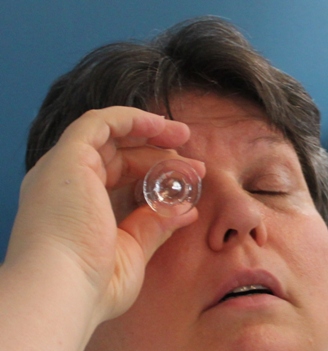
See An Herbal Eyewash for Tired, Irritated Eyes for full directions, and my video of the flush at daradietz.me.
Hot and Cold over the Eyes
Hot and cold water over the eyes pumps circulation in and out of them, and it helps every condition on this sheet. In the shower, hold a washcloth over your closed eyes so the force of the spray doesn’t hurt the tender tissue on and around the eye. Use one washcloth for the hot water and one for the cold, and go back and forth.
Hot and Cold: Keep It Gentle
- Comfortably hot, never scalding. The skin of the eyelids is the thinnest on the body.
- Keep the eyes closed, and don’t press on the eyeball itself, especially with glaucoma.
- Not right after eye surgery. Wait until your surgeon says water near the eye is fine, usually a couple of weeks.
- Use a clean washcloth each time.
The Eye Exerciser: Lifting Weights with Your Eyes
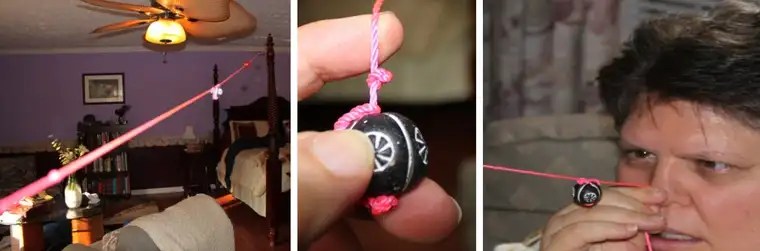
My father, a doctor of biochemistry, used this string exercise in his practice when I was a teenager. There was always one hanging somewhere in his home, tied to a ceiling fan or a curtain rod. He read his novels without glasses into his late 80s. Eye doctors use a similar tool, called a Brock string, to train the eyes to work together.
Making it. Use about 10 feet of string; twine is great. Tie on or press in place 4 or 5 beads, buttons or other small objects, about 18 inches apart. Tie the far end to a ceiling fan, a bed post, or the top of a curtain rod next to your favorite chair, anywhere it can hang out of sight and be easy to use.
Using it.
- Hold the end of the string, with the first bead, right at your nose, or as close as you can get and still focus on it.
- Focus on that first bead. Make it as clear as you can and hold for a few seconds. The string behind it will split into a V: that is both eyes working together. If one side of the V fades, that eye isn’t doing its share.
- Jump your focus out to the third or fourth bead, letting the eye muscles relax there.
- Jump back to the first bead and hold it clear again.
- Then go out to the farthest bead, and play back and forth between the distances, focusing for a few moments on each, always coming back to the bead by your nose.
- How often: at least once a day, and sometimes more.
Up close, the muscles in the eyes tighten; at a distance they relax. Moving between them is lifting weights with your eyes. No string handy? Use two pens, one at your nose and one at arm’s length, with something across the room as the third point.
Feeding the Eyes
- Dark leafy greens. The macula has its own yellow pigment, made from lutein and zeaxanthin. The body cannot make these; they come only from food, especially kale, spinach and collards, along with egg yolks, corn and orange peppers. This pigment acts like built-in sunglasses, filtering harsh light and protecting the cells.
- Carrot juice. For poor eyesight, Dr. Christopher had people clean the bowels and drink a quart or more of freshly made carrot juice a day, six days a week. His story of the young pilot is below.
- Rest the eyes. Look up from close work and screens often, and look into the distance.
Cataracts
Flush faithfully, at least twice a day. It can take a few months of flushing to completely clear the buildup that is a cataract, and for many the results are lasting.
When the Flush Isn’t Working
Give it three months of faithful flushing, then have your eyes checked again. There should be progress. If there is none, schedule surgery. A cataract left on the lens too long can damage the eye.
Glaucoma
I have not personally supported a glaucoma case, so what follows is Dr. Christopher’s teaching. Glaucoma is a problem of pressure. Treating the eyes alone would be a foolish, inexperienced step. Something like this needs the whole body supported: the full flushing programs and liver cleansing, along with the Eyebright flush.
Understanding how glaucoma progresses, I can see how the Eyebright would be helpful. It supports circulation in and out of the eye and keeps the eye clean of debris, supporting all the small pumps and drains so they keep working well.
Keep having your eye pressure checked while you do the work. Early glaucoma has no symptoms, and only a pressure check will tell you how you are doing.
Macular Degeneration
I have worked with macular degeneration, and the Eyebright is very helpful. I have yet to see it fail to clear this issue. Flush at least twice a day, eat your greens, and support the whole body. If straight lines suddenly look wavy, see the eye doctor right away; that is the warning of the wet kind.
If you have been flushing for a few months without results, it is time to flush the liver (see When It Stops Working, Flush the Liver, above).
Fuchs Dystrophy
- While the surface of the eye is whole, in the early and middle stages, the Eyebright flush supports circulation in and out of the eye as it does for any other eye condition.
- If blisters form. If the eye becomes painful, feels like something is in it, or you are told blisters have formed, stop flushing that eye until it heals, and see your eye doctor.
- Infection Salve for the blisters. Apply it over the closed lid, a little back from the lash line, never in the eye itself. Cover with a gauze pad and an eye patch. It speeds the healing of the blisters and helps clear any infection.
- Watch for infection. A broken blister that becomes infected can turn into an ulcer on the cornea, which can scar quickly. If the eye grows redder, has discharge, becomes more painful, or can’t stand light, see the eye doctor the same day, and keep the salve going alongside.
- Before any eye surgery, including cataract surgery, tell your surgeon you have Fuchs, so they can protect the pump cells.
Use distilled water for all teas and eye washes, and when taking your extracts in hot water.
Level of Commitment
- Gentle support. Tired eyes, floaters, dry eyes and changing eyesight: the Eyebright flush as needed, the eye exerciser daily, and hot and cold over the eyes.
- Focused cleansing. Cataracts and dry macular degeneration: the flush at least twice a day, the exerciser and hot and cold, greens and carrot juice, with liver flushing and kidney flushing so the body stays on top of the waste the eyes let go of. Have your eyes checked after three months. If the eyes aren’t responding, flush the liver.
- Incurables Program. Glaucoma, wet macular degeneration and advanced Fuchs: the whole-body work of the Incurables Program alongside the eye work, with your eye doctor keeping watch on the pressure and the retina.
A Loose Healing Plan
- Start the flush: Eyebright in both eyes, once for tired eyes or floaters, at least twice a day for cataracts or macular degeneration, with Eyebright in hot water morning and evening.
- Every day: the eye exerciser at least once, and hot and cold over the closed eyes in the shower.
- Feed the eyes: dark leafy greens every day, and fresh carrot juice.
- Clear the body: keep the bowels moving with LBF, and add liver and kidney flushing for cataracts, glaucoma and macular degeneration.
- Not moving? when what should work doesn’t, or what was working stops, flush the liver.
- Look at the heart: the energy work above, especially when nothing else seems to move.
- Check in: for cataracts, have your eyes checked after three months; for glaucoma, keep your pressure checks; for any of the emergency signs, go now.
Stories from the Work
Dara’s Story: Back to the Daily Flush
For about two years I had been waking up with blurred vision and a gritty feeling in my eyes. I get up in the dark, and I could not bring the clock into focus until I rubbed my eyes awake. When a friend came asking about Fuchs dystrophy, I decided to start using the flushes again seriously. The morning blur is gone, and the gritty feeling has ended. I just have to remember to keep up the daily flush, because it is obvious I am benefiting from it.
Dara’s Story: Floaters in My Glass of Water
Floaters have always been an issue for me. When I find myself trying to pick floaters out of my glass of water, I know it is time to flush my eyes. I’ve been told floaters can become so big that they are like ropes in the field of vision; for me it has always been specks floating around. The Eyebright flush normally clears them in one application. Quick, easy and very refreshing to tired eyes.
Dara’s Story: Allergy Eyes in the Humid South
Since moving to the wet, humid South from the dry climate of Southern California in 1996, I began to experience itching and burning in my eyes during the spring and summer months. Allergy eyes from the high pollen, added to the eye strain from long hours working in front of a computer screen, would leave my eyes feeling like sandpaper. Flushing my eyes using the eyecup with the Eyebright drops mixed in distilled water completely cleared the watery, gritty and tired feeling after a long day of overuse.
A Story From the Work: “But I Don’t Want to Go Blind!”
A long-time member couple were caring for the wife’s mother, a lively, dramatic lady who was always entertaining. At an eye exam, her doctor found that her dry macular degeneration had turned wet, and told her she would likely go blind in time. “But I don’t want to go blind!” she cried. Her daughter answered, “Then do the eyewash Miss Dara sent.” She began flushing every day, at least twice a day. At her next visit, the wet macular degeneration had reversed and the dry was greatly improved.
Dara’s Story: My Husband’s Cataracts
My husband was one who had to have his cataracts removed. His were fast growing and under the lens. He used the flush faithfully for a year or more with only slight results. It was obvious he was falling into the group Dr. Christopher talked about: the few who do not respond to the eyewash. He had surgery on both eyes at the end of 2025. Most people who flush dissolve their cataracts, but for the few who don’t, it needs to be taken care of.
Dara’s Story: Two Pens Before Bible Study
I use two pens in the morning before I start on my Bible study: one on my nose and the other at arm’s length, with the chair across the table as my third focus point. I’ve had mornings when I had a hard time focusing even with my reading glasses on. After stretching out my eye muscles, I was able to focus fine. It isn’t as good as the string, but it works.
From Dr. Christopher’s Files
These stories come from Dr. John R. Christopher’s books and newsletters, used with his original eyewash formula. They are his, not mine.
Carrot Juice and the Air Force Pilot
A young man wanted to become an Air Force pilot but was turned down because of bad eyesight, though he had passed everything else with high grades. When he asked if he could try again later, he was laughed at and told the condition could not be changed. He persisted and was given a three-month return date. We had him clean his bowels, go on the mucusless diet after the three-day cleanse, and drink one quart or more of freshly made carrot juice each day, six days a week, with nothing but distilled water on the seventh. In three months he returned for another eye examination and was approved with a clean bill of health and good eyesight.
Blind for Ten Years
An elderly, white-haired woman came into Dr. Christopher’s office in Evanston, Wyoming, led by a little child. She had been completely blind for over ten years. He could not promise her anything, but said the eyebright formula had done much good and never any harm. She began the mucusless diet and the eyewash, and kept visiting for adjustments and other therapies. One day she walked into his office without a child or a seeing-eye dog, smiled and said, “Hello, Doctor.” It was the first time she knew what he looked like. She picked up a book from his desk, read the title, opened it and read several verses.
Eighty-Two and a Driver’s License
“I began using Dr. Christopher’s herbal eyewash. In a few weeks I could read fine print without glasses, even though two years ago I had been told I had cataracts in both eyes. I had them tested again in January, and the cataract in my right eye was gone. The doctor OK’d the paper for my driver’s license. I am eighty-two.”
Glasses Off After Forty Years
“On December 23rd, 1978, after using the eyewash since October 10th, five to eight times daily and enjoying it burning and running down my face, I took off my glasses after 40-plus years, never to put them on again. When I looked in the telephone book and realized I could see names and numbers, I started calling friends. They had said that if I was not blind, with a white stick and a lead dog, within four months of starting the eyewash with cayenne, they would consider using it too. Already, five have started.”
Glaucoma Disappears
“I have a friend who had eight major surgeries and lived in constant pain. She went on Dr. Christopher’s three-day cleanse and mucusless diet, and started on herbs to cleanse the colon and the blood, cayenne, and Herbal Eyebright. In about three weeks her pain was gone. She had had glaucoma for 13 years, and her glaucoma medicine was making her ill. Her eye specialist tested her and said there was not even a trace of glaucoma left. He told her, whatever it is, don’t stop it, and took her off her glaucoma medication. She can now watch TV without glasses, which she had never done before.”
Cataracts, Glaucoma and Bad Vision
“I was diagnosed with a fast-growing cataract in my right eye and a build-up of pressure in both eyes causing glaucoma. I started the eyewash and capsules three times a day. Within three days I could see through my new bifocals, which I hadn’t been able to do. Within two weeks I realized I could see much farther with the eye with the cataract, when I could not see with it at all before. All along, small pieces of mucus came out of my eyes many times a day. Before the eyewash, car headlights, taillights and streetlights all had huge, flashing halos around them at night. Now the halos have disappeared.”
Cayenne in the Eye
Dr. Christopher told of a fine student of his who had begun teaching herb classes, and who happened to speak just before him one evening in Arizona. The young man said, “Dr. Christopher has always made me gasp. I’ve seen him drink two or three tablespoons of cayenne in water, and I’d just shudder. But tonight I’m going to do something he may never have done himself.” With that, he reached into a container of cayenne and threw a pinch right into his eye. Dr. Christopher thought he must have gone crazy, though he knew cayenne can never hurt the cell structure, no matter how delicate. The tears ran down the man’s cheek as he kept talking, and when he finished, he opened his eye and invited everyone to look. It sparkled; it was by far the brighter of the two. Dr. Christopher said he never saw the antic performed again, and never dared to try it himself!
Watch
More on the Eyes
- An Herbal Eyewash for Tired, Irritated Eyes
- Infection: Ears, Sinuses & Eyes
- Cleansing the Liver and Gallbladder, and Clearing Parasites
This information is for education only. It is not meant to diagnose, treat or replace care from a qualified health professional.


