This sheet is part of the cancer series. The Cancer sheet explains what allows cancer to form anywhere in the body and lays out the full Incurables Program. This sheet covers what is particular to the skin. Lumps under the skin, moles and other look-alikes are on the Tumors & Lumps sheet.
Understanding the Condition
How the Healthy Skin Works
The skin is the largest organ of the body. It has three layers. The epidermis is the thin outer layer we see. Its surface is made of flat cells called squamous cells, which are always wearing away and being replaced. At the bottom of the epidermis sits a row of basal cells, which divide all day long to make the new cells that move up to the surface. Scattered among the basal cells are the melanocytes, the pigment cells. They make melanin, the brown color of the skin, and when the sun touches the skin they make more of it. A tan is the skin’s own sun shade.
Under the epidermis is the dermis, a thicker layer full of blood vessels, lymph vessels, nerves, hair roots, oil glands and sweat glands. The blood feeds the skin from below and the lymph carries its waste away. Below that is a cushion of fat.
The skin is also one of the body’s channels of elimination. Through the sweat glands it carries waste out every day, which is why it has been called the third kidney. The liver is the vacuum cleaner of the body. When the liver and bowel are backed up, the body pushes more of its waste out through the skin, and the skin shows it: rashes, boils, acne, eczema. Skin cancer grows in this same skin.
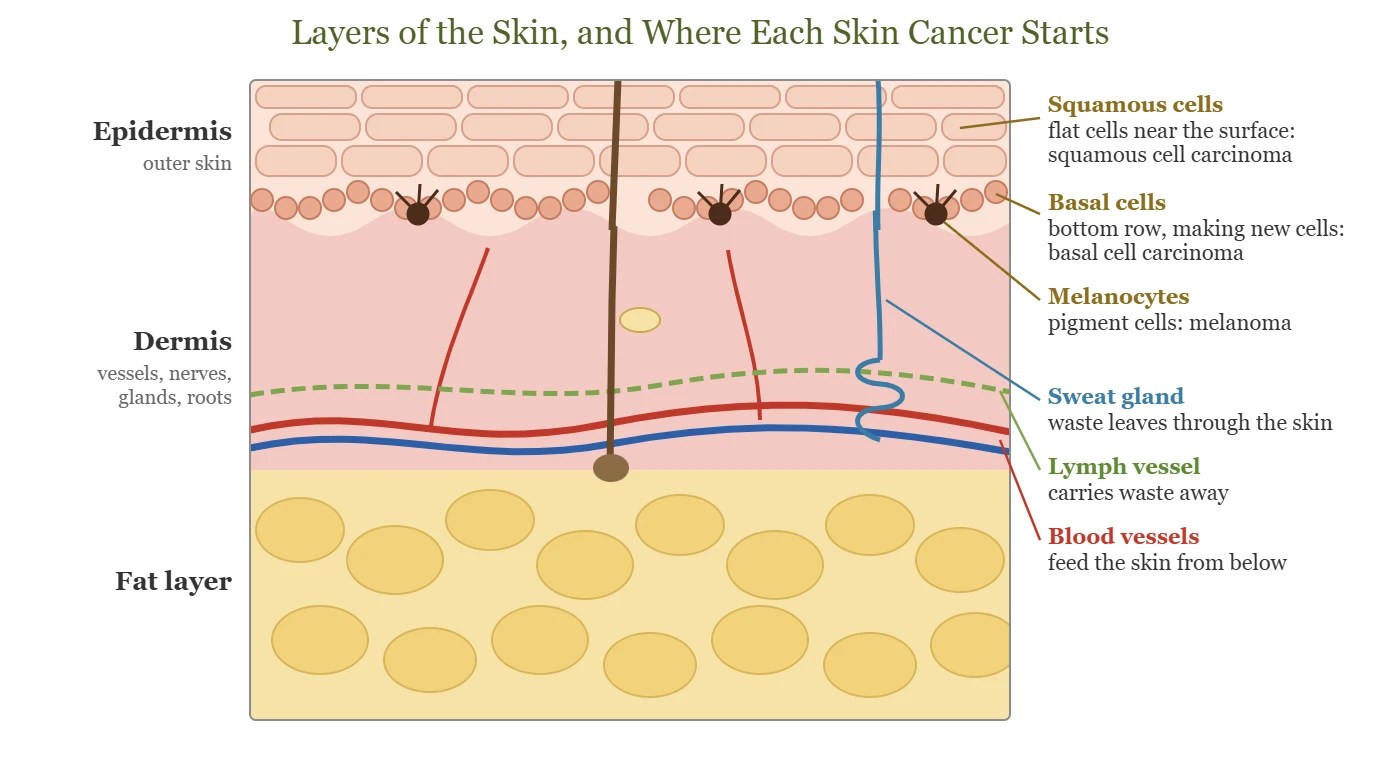
The layers of the skin. Each of the three main skin cancers starts in a different kind of cell in the epidermis. Simplified diagram drawn for H.E.A.L.
How Skin Cancer Forms
Skin cancer follows the same road down that the Cancer sheet describes: years of waste coming in faster than the bowel, liver, kidneys and lymph can carry it out, until the tissue is starved, congested and no longer able to keep its designed structure. The skin cells at the bottom of the epidermis divide constantly, and when they are damaged and poorly fed, they can begin to grow out of order.
Dr. Christopher taught that skin cancer starts on the inside. In his words, “it is the putrid condition of the body that is poisoning the tonsil, or the skin!” He did not believe the sun creates cancer. He taught that the sun can “ripen and bring the cancer that is already there to the surface, wherein the waste matter can slough off, so that the body may heal.” He pointed to tribal peoples who lived in the sun year round with very little cancer until they began eating “civilized” food.
What science has found. Ultraviolet light from the sun and tanning beds can damage the inner workings (the DNA) of skin cells, and repeated burning is linked to skin cancer (World Health Organization). But the kind of sun matters. A review of 57 studies found that sunburns roughly doubled the risk of melanoma and short, intense bursts of sun on unprepared skin raised it, while steady, regular sun, such as outdoor work, did not raise it (Gandini and others, European Journal of Cancer, 2005). And food matters. In a two-year study of people who had already had skin cancer, those who cut their fat intake to 20 percent of calories grew about one-third as many new precancerous spots as those who ate their usual diet (Black and others, New England Journal of Medicine, 1994).
Other things that raise the risk: fair skin that burns easily, many moles, a family history, older age, a weakened immune system (for example, from anti-rejection drugs after a transplant), arsenic and other chemical exposures, smoking (especially for cancers of the lip), old scars and wounds that never fully healed, and tanning beds. Melanoma can also appear where the sun rarely reaches, such as the soles of the feet, the palms, under the nails and inside the mouth (American Cancer Society). The sun is not the whole story.
The Three Main Kinds
- Basal cell carcinoma is by far the most common: about 8 out of 10 skin cancers (American Cancer Society). It starts in the basal cells and usually shows up on the face, nose, ears, neck, scalp and other places that get a lot of sun. It often looks like a pearly or waxy bump, sometimes with tiny blood vessels on the surface, or a flat, pink, scaly patch. It may bleed, crust over, seem to heal and then come back. It grows slowly and almost never spreads to other parts of the body, but if it is left alone for years it can dig deep and destroy the tissue around it.
- Squamous cell carcinoma is the second most common. It starts in the flat cells near the surface and often looks like a rough, scaly red patch, a firm bump, a wart-like growth or an open sore that will not heal. It favors the face, ears, lips, scalp and backs of the hands. It is more likely than basal cell to grow deep and, now and then, to spread, so it deserves more attention.
- Melanoma starts in the pigment cells. It is much less common, but it is the most serious, because it can spread through the lymph and blood to other organs, sometimes quickly. It can start in an existing mole or as a new dark spot. Most melanomas are brown or black, but some are pink, red or skin colored.
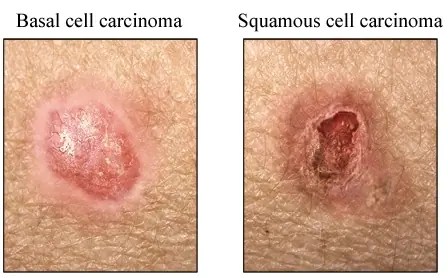
Left, basal cell carcinoma: a pink, pearly, raised spot. Right, squamous cell carcinoma: a rough, crusted sore. Photos: National Cancer Institute (public domain).
Know a Melanoma: ABCDE
Most moles are harmless. A normal mole is usually small, round or oval, with a smooth, even edge and one even color. The signs that a mole or dark spot may be a melanoma are easy to remember:
- A, Asymmetry. One half does not match the other half.
- B, Border. The edges are ragged, notched or blurred.
- C, Color. The color is not the same all over: shades of brown or black, sometimes with patches of pink, red, white or blue.
- D, Diameter. It is larger than ¼ inch (6 mm), about the size of a pencil eraser, though melanomas can be smaller.
- E, Evolving. It is changing in size, shape or color, or it begins to itch, crust or bleed.
Watch also for the “ugly duckling,” a spot that looks different from all the other moles on your body.
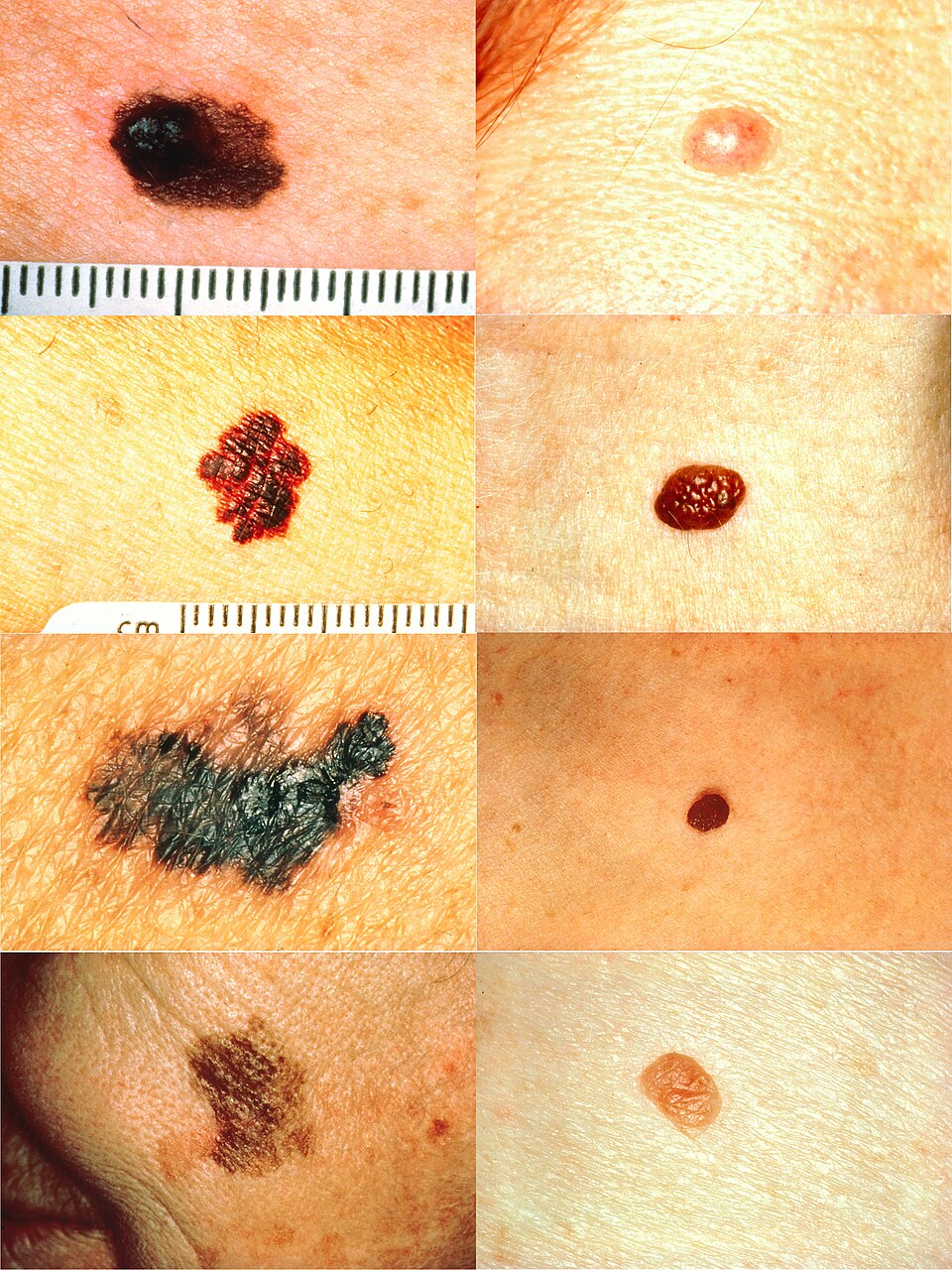
A melanoma (left) beside a normal mole (right) for each sign, from top: Asymmetry, Border, Color, Diameter. Photos: National Cancer Institute, NCI Visuals Online (public domain), via Wikimedia Commons.
Before Cancer: Rough Spots (Actinic Keratosis)
Many skin cancers announce themselves years ahead. Actinic keratoses are small, rough, dry patches that feel like sandpaper, often easier to feel than to see. They may be pink, red, tan or skin colored, and they come and go on the face, ears, scalp, lips and backs of the hands. They are not cancer, but some of them, left alone, go on to become squamous cell carcinoma. This is the easiest stage to turn around, and it is the body telling you it is time to clean house. It is also the stage the low-fat diet study above was measuring.
Spots That Are Not Cancer
Not every spot is something to fear. Moles are small clusters of pigment cells, and almost all are harmless. Seborrheic keratoses are waxy, brown, “stuck-on” looking growths that come with age; they are harmless. Skin tags are small, soft flaps of skin on a thin stalk, often on the neck, under the arms or around the eyes. Warts are rough growths caused by a virus. Cherry spots (cherry angiomas) are tiny, bright red dots of blood vessels. See the Tumors & Lumps sheet for what to do with these. Any spot that is changing, bleeding or not healing should be looked at more closely.
Watch Your Skin, and Know When to Have a Spot Checked
Check your skin once a month, front and back, using a mirror for the back and scalp. Take a dated photo of any spot you are watching, with a ruler beside it, so you can see real changes instead of guessing.
A spot deserves a closer look if it follows the ABCDE signs above; if it is new and growing; if it is a sore that does not heal within about a month; if it bleeds without being hurt; or if it keeps coming back in the same place. Those of you who use a doctor will want to have it checked.
Melanoma is the one to take most seriously. It can spread quickly through the lymph. If you go straight to the poultice, work closely with someone experienced and keep your weekly photos. If a dark spot keeps growing while you are on the program, if new dark spots appear around it, or if a gland near it (in the neck, under the arm or in the groin) swells and stays swollen, have it seen right away. Herbs and cleansing are support alongside medical care, not a replacement for it.
Imaging and a biopsy are the only ways to know for certain what a spot is. My caution about biopsy is on the Tumors & Lumps sheet; weigh what you will gain from knowing.
The Emotional Side: the Energy Work
Healing the whole person. We are body, mind and spirit, and all three must heal together. When one part is neglected, the other two cannot find complete healing.
The skin is the boundary between ourselves and the world. It is how we are seen, and it is the first thing that feels what comes at us. When we are carrying fear, anxiety or old hurts we have never dealt with, the skin is often where it shows.
Louise Hay, in her book Heal Your Body, describes these patterns:
- Skin: “Protects our individuality. A sense organ.” Turn it around: “I feel safe to be me.”
- Skin problems: “Anxiety, fear. Old, buried guck. I am being threatened.” Turn it around: “I lovingly protect myself with thoughts of joy and peace. The past is forgiven and forgotten. I am free in this moment.”
- Cancer: “Deep hurt. Longstanding resentment. Deep secret or grief eating away at the self. Carrying hatreds. ‘What’s the use?’” Turn it around: “I lovingly forgive and release all of the past. I choose to fill my world with joy. I love and approve of myself.”
Emotional patterns quoted from Louise Hay, Heal Your Body (Hay House). These are not faults to blame anyone for; they are a reminder of how much the heart is carrying.
Areas Affected & Opening the Way to Healing
The spot is where you see it, but it was fed from the inside. The work has two sides. On the inside: open the bowel, clear the liver and blood, and keep the lymph moving, so the waste has somewhere to go. On the outside: draw the spot out with the Black Cancer Poultice, then rebuild the skin. For melanoma, or any skin cancer that is large, deep or spreading, first establish the full program on the Cancer sheet.
Opening the Way to Healing
1. Clear the blockage.
2. Get the healing nutrients into the area.
3. Let sunshine and fresh air cycle over and through the affected part.
4. Bathe regularly.
5. Move the area as much as you can.
6. Know which area is truly affected. With skin cancer the spot is on the skin, but the liver is where the trouble is held. The poultice draws the waste out, and the liver has to be free to carry it away.
Clear the Liver and the Blood
- Bowel first. The Lower Bowel Formula (LBF), building up until the bowels move two or three times a day. Castor oil packs over the whole front of the body, with a hot water bottle over the liver, to soften years of backup.
- Liver and kidney flushing. A week of liver flushing followed by a week of kidney flushing. Plan on at least one, and better two, rounds of liver flushing while the poultice is working on a spot. This is the step people skip, and it is the one that decides whether a spot clears for good.
- The Blood Purifying Formula or the Detox Formula during the cleanse weeks, as directed on its formula sheet. Either one supports the liver in clearing the blood and tissues. Chaparral, the backbone of the Blood Purifying Formula, has a long history with skin cancer: Dr. Christopher wrote that it “aids in reducing the size of and eliminating growths and malignant tumors, malignant melanomas… and skin cancers.” See his story of the man with the recurring melanoma below.
- Essiac for diagnosed skin cancer, as on the Cancer sheet.
- Echinacea every day for squamous cell or melanoma, and for anyone on the full program, to keep the immune system strong enough to handle the die-off. If you have an autoimmune condition, talk with Dara before starting. Echinacea can overstimulate an immune system that is already attacking the body. In its place we use astragalus and marshmallow root. This is much slower, and the whole program has to be done in a gentler way so the body can handle the detoxing. Some people are able to use Echinacea later, once their system has healed and cleared; others never can.
Using Chaparral and Comfrey With Care
Chaparral is one of the herbs in the Blood Purifying Formula. It has long been regarded as one of the strongest blood purifiers in herbal use and has had years of bad press, but used wisely it supports the body in clearing what has built up. Stay at the dose on the formula sheet. Avoid it with existing liver disease. If the skin or the whites of the eyes turn yellow, the urine turns dark, or there is pain under the right ribs, stop and have the liver checked.
Comfrey root is one of the nine herbs in BF&C, where it feeds and rebuilds tissue as part of a traditional blend. Take the extract at 1 teaspoon three times a day. Use the salve as an overnight pack, and leave the area open and clear of salves for at least 6 hours each day. More is not faster.
Working on the Spot: The Black Cancer Poultice
The Black Cancer Poultice is my first choice for skin cancer. It is a dry mix of red clover blossoms, powdered poke root, slippery elm, bentonite clay, goldenseal and activated charcoal, blended into a paste with apple cider vinegar, bloodroot, tea tree oil and garlic. In my experience it does not harm the healthy skin around the spot. Garlic is the big killer in this poultice and one to respect.
- Make the 50/50 solution: 4 oz raw apple cider vinegar and 4 oz distilled water. Add 1 oz bloodroot extract for every 8 oz of 50/50 solution.
- Blend: In a Magic Bullet, pour in 2 oz of the solution first, so the liquid is on the bottom. Add ¼ tsp tea tree oil for every 8 oz of liquid used. Add 1 to 2 Tbsp of the herbal powder mix on top (start small; a skin spot needs only a little), then more solution on top of the powder. Add 3 large garlic cloves for every 16 oz of liquid; adjust it to your preference. Blend until smooth, adding solution until it is a paste.
- Store in a lidded glass jar in the refrigerator for up to one week.
- Apply a thick layer over the spot twice a day and hold it in place with a bandage. It often dries to a hard crust, which can be soaked off in the shower or bath before the next application.
- What to expect. As the poultice works, the spot usually becomes red, angry and tender, and it may open. Sometimes a core or a solid mass comes out of the middle. Then it crusts over and begins to heal from the bottom up. This can take a few weeks for a small spot, and much longer for a larger or older one.
- When the bleeders begin, add cayenne. Dr. Christopher and Dr. Schulze both taught adding cayenne powder right into the poultice mix to help prevent small bleeds: a rounded teaspoon in a regular batch, more for a larger one. If a bleed breaks through, pack it with cayenne powder.
- Don’t stop when it looks better. The poultice works all the way down if you stay with it long enough. Spots come back when people stop as soon as the surface looks healed. I have watched a spot on the back of a hand come and go for years because the poultice was stopped every time it looked better. Keep going past that point.
- Stop if the healthy skin around the spot becomes raw, blistered or very painful, and let it calm before starting again.
Watch How It’s Made: Making a Black Drawing Poultice
See the poultice mixed step by step in our video, Making a Black Drawing Poultice.
Dr. Christopher’s Black Ointment, a drawing salve of chaparral, comfrey, red clover, poke root and other herbs in pine tar and mutton tallow, was used the same way in his day, and his newsletters carry many letters about it clearing skin cancers. We use the Black Cancer Poultice for this work today.
Healing and Rebuilding the Skin
- Healing Salve first, once the poultice work is done, to calm the inflammation.
- Then BF&C (Bone, Flesh & Cartilage) to rebuild the tissue: the extract at 1 teaspoon three times a day, and the BF&C Salve as an overnight pack, leaving the skin open and clear of salves for at least 6 hours each day. Done this way, the skin can fill in and heal over until you cannot see where the spot was.
- A word of warning about BF&C. It has a good chance of reminding you of any and all old injuries that healed poorly. The formula goes through and cleans house beautifully, so an old hurt may ache or act up for a while as it is finally put right. Once you are reminded, you need to support the proper healing process: rest and support that area (a sling for an arm or shoulder, for example) and keep up the BF&C until it has healed correctly.
- For scars and hardened tissue: the three-oil massage. Once the skin has closed, massage the area with castor oil for two days, olive oil the next two days and wheat germ oil the following two days, then rest a day and repeat. Dr. Christopher taught that the castor oil cleanses and draws out toxins, the olive oil feeds and rebuilds the flesh, and the wheat germ oil, rich in vitamin E, heals. Follow it with a short sunbath (see below). He used it for a woman whose three C-section scars were so bad her doctors told her another pregnancy would kill her. Her scar tissue softened and became healthy tissue, and she went on to have more children.
- Potassium foods. Dr. Christopher taught that moles, warts and growths form where the body lacks potassium: fresh vegetables and their juices, and the Potassium Broth on the Tumors & Lumps sheet.
The Sun, Used Wisely
The sun is a true healer, and I find it sad that people have been made afraid of a free source of healing. Dr. Christopher called it “the Great Doctor of all times,” but he warned that it “is like fire, which can either provide gentle warmth or it can burn a city down.” A burn is the opposite of healing. The answer is not to hide from the sun but to build up to it slowly and never burn. Wisdom must be used, or anything, no matter how healing, can become toxic.
Dr. Christopher’s directions, with his three-oil massage, which he taught lets the skin take the sun without burning:
- The three oils. Massage the whole body with castor oil for two days, olive oil the next two days, and wheat germ oil the following two days. Rest one day, then repeat the cycle week after week.
- Right after the oil massage, lie in the sun with as much of the body bare as you can: 2 minutes on the front and 2 minutes on the back the first day. Add 2 minutes front and back each day. Fair skin that has never sunned should start with 1 minute, timed by a clock, and add a minute a day.
- Never at midday. No sunbathing between 11 and 1, when the sun is harshest. The sun feels so good that you will want to stay longer, and that is where the trouble starts.
- Help from inside. Burdock root or burdock seed tea, which works on the lymph and the oil glands, makes the sunbath more beneficial.
- Keep a spot under treatment covered with its poultice and bandage while you sun the rest of the body.
- Some medicines, including some antibiotics and chemotherapy drugs, make the skin burn very easily. Ask your doctor or pharmacist before sunbathing while you take them.
When you will be out longer than your skin is built up for, cover with light clothing, a wide-brimmed hat or shade.
Food, Skin and Bathing
- Eat for clean skin. The full food program is on the Cancer sheet. Cut the fried foods, fatty meats and refined oils; the low-fat diet study above shows how quickly the skin responds. Fresh vegetables, fruit and their juices every day, with carrot juice a favorite.
- Dry skin brushing every day with a natural-bristle brush, toward the heart, to open the pores and move the lymph.
- Hot and cold showers to open the pores and drain the skin. Finish with cold.
- Sweat. A good sweat, from exercise or a hot bath, lets the skin do its work as a channel of elimination.
- Move the lymph. Rebound or walk every day. The lymph has no heart to pump it; it depends heavily on movement and breathing.
Use distilled water for all teas, and when taking your extracts in hot water.
Level of Commitment
- Gentle support. For healthy skin and for anyone with fair skin, many moles or a family history who wants to stay ahead of it: a clean food program, daily juice, seasonal liver cleansing, skin brushing, and sunshine built up slowly so you never burn. Check your skin monthly.
- Focused cleansing. For rough precancerous spots and small basal cell spots: bowel cleansing, a week of liver flushing followed by a week of kidney flushing, the Blood Purifying or Detox Formula during the cleanse week, the Black Cancer Poultice on the spot twice a day, and Healing Salve and BF&C to rebuild. My father’s small spots cleared with this; his large one did not, because his liver was never flushed.
- Incurables Program. For squamous cell carcinoma that is growing, any melanoma, a large or deep spot, a spot that keeps coming back, or any sign of spread. The full program on the Cancer sheet, full time, with the poultice work on this sheet. Plan on six months or longer, and keep going after the skin looks clear.
More Is Not Faster
These doses are set to what the body can clear. Taking more stirs up more than the bowels, liver and kidneys can carry out, and that is when cleansing starts to feel like poisoning. Healing the body requires steady, consistent nutrition and action, not a bigger dose.
People are different, and now and then someone reacts poorly to a particular herb. If that happens, stop it. What I offer here is a guideline. You are the one living in your body, so work with the Holy Spirit and the wisdom the Lord has given you to apply these supports in the best way for your life.
A Loose Healing Plan
- First: know what you are working with. Look closely at the spot, measure it and photograph it. If you use a doctor, have it checked. For melanoma or a large spot, set up the full Cancer sheet program before starting the poultice.
- Week 1: open the bowel. LBF until the bowels move two or three times a day, castor oil packs over the liver and bowel, juices and Superfood every day. For a small spot, start the Black Cancer Poultice twice a day.
- Week 2: liver flushing, with the Blood Purifying or Detox Formula. Week 3: kidney flushing. Repeat the cycle while the poultice is working.
- As the spot opens and drains: keep the poultice going twice a day, add cayenne if it bleeds, and keep the liver clearing. Stay with it past the point where it looks better.
- When the spot has closed: Healing Salve to calm it, then BF&C Salve packs and the extract to rebuild the skin.
- All along: the three-oil massage and the sunbath built up slowly, skin brushing, hot and cold showers, potassium foods, and the heart work.
- Every month: take stock. Check your skin and compare your photos. Keep flushing on schedule.
Stories from the Work
Dara’s Story: The Spot Beside My Husband’s Nose
For years my husband had a small pale bump right beside his nose, just under his eye. Then it began to grow. At first he thought it was a pimple, but it didn’t act like one, and by the time of his cataract surgery it had grown so large that his eye doctor told him he should have it looked at. He never did see a doctor for it. He put the cancer poultice on it himself and stayed with it for quite a while before the lump opened, and the opening was something he had to endure. On October 17, 2025, it broke open and a solid mass came out of the middle. He kept up the poultice as it crusted over, even using a batch that was over a month old, and it kept working. It sealed up and healed over, and today you cannot see where it was. It was never diagnosed, so we will never know for sure what it was. Stay with it until the job is done.
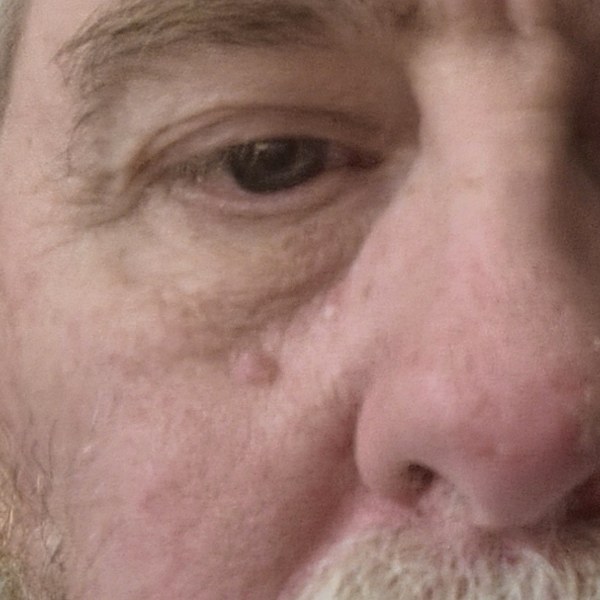
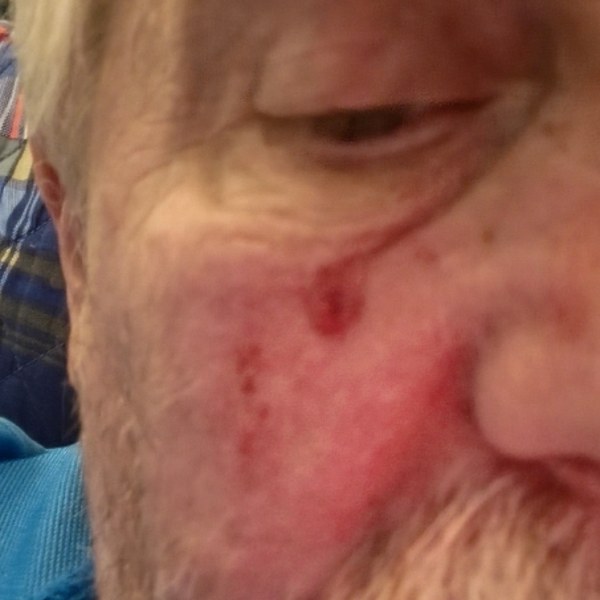
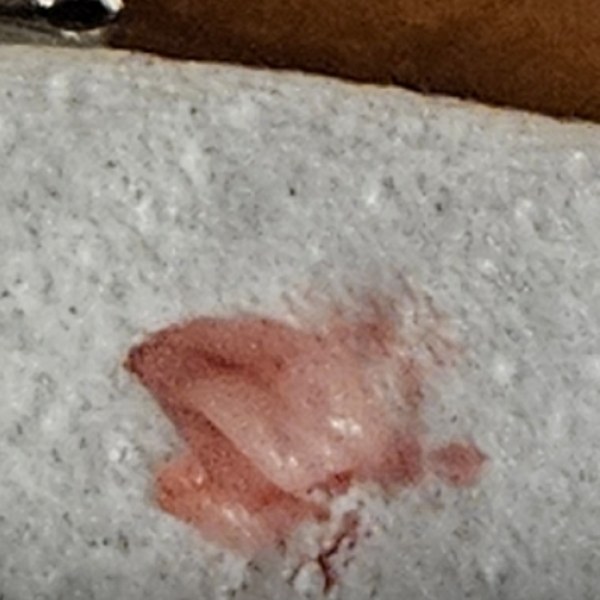
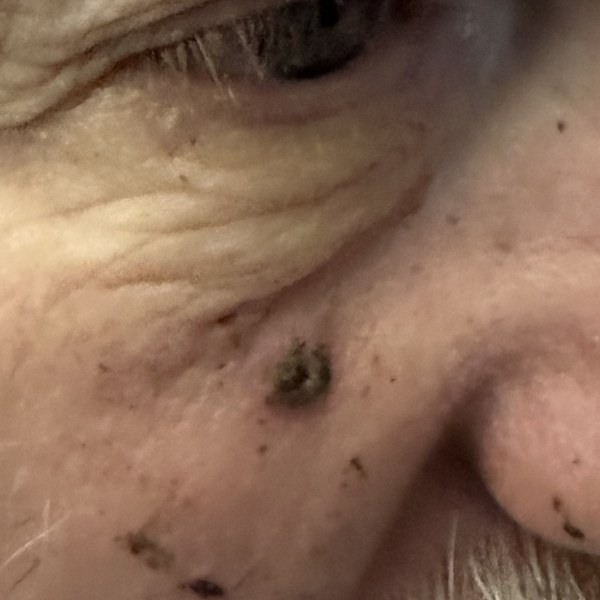
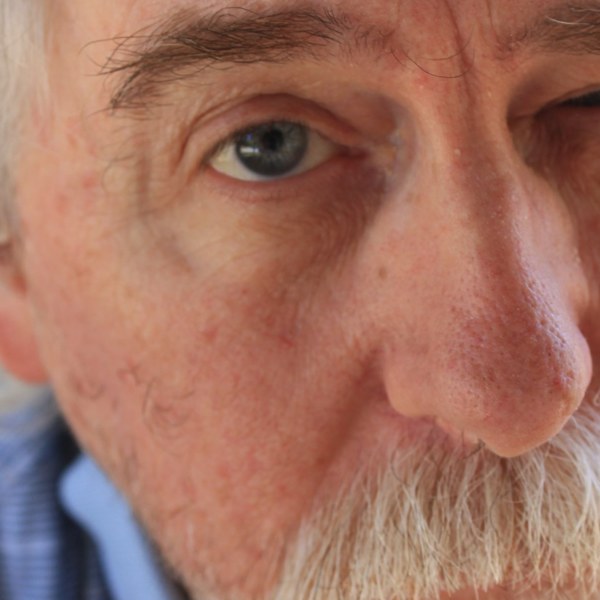
Family photos, used with permission.
Dara’s Story: My Father’s Skin Cancer
My father came to live with us in 2008 with three spots of skin cancer, diagnosed at the VA, where he had already had others cut out. The Black Cancer Poultice cleared the smaller spots in short order, with no harm to the skin around them, even though he wasn’t careful to keep it only on the spots. But he would not do a liver flush. The largest spot, right beside his nose, would not clear. His liver was full and could no longer draw the cancer out, so he went in for surgery to have the rest removed. The poultice draws the waste out, but the liver has to be free to carry it away.
A Member’s Story: Deborah’s Spot
Deborah, a local member, had a spot on the side of her face. Around 2018 she used the Black Cancer Poultice on it several times, and it went away. This past year it came back. She spends a lot of time out in the sun, and she likely did not stay with the poultice long enough the first time to clear it completely.
Her story is a good reminder: keep going past the point where it looks better, and keep the liver clearing, so the spot clears all the way down.
From Dr. Christopher: The Man With the Recurring Melanoma
Dr. Christopher often told of a case reported by doctors at the University of Utah. An 85-year-old man had a malignant melanoma on his right cheek that had been cut out three times, and each time it grew back larger. When it returned a fourth time, with a large tender mass in his jaw and neck, he refused more surgery and went home. On the advice of a friend, he began drinking 2 to 3 cups of chaparral tea every day. Within about three months the growth on his cheek had shrunk to a few millimeters and the mass in his neck was gone, and his weight, color and strength had greatly improved.
Credited to Dr. John R. Christopher’s writings; the case was published by Dr. C. R. Smart and others in Cancer Chemotherapy Reports, 1969.
I have not used chaparral on skin cancer myself; the Black Cancer Poultice does that job well. In my work chaparral goes in through the Blood Purifying Formula, to help the liver clear the blood.
From Dr. Christopher’s Letters
“We have used your Black Ointment with great results. I had skin cancer on my forehead; in six weeks it healed up beautifully.”
A woman whose doctor wanted to refer her to a skin cancer specialist told him it was her body and she would try the herbal remedy first. In six weeks the spot was cleared, and it had not returned two years later. Her husband was then using the ointment on a spot on his nose.
Letters to Dr. John R. Christopher, from his newsletters. His Black Ointment was his drawing salve; we use the Black Cancer Poultice for the same work.
More on Skin Cancer
- Cancer
- Tumors & Lumps: moles, cysts and other lumps
- Breast Cancer
- Essiac: A Four-Herb Cleansing Tea with a Long History
- Knitting Bone, Flesh and Cartilage Back Together
- A Strong Formula for Cleansing the Blood and Lymph
- Eleven Herbs for a Deep Blood Cleanse
- Echinacea: Telling the Immune System to Gear Up
- A Simple Drawing Poultice: Charcoal and Flaxseed
- ELF; Liver Flushing Updates
- How to Do a High Enema
- “INCURABLES” Program: FIRST 30 Days


