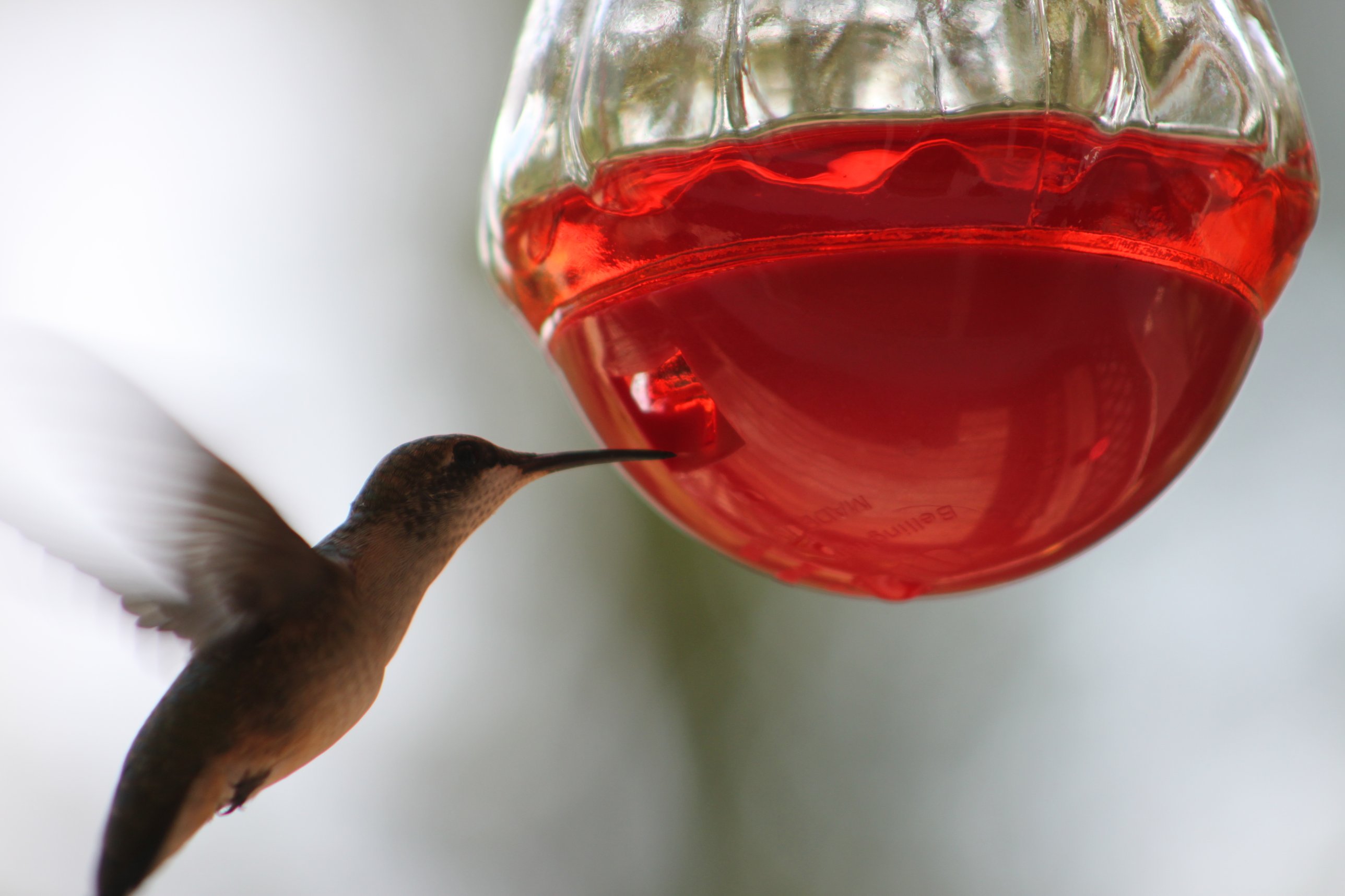
So small, yet she leaves beauty in the world just by being who she is.
“What, after all, is Apollos? And what is Paul? Only servants, through whom you came to believe — as the Lord has assigned to each his task.” (1 Corinthians 3:5, NIV)
Paul answers his own question: only servants. Knox calls them “ministers of the God in whom your faith rests.” The Remedy, by Dr. Tim Jennings of Come and Reason Ministries, puts it beautifully: they are “merely aids of God; conduits of his,” each doing their part in the healing process, as the Lord has assigned.
We each have our talents, gifts and abilities. We are a tool in the hand of the Lord. When we allow the Lord to use us to bless others, we are no more than a guide for those who have not traveled this way before. Someone had to show us the way. Someone allowed the Lord to use them to be our blessing, and now we are passing the blessing on to those we meet each day.
That is all Paul and Apollos ever were. The Corinthians were arguing over the guides and forgetting the One who sent them.
Often we are a blessing without ever being aware of the fragrance we leave in our wake. We rush through our day and still find the Love and Grace to say the kind word, do the quick kind act, astonishing those we pass with our kind generosity.
And I do mean shocking. I have found this effect is more common than one would realize. People are truly astonished when they witness or receive an unconscious act of kindness. The stronger the act, the more dissonance it creates in the mind, and the stronger the opportunity for real change. This is the true science of permanent change: for the mind to accept change, there needs to be a strong push to take note of it and to want it.
They are not used to witnessing such kindness. It leaves an impression. The next time we pass that way, our reception will be more welcoming, and we will have a better opportunity to share with them.
Paul knew that fragrance well. “Thanks be unto God, which always causeth us to triumph in Christ, and maketh manifest the savour of his knowledge by us in every place” (2 Corinthians 2:14). The fragrance is His; we only carry it.
Just walking through our day with the fires of Love and Truth flowing out of us to all we pass is a powerful witness for the healing power of Christ. Keep your eyes, heart and ears open for the little questions and small gestures the Spirit can make you aware of, as you continue to focus outward.
“For when one says, ‘I follow Paul,’ and another, ‘I follow Apollos,’ are you not mere human beings?” (1 Corinthians 3:4, NIV)
The Corinthians had slogans. One group said, “I follow Paul.” Another said, “I follow Apollos.” The Jerusalem Bible asks what could be more unspiritual than that. The Living Bible says it shows “how little you have grown in the Lord.” The Remedy, by Dr. Tim Jennings of Come and Reason Ministries, goes to the heart of it: the spirit of division and competition turns the mind away from Christ.
We are all to be followers of Christ.
That doesn’t mean we walk alone. The mature Christians are to stand as examples to those who have no idea what this life should look like, how we do our daily walk with the Lord. Seeing the Jesus in you will encourage those who are new to the faith to follow your example, the way a small child copies a parent, learning how and why life works as it does.
We are to follow the example of Christ shown us in our mentors and teachers. During our infancy in the faith, we have yet to connect directly with Christ. There is a time when it is healthy for a child to connect completely with the parent or caregiver. This is only for a short while, as the infant learns the ABCs of Love and can begin to express that healthy love to others.
A small child still needs a trusted parent to answer all the “why” questions. After the “why” age, they begin to express their own opinions, forming thoughts, not always correct ones, but they are thinking for themselves, putting facts together as they see them. Their vision is very narrow and concrete, so guidance is still needed. This is the age when many wise parents hand their kids the set of encyclopedias and say, “Look it up for yourself.” In the early teenage years, Christian parents introduce their children to Christ, supporting their growth as needed. By the time their brains mature in their early twenties, they are able to begin deciding the direction of their own lives.
Apply this to the newborn Christian. There will be a period of time when it is spiritually healthy to draw your understanding from your mentor, but the sooner you grow past this stage, the better. A good mentor will work from the beginning to connect you directly with Christ. As maturity comes, the need to draw support from a single mentor lessens as your ability to connect with Christ strengthens. You will find your answers coming from the Source of all Truth, and the fellowship of fellow believers becomes a place to share and grow as a community.
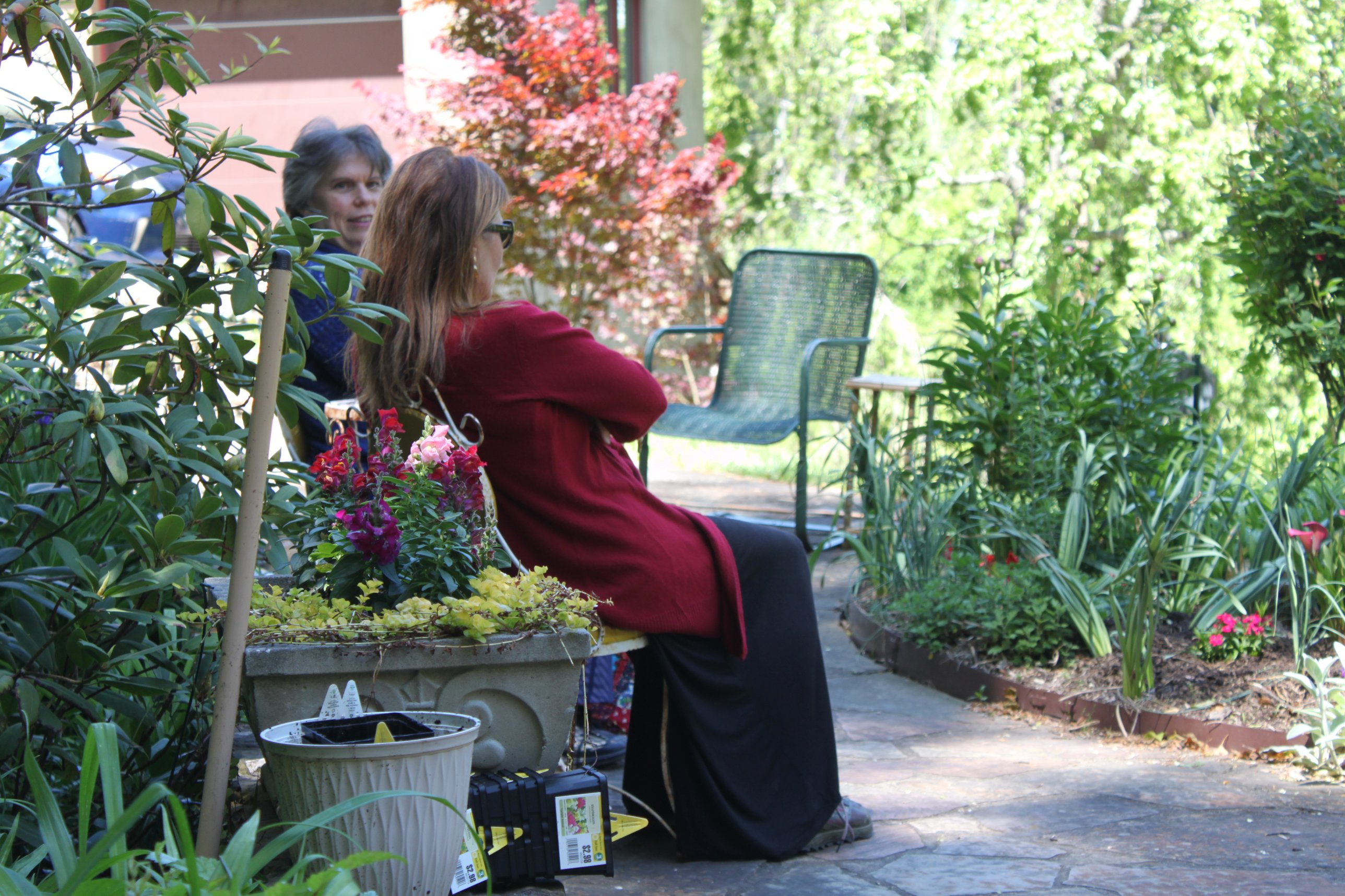
Denise and I catching up on her front-yard bench. She is my mentor in writing, and I am hers in herbs.
That is where Corinth was stuck. They were still clinging to a single teacher, “I follow Paul,” “I follow Apollos,” long after it was time to grow past that stage.
We are to be a sermon in shoes. Our witness is not to be with words but with our actions: love acted out with each choice we make each day.
Saying “I trust in the Lord” is only words. Trusting Him means allowing Him to lead and letting His methods become your way of living: doing the best you can, then leaving the results in His hands. Not in a fearful way, but with confidence, because you have learned by experience that God can be trusted. He has never failed to bring about the best results. We don’t have to see how it will all work out to know that however it turns out, it will be the best.
That kind of trust is what Corinth was missing. When you trust the Lord yourself, you don’t need to rank His servants or line up behind one of them. You follow Christ, and let others see Him in your shoes.
“In the same way, after supper He took the cup, saying, ‘This cup is the new covenant in my blood; do this, whenever you drink it, in remembrance of me.’” (1 Corinthians 11:25, NIV)
The symbolism in this verse has to be understood before the mind and heart of Christ can be seen in it. So try something. Replace the word “blood” with the word “life.” Scripture gives us that right: “the life of the flesh is in the blood” (Leviticus 17:11).
“This cup is the new covenant in my life.”
Read that way, the verse becomes a personal revelation from Christ, given the night before His death, of the gift He was giving and the impact He knew it could have on a life. He is saying: Remember my life. The life I lived to show you who I truly am. The life I freely allowed to be taken by my own creation, so that you and all intelligent beings could see me, see the Love I have always had for you, and see clearly my Father, who in every way shares my heart for you. Do this, and remember me.
Why the Blood
God explained this all the way back in Leviticus. The life of the animal was in the blood, and the blood was never to be eaten (Leviticus 17:10–14). We were not to take in the life of an animal so that it became part of who we are. Whatever you take into your body becomes a part of you.
So when Christ hands His disciples the cup, He is offering them, and us, His life to take in, so that it becomes a part of us. This is absolutely necessary for salvation and healing to happen in a life. The perfect life He lived, He now offers to us as the antidote for the broken humanity we were born with.
We are not guilty from birth; we did not choose to sin. But we were born with a sinful nature passed down from Adam. When he broke faith with God, he damaged his own nature, and that was all he had to pass on to his children. All of humanity has inherited it. We were born not with guilt, but with a lethal condition, one that must be healed or it will destroy us. Christ lived the perfect life and restores to humanity what we could not receive any other way. “We shall be saved by his life” (Romans 5:10).
That is what drinking the cup represents: taking His life into ours. And it is a real healing that must take place in us, by our own choice.
A Promise Kept
As I compared translations this morning, one word stopped me. Goodspeed and Moffatt say the new covenant was “ratified” by His blood; others say “sealed.” About half the translations add a verb like that. But Paul’s Greek has no verb there at all. It simply says, “This cup is the new covenant in my blood.”
The word ratified doesn’t sit well with me. To ratify something is to make it binding, as if God had not fully put His heart behind the plan of salvation until the blood was shed. But God made His promise to Adam right after the fall, before he ever left the garden (Genesis 3:15). What Christ presented at that table was the next step, the final thing that needed to be done so fallen humanity could be restored and all God’s promises kept. It was not ratifying anything. It was finishing what He began.
Even the surrender was settled before the cross. In Gethsemane, Christ prayed, “not as I will, but as thou wilt” (Matthew 26:39), and salvation was won for us there. He could have died right then; He had nothing left to give. But there was still so much that needed to be revealed, so the Father sent an angel to strengthen Him (Luke 22:43). He went on to show the onlooking universe, the angels, and one day all of humanity, when we finally open our eyes, what God is truly like.
The cup is not a contract being signed. It is a promise being kept.
The Weekend That Changed Everything
The birth of a flower. The Last Supper was the birth of a new era.
The Last Supper was pointing to the resurrection. That weekend the battle would be won, and healing and redemption would be completed for humanity. Everything was going to change. Even at the table, Jesus looked past His death: He would not drink the cup again “until that day when I drink it new with you in my Father’s kingdom” (Matthew 26:29).
When He cried out, “It is finished,” all creation shook. Graves were rent open by the earthquake, and after He arose, many of the saints came forth (Matthew 27:51–53). Prophets once murdered for carrying God’s message came out to continue their God-given mandate, now proclaiming a risen Savior in and around Jerusalem. I personally believe John the Baptist was among them. The loving heart of Christ would not have left that faithful friend and servant in the grave.
That weekend, the truth changed from a Savior to come to a Savior has come. Not another animal need be sacrificed. All that death of innocent creatures met its fulfillment at the cross.
What They Could Not Yet Hear
That same evening, the God of all creation knelt and washed His disciples’ feet, an act He did not consider beneath His dignity. I am sure that, in His loving wisdom, He would not have missed the chance for a private word with each man. Yet their quarrel over who was the greatest (Luke 22:24) kept them from hearing understandings that would have spared them a world of grief that weekend. Their hearts were not yet ready to know the true character of the One they had walked with for three and a half years. “I have yet many things to say unto you, but ye cannot bear them now” (John 16:12).
Christ walked alone. No one but His Father understood the depths of humility He would be subjected to by those He came to heal, men who had no idea of the brokenness within their own hearts and minds. But Love saw more. It saw the chance, the hope, of a restored life in all who would choose it. So He gave them the Last Supper, and asked them to remember Him.
Milk and Meat
The flower it bloomed, beautiful and thriving.
This is milk for the newborn in the faith, and meat for the most mature in Christ’s army. What Christ revealed, and what Paul received directly from the Lord (1 Corinthians 11:23), is simple enough for a child to grasp, yet the pool of knowledge here goes deep enough to stretch the deepest minds.
The next time you take the cup, hear it the way He meant it: This is my life. Remember me.
“For since there is jealousy and quarreling among you, are you not worldly? Are you not acting like mere humans?” (1 Corinthians 3:3, NIV)
Paul gives the Corinthians a test they can check for themselves. Spiritual babies don’t show it by what they don’t know. They show it by how they treat each other: jealousy, quarreling, and, as Beck adds, “forming different parties.” The Living Bible asks whether that doesn’t prove they are “still babies, wanting your own way.” The Remedy, by Dr. Tim Jennings of Come and Reason Ministries, calls it “the infection of selfishness,” with people “looking out for yourselves and promoting your own agenda.”
Paul gives us the stages of growth in another letter: “love, joy, peace, patience, kindness, goodness, faithfulness, gentleness and self-control” (Galatians 5:22–23). Love comes first, and that surprised me. How would a new baby know a thing about what love is? But this list is about what we receive and then are able to give. As we grow through the stages Paul gives us, the way we are treated by Christ and by our mentor is mirrored in the way we are then able to treat others.
The bickering and infighting at Corinth belong to stage three: learning to be comfortable with a peaceful environment.
The need to stir the pot, to keep tension and animosity churning, comes from the need to keep people’s focus off yourself and on others. It can grow out of insecurity or a lack of self-confidence: If people really looked at me, they would not like me. I am at fault. Usually what you point out in someone else is a finger pointing back at yourself. We see our own weak points of character mirrored in other people, or we project them onto others. The one doing the stirring or the blaming needs to be looked at the closest. They are normally the ones who need the most help.
So at this level, the work is to deal with yourself and stop projecting your issues on everyone else. Patience and kindness, the next two on the list, fit this healing perfectly.
I learned how to meet that kind of storm years ago, as a worker at the DPSS. I discovered the real way to a peaceful conversation with a fired-up client was to answer the emotion behind the harsh words. This was my gift, and I tended to be given the worst issues to sort out.
The first step, even before approaching the woman, was to remove her from her audience into a nice private booth. I would walk up to my side of the table with a bright smile and let her know I was there to help. Normally she would need a few minutes to vent her frustration. Once she had her uninterrupted say, I would address the emotion coming from her heart: “You’re concerned you will not have anything to feed your children tonight. Let’s see what we can do to help.”
Normally they were blaming anyone except themselves. Since I was required to see monthly bank statements, I had a good idea where the money was actually going. But that was not the issue or my concern. I could have been right about where her money went. I chose to be helpful instead. The issue I was dealing with, in that moment, was getting a screaming woman to calm down and rationally deal with her life.
Kindness listens to the heart, but it does not take the problem off their shoulders. I could hear her fear and still hand her life back into her own hands.
People who refuse to deal with themselves will want to dump their junk on you, throw it in your lap and make it your problem. I have seen this play out in the natural healing world also. People want concrete answers to follow, and no one can give those to another person. You are living in your body; only you know exactly what is going to work best. Refusing to be responsible for your own health means you will not have a healthy body. No one can do it for you.
This also fits our relationship with Christ. No one else can choose our life for us. We must be the ones to decide what we will believe. That was the trouble in Corinth. They wanted Paul or Apollos to be responsible for them, so they quarreled over whose followers they were instead of growing up into Christ themselves.
God gives each of us our own gifts and makes each of us responsible for using them. When we are working on our own lives and our own connection with Christ, we do not have the time or the inclination to look at others with an eye to putting ourselves above them.
Take care. Remember, when you point a finger at someone else, you are pointing three back at yourself. Think carefully about why you feel the need to point out issues in someone else, and find a good mirror to look in. Be honest with yourself. The issue is in you. Deal with yourself.
“I gave you milk, not solid food, for you were not yet ready for it. Indeed, you are still not ready.” (1 Corinthians 3:2, NIV)
Paul fed the Corinthians milk. Phillips says they were “unable to digest meat,” and Knox gives the reason: “nature still lives in you.” The Remedy, by Dr. Tim Jennings of Come and Reason Ministries, calls the milk “the ABC’s of God’s treatment plan.” Then it adds something that stops me: many of them had preferred the elementary teachings. They didn’t just fail to grow. They chose to stay where they were.
Why would anyone choose to stay on milk?
I believe the answer is fear. Living on milk is living on the opinions of others. Milk is digested food from another body. Someone else does your thinking for you, and that feels safe. Your mentor is responsible for having the answers you need. But if you mature past that place, or he moves on, who will tell you how to live and what to do?
People come and go in our lives. Each person you meet has a pearl to give you, something they alone possess. Learn to allow the teachers into your life, accept the gifts they bring, and then allow them to move on so the next teacher will appear. When the student is ready, the teacher will appear. In Corinth they were refusing to let their teachers move on, trying to hang onto them out of fear of having to grow up. A few verses later, they are quarreling over whether they follow Paul or Apollos.
There is a saying I have repeated for years. It has been so long I don’t know if I made it up or borrowed it from someone lost in the mists of time, but it is me:
People want to give their brain to the teacher, their body to the doctor, and their soul to the minister, then sit back and wonder why their life is garbage.
They refuse to take responsibility for anything. This is no way to live. There is freedom in knowing what you know, and in finding the answers as you need them. My father had his PhD in biochemistry. He once told me that intelligence is not about having all the answers, but knowing where to find them. No one can possibly know it all. The intelligent understand that they don’t, and they know where to find the ones who do.
It takes faith in the Lord, and in yourself, to rely on what you have found by trial and error to be truth, and on the Lord’s guidance. Living one step at a time, seeing what works and what won’t, is the maturity that allows you to trust yourself. This is true independence. It comes with wisdom and maturity: knowing who has the answers for any question, and when there is a question that needs to be asked, while trusting that the Lord is guiding our steps.
Growing up does not have to be an awful, scary experience. It is an awesome one. It can be a natural progression up the steep mountain that is our life. Every so often, turn and take a look back down at the view. It is magnificent. This is the view that comes with maturity: the chance to see where you were and what you have become.
The path keeps climbing. Sometimes you are cutting it right out of the untried dirt, so you must tread carefully. But each step brings a bit of wisdom. The step sticks, and taking it teaches you more about the ground you are moving over. The more steps you take, the more wisdom you gain.
But wisdom and maturity will never come if you don’t move your foot forward and take that first step.
Learn to be the milk supply for others, and start becoming you.
So what answer have you been waiting for someone else to chew for you?
“For I received from the Lord what I passed on to you: The Lord Jesus, on the night he was betrayed, took bread, and when he had given thanks, he broke it and said, ‘This is my body, which is for you; do this in remembrance of me.’” (1 Corinthians 11:23–24, NIV)
The first thing that jumps out at me is that Paul learned this from the Lord Himself. Christ met with Paul and spent time teaching him personally. In some ways He had a closer relationship with Paul after the fact than He was able to have with the other disciples, who had so many false expectations. They spent their time arguing about who would be greatest, rather than asking the questions they would need answered after He died and returned to heaven.
Paul spent about three years alone with Christ in the desert, relearning everything he had been taught was truth. He didn’t need as much time as the disciples did. He was ready to understand and be taught, while they were constantly fighting what the truth actually was. With Paul’s personality he didn’t waste time on prideful issues; he cut to the meat and asked all the things the others failed to ask.
Christ once told His disciples, “I have yet many things to say unto you, but ye cannot bear them now.” Their hearts weren’t ready. Christ in Love never runs ahead of us. He gives us exactly what we can handle and leads us no faster than we can go.
A Memorial of a New Beginning
Christ waited until their last night together to give them this new ordinance. It was to be a memorial of a new beginning for all humanity. The gift of God was being completed, and Christ was about to reveal the very heart of God to the entire universe: “And I, if I be lifted up from the earth, will draw all unto Me.”
Most Bibles add the word “men” to that verse, but it isn’t in the original. Christ said simply, “all.” The Cross was not only a message to humanity; it opened the heart of God to every created being, to the whole universe watching.
The heart of God, opened to the whole universe watching.
Everything was about to change over that weekend. The ceremonial system, the way of salvation taught since the fall of Adam, was coming to an end. Present truth is the truth that has the power to set us free and heal our souls. What was saving present truth on Friday, as Christ hung on the Cross, stopped being saving truth when He ripped open His tomb on Sunday morning, coming forth as our risen Savior. Faith in a Savior who was coming gave way to faith in a Savior who had come and conquered. This is the unrolling of the scroll, the moving on of salvation and God’s plan to redeem a lost race.
From the darkness of Friday into the light of Sunday morning.
Set aside all other thoughts, and let it sink in.
The disease of sin had been overcome, conquered and eradicated in the humanity of Christ. Love overcame sin and death, bringing life, health, peace and joy to this earth and to the whole creation of God. The Lord’s Supper is our celebration of that victory. It is our chance to set aside all other thoughts and plans and allow the reality of what Christ achieved to sink in. It is milk for the babies and meat for the mature.
Love in Action
That last evening was full of meaning. Before the bread was ever broken, Christ had shown them how Love acts: He knelt and washed twelve pairs of dirty feet. So when He said, “Do this in remembrance of Me,” it was this He wanted us to remember: not just the broken bread, but the heart that knelt to serve. Remembering Him means remembering His character.
Everything from their last meal together is a lesson to be understood in the light of the resurrection. They all vowed to stand by Him no matter what, not just Peter. He understood them better than they understood themselves. They hadn’t yet embraced who He was or the work He came to do. And that is the lesson for us: the truth will set you free and heal you, but if you don’t understand it or believe it, it cannot do its saving, healing work in you.
One Word That Troubles Me
One translation renders His words, “This is my body which takes your place.” Something is wrong there. Taking our place doesn’t heal us. It doesn’t eradicate the damage sin has caused, so we’d just be saved sinners. I don’t want to be saved in my sins. I want to be saved from them, healed to the place where I no longer want to do them, because the Love and mind of Christ are in me.
Christ healed humanity in Himself and gives that healing to us. To say He only took our place means we receive no real benefit from what He did; we’re simply spared. And sin would still destroy us in the end unless we let Christ heal us. Nearly every other version says simply for you, on your behalf. The Remedy puts it this way: “broken for your healing.”
When you take the bread, what are you remembering: a substitute who took your punishment, or a Healer who gave Himself to make you whole?
“Brothers and sisters, I could not address you as people who live by the Spirit but as people who are still worldly – mere infants in Christ.” (1 Corinthians 3:1, NIV)
Paul has just told the Corinthians the most wonderful thing: “we have the mind of Christ.” And then, in the very next breath, he says he couldn’t talk to them that way. Knox says they were “little children in Christ’s nursery.” The Remedy, by Dr. Tim Jennings of Come and Reason Ministries, calls them “people who are just starting God’s treatment plan, newborn babies in Christ.”
The mind of Christ was theirs for the taking. They simply hadn’t grown into it.
There is nothing wrong with being a baby. Every one of us begins there. The trouble comes when we stay.
We grow through personal experience. We must taste and see that God is good (Psalm 34:8), and experience Him daily for ourselves. God is faithful. It is we who hold onto our old bad habits, so afraid the new life in Christ will lack all that makes life worth living. We refuse to surrender the habits and comforts that are destroying us. We refuse to allow the healing to happen. We are used to how things are, and we don’t want to apply ourselves to change.
As we accept the healing from Christ, and surrender our long-held, comforting habits for better things, our minds become more in tune with the mind of Christ. To have the mind of Christ, we must grow up into mature Christians who can understand the things of God. Paul is explaining that he cannot address the Corinthians as mature Christians. They are not yet able to understand themselves, much less the things needed to care for and nurture someone else.
That last leap of faith must come before maturity can begin. It comes when you decide that, regardless of the cost, this is what you want. You let go of your hold on all the things binding you to this earth and reach up for the hand of Christ, only to find He already has you held firmly and safely in His care.
In 1996, the Lord called me from my steady job to an unknown life across the country. I stepped out on thin air, with no job prospects, just the understanding in my heart and the peace that comes from knowing I was following where the Lord was leading. Since that choice, we have never wanted for anything needful for this life. He has proven to me over and over that thin air is very solid when He is standing in it with you.
The change is wonderful. Life with Christ is the most fulfilling, rewarding, stimulating life one could ever imagine. The reward for healing is beyond anything you can imagine.
So what are you holding onto that you’re afraid to let go?
Morning light on every cloud: one Light, reflected everywhere.
“For, ‘Who has known the mind of the Lord so as to instruct him?’ But we have the mind of Christ.” (1 Corinthians 2:16, NIV)
Paul ends this chapter with a question borrowed from Isaiah 40:13: who has ever known the Lord’s mind well enough to give Him advice? No one. The Corinthians were proud of their wisdom, but none of it could teach God a thing.
Then comes the turn: but we have the mind of Christ.
Lining up the translations side by side, nearly all of them say it plainly. Knox says, “Christ’s mind is ours.” Moffatt says, “our thoughts are Christ’s thoughts.” The Remedy, by Dr. Tim Jennings of Come and Reason Ministries, says that we who have opened our minds to the Holy Spirit “have Christ’s mind reproduced within us!”
One translation stopped me. The Living Bible says we have “a portion” of Christ’s thoughts. Not a portion. It says we have His mind, because we have the Holy Spirit. That reading waters down what Paul is offering.
We are not here to instruct God. We are here to receive Him. Paul began this chapter by setting aside polished human wisdom (2:1–5), and he ends it by saying we have been given something far better: the very mind of the One we follow.
What does that look like in a life? Maturity is becoming Christlike. It means having the mind of Christ so we can do as He would do in every situation we meet. We see others through the eyes of Love, understand their struggles, and allow them their mistakes and weaknesses. His wisdom lives in us. In the verse just before this one, I wrote that the Jesus in me can be seen only by the Jesus in you. This is how that happens: the same mind, living in each of us, recognizing itself.
To have the mind of Christ is to see people as He sees them. It is to have His heart of Love, and even His knee-jerk reactions to life’s painful events. It means we don’t think the worst of someone just because we don’t understand their heart. This is our only safeguard against hurting others and making fools of ourselves.
But having the mind of Christ is a two-edged sword. Our hearts hear the cries of the sin-sick soul needing love and comfort, and that is all good. The other side is that we also see and understand the one who has turned away from the Lord. Our hearts are tuned in to the ones we are with, and we feel deeply the rejection of a soul who refuses the truth that would save him. With the heart of Christ you see more and feel more. Christ felt the rejection of Judas. He knew the pain Peter would have to endure after his denial.
There is a price for the wisdom that sees deeply into a matter. Understanding the soul standing before you does not mean you can make up their mind for them. It only means you can present the truth in the very best way, to encourage them to take a chance on trusting the Lord.
I have paid that price. I remember sitting on the couch, looking at my father while my mother was going off on him, and realizing he had stopped caring. He was gone. I will never forget that day. It was the day I knew my father was going to leave us. I could see it in his eyes. The joy was gone, and only a deadness showed.
There are times you don’t want to know the truth about someone you look up to or care about. Love lets us see through the masks people wear to the real hurting soul inside. Sometimes we are not able to help, and we know it, because we have seen their decision written in their eyes.
And still, because we know we are loved and cared for, we don’t need to think of ourselves first. We can stop self-protecting. Living is thinking of others first, because we know our life is hid with Christ in God (Colossians 3:3). Even when our hearts ache for those we love, nothing can disturb our peace when we have the mind of Christ.
So here is the question I’m left with as Chapter 2 closes: if we truly have His mind, not a portion of it, what would change in how I look at the next person who disappoints me?
This sheet covers eczema, itchy rashes, hives and the other skin troubles that come from the body pushing its waste out through the skin. It also covers cradle cap, and how to support a baby who is too young yet for a liver flush. Poison ivy, skin infections and wounds, and skin cancer each have their own sheets.
Understanding the Condition
How the Healthy Skin Works
The skin is the largest organ of the body, and it is far more than a covering. It is our third lung: through thousands of tiny pores the body breathes in the air around it and lets out waste in the sweat. In health the skin carries only a small, light share of the cleansing work. The heavy work belongs to the liver, which gathers the waste from the blood, and to the bowel and kidneys, which carry it out.
What Goes Wrong
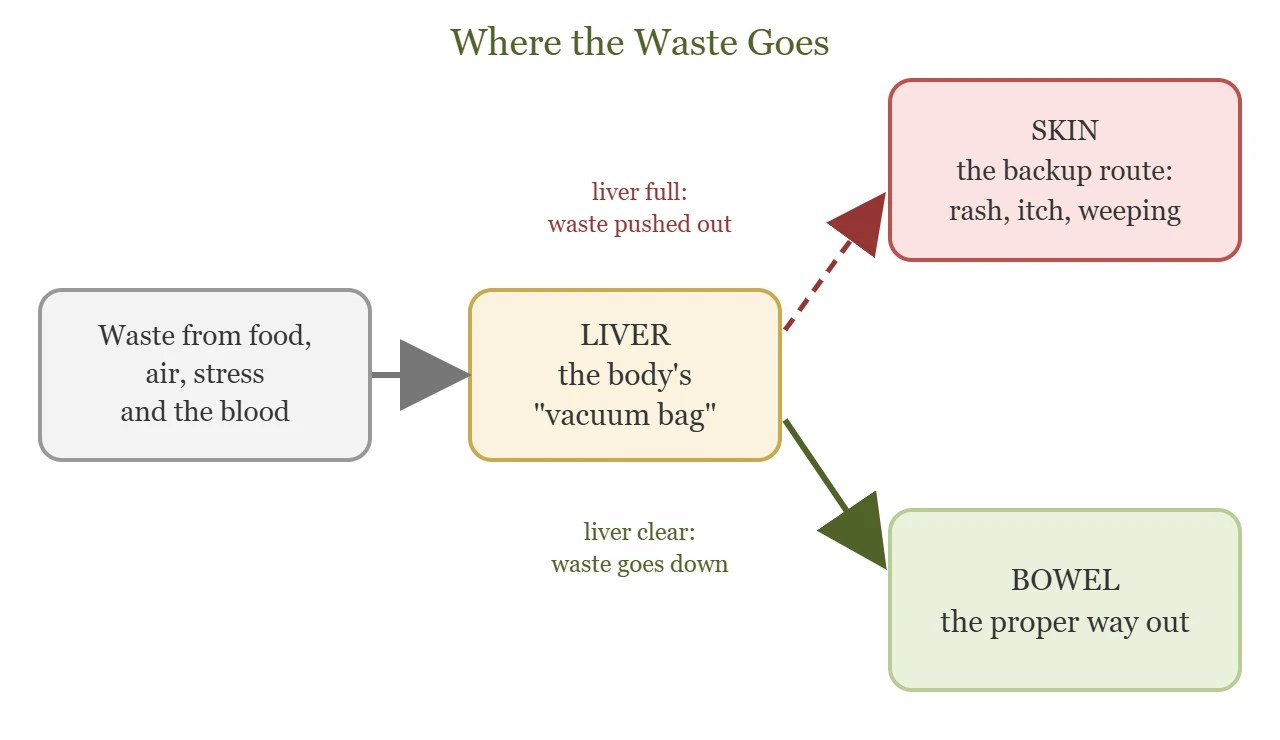
When the liver, the body’s vacuum bag, gets full, and especially when the bowels are not moving well, the waste has to go somewhere. The body begins to detox through the skin. The skin was never built to handle that load of toxic waste, and it breaks down quickly: red patches, tiny pimples that turn to water blisters, weeping, crusting, dry scales and cracks, and an itch that can be almost unbearable. Scratching breaks the skin open and invites infection on top of it.
When the liver is clear, its waste goes down to the bowel. When it is full, the waste is pushed out through the skin. Simplified diagram drawn for H.E.A.L.
Eczema is this pattern settled in: dry, red, itchy, sometimes weeping skin that flares and calms and flares again. It often begins in babies and young children.
Hives are the same push coming on fast: raised, itchy welts after an insect sting, a food the body can’t tolerate, or a load of waste cut loose all at once.
Psoriasis brings thick, silvery scales. The real answer is the same: clear the liver so it stops pushing its waste out through the skin. Then the body clears the skin quickly, and the salves on this sheet can do their work.
What feeds it: a congested bowel; junk and processed foods and heavy, mucus-forming foods, which make the sweat sticky so it dries and clogs the pores; synthetic clothing that doesn’t let the skin breathe; and stress.
The longer it goes on, the harder it is to turn around. A fresh flare can clear in a day or two. But when the skin has been used as the way out for years or decades, the body comes to treat it as normal and begins to protect the problem. It then takes time, repeated liver flushing and cleansing of the whole body to redirect the waste. Any weakness, and the body will want to go back to the skin route.
Cradle Cap or Eczema?
In a baby the two can look alike, but they are not the same thing. Cradle cap shows as greasy, yellowish scales or crust, starting on the scalp. It is linked to a yeast that lives on the skin, and it can travel to the face, behind the ears, into the skin folds and the diaper area (Health New Zealand). Because it is a fungus, Black Walnut is the answer for it. Eczema is dry, red and itchy, without the greasy scales on the scalp; it is liver and skin work. A baby can have both at once.
Know the Signs, and When to Get Help
Get help right away if the skin breaks out in clusters of painful blisters or punched-out sores with a fever, especially in a baby or in someone with eczema. This can be a serious virus infection of the skin.
Skin that weeps yellow, crusts like honey, turns hot and red and spreading, or comes with a fever has become infected. A baby that young needs checking right away. The Infection: Skin & Wounds sheet covers the infection work.
Hives with swelling of the lips, tongue or throat, or any trouble breathing, is an emergency.
The Emotional Side: the Energy Work
Healing the whole person. We are body, mind and spirit, and all three must heal together. When one part is neglected, the other two cannot find complete healing.
The skin is where we meet the world, and how we look in our skin affects how we feel and how others treat us. Stress is one of the strongest triggers I see: skin that was almost clear flares again after a hard week. Learning to lay the stress down is part of the healing.
Louise Hay, in her book Heal Your Body, describes these patterns:
Skin: “Protects our individuality. A sense organ.” Turn it around:“I feel safe to be me.”
Skin problems: “Anxiety, fear. Old, buried guck. I am being threatened.” Turn it around:“I lovingly protect myself with thoughts of joy and peace. The past is forgiven and forgotten. I am free in this moment.”
Eczema: “Breath-taking antagonism. Mental eruptions.” Turn it around:“Harmony and peace, love and joy surround me and indwell me. I am safe and secure.”
Itching: “Desires that go against the grain. Unsatisfied. Remorse. Itching to get out or get away.” Turn it around:“I am at peace just where I am. I accept my good, knowing all my needs and desires will be fulfilled.”
Psoriasis: “Fear of being hurt. Deadening the senses of the self. Refusing to accept responsibility for our own feelings.” Turn it around:“I am alive to the joys of living. I deserve and accept the very best in life. I love and approve of myself.”
Rash: “Irritation over delays. Babyish way to get attention.” Turn it around:“I love and approve of myself. I am at peace with the process of life.”
Hives: “Small, hidden fears. Mountains out of molehills.” Turn it around:“I bring peace to every corner of my life.”
Emotional patterns quoted from Louise Hay, Heal Your Body (Hay House). These are not faults to blame anyone for; they are a reminder of how much the heart is carrying.
Areas Affected & Opening the Way to Healing
The trouble shows on the skin, but the skin is not where it starts. The work is to clear the liver, keep the bowel carrying the waste out, support the kidneys, and spare the skin while it heals.
Opening the Way to Healing
1. Clear the blockage.
2. Get the healing nutrients into the area.
3. Let sunshine and fresh air cycle over and through the affected part.
4. Bathe regularly.
5. Move the area as much as you can.
6. Know which area is truly affected. With skin trouble, the trouble shows on the skin, but the liver is where it is held. Clear the liver so the waste goes out through the bowel, and the skin can heal.
Keep the Program Cayenne-Free
Cayenne is one of our most valued herbs, but it encourages the body to detox through the skin. While the skin is being abused this way, we must not push more through it. Anyone clearing a skin problem, light or serious, should keep the whole program free of cayenne:
LBF #1, no cayenne, not the regular LBF.
Plain Echinacea, not Echinacea Plus.
The Blood Purifying Formula, not the Detox Formula.
No hot lemonade or cayenne tea, and no Herbal Aid 1, which contains cayenne.
The ELF itself has no cayenne in it.
Clear the Liver: the ELF
The answer to skin trouble is always to clear the liver, so it stops pushing its toxic waste out through the skin. Once it is clear, the body clears the skin quickly, and the salves become effective. When what should be working isn’t working, it is time to flush the liver.
A fresh flare: one strong ELF will clear most acute skin trouble, often very quickly. See my liver flushing directions.
Long-standing skin trouble: repeated ELFs, the five-day week of liver flushing as needed, and cleansing of the whole body over months. Don’t be discouraged if it comes back after a good clearing; that is the body’s old habit, and each round weakens it.
During the ELF, if nausea or bloating comes up, 2 teaspoons each of L/P and Digestive Tonic in a little hot water settles it.
Keep the Bowel and Kidneys Moving
LBF #1, no cayenne. Build up one capsule a day until the bowels move two or three times a day. People who need more than 5 capsules often prefer it without the cayenne anyway.
Kidney Support, and kidney flushing for itching that won’t let go.
The Blood Purifying Formula, as directed on its formula sheet. It is our cayenne-free blood cleanser, and it supports the liver to detox properly.
Plain Echinacea when the skin is open, weeping or infected. If you have an autoimmune condition, talk with Dara before starting. Echinacea can overstimulate an immune system that is already attacking the body. In its place we use astragalus and marshmallow root, which is much slower, so the whole program has to be done more gently.
Using Chaparral With Care
Chaparral is one of the herbs in the Blood Purifying Formula. It has long been regarded as one of the strongest blood purifiers in herbal use and has had years of bad press, but used wisely it supports the body in clearing what has built up. Stay at the dose on the formula sheet. Avoid it with existing liver disease. If the skin or the whites of the eyes turn yellow, the urine turns dark, or there is pain under the right ribs, stop and have the liver checked.
Calming the Itch and Healing the Skin
Hot and cold showers for the itch. This is the quickest way I have found to stop the itch and knock out the inflammation. A handheld shower head works best. Run the water as hot as you can take without scalding, over the itchy area, for a minute or so; it pulls fresh blood into the area and scratches the itch without wrecking the skin. Then switch quickly to completely cold for a minute or so, driving the blood deep through the area so the body can clear what is causing the inflammation. Seven hots and seven colds seem to work best. For me the relief lasts for hours; repeat when the itch returns.
The ginger bath. Ginger supports the downward motion, so the body moves its waste down toward the bowels and not out toward the skin. Use ginger powder only; fresh ginger is too caustic. For an adult, 1 to 2 cups of ginger powder in a tub of tepid water, depending on the size of the tub and the person, and soak 30 to 45 minutes. Rinse off with clear water at the end of the soak. Ginger is drying to the skin, so put on the Healing Salve or BF&C Salve right after. For an adult this is a short-term support while the ELF does the real work.
The salves, in order:
Healing Salve during a flare. When the skin is red, hot, itchy or weeping, the Healing Salve takes down the inflammation and relieves the dry, itchy skin. It can be used as a pack under flannel.
BF&C Salve once a patch has calmed but is still dry, cracked, rough or thickened. It rebuilds the skin.
Give the skin at least 6 hours a day open, free of salve, so it can breathe.
Black Walnut for fungus, such as cradle cap or a rash that behaves like yeast. Start with the Black Walnut Salve. If that isn’t strong enough, dab on the Black Walnut extract full strength with a cotton ball. It will stain the skin for a few days or weeks.
Both the Healing Salve and BF&C contain comfrey root, used on the skin. Use them as directed; more is not faster.
Bathing and clothing. Bathe regularly so dried sweat doesn’t clog the pores. Olive leaf soap is gentle and cleansing. Wear and sleep in natural fibers, such as cotton, linen, wool and silk, so the skin can breathe; synthetics hold the waste against it.
Sunshine and fresh air. The sun is a true healer, and fresh air over the skin helps it clear. Build up slowly, and cover with light clothing, a hat or shade once you have had enough for the day.
Food
Clean up the food program. Cut the junk, processed foods and sugar, and lean on fresh vegetables, fruit and whole foods. Heavy, mucus-forming foods make the sweat sticky and clog the pores.
Know your own triggers. For me, even a bit of pork brings it on overnight.
Juices: carrot and cucumber.
Drink plenty of distilled water, so the kidneys can carry their share of the load.
Supporting a Baby Until the Liver Is Ready
An adult can do an ELF and clear the issue quickly. A baby can’t yet. The liver and the stomach need time to mature before they can do the work needed to clear it up, and a child needs to be about two years old before an ELF. Until then, the baby is supported, so the skin is as comfortable as possible while it waits. Then the liver can be cleared.
Mom does the cleansing. For a nursing baby, the mother’s food program and cleansing reach the baby through her milk. A nursing mother takes regular adult doses; the baby gets only a small amount, which usually only helps. Her own ELF, bowel work and clean food program may be the strongest help the baby has. A good probiotic in Mom’s diet helps too.
The ginger bath: ¼ cup of ginger powder in a baby bathtub of tepid water, and soak 15 to 20 minutes, every other day or so. Rinse with clear water at the end, then put on the salve right away, since ginger dries the skin.
Olive leaf soap for the bath. It is not too strong for a baby’s skin.
The salves: Healing Salve on the red, itchy, flaring patches, and BF&C Salve on the patches that have calmed but are still dry or cracked. The salve is safe; its oils are light. Still, try it on one small spot first, so you know the child won’t react strangely. It is the responsible thing to do and makes everyone comfortable.
Cradle cap: Black Walnut Salve on the scalp first; if that isn’t strong enough, the Black Walnut extract full strength on a cotton ball. Expect a stain for a few days or weeks.
Lobelia for a gassy baby: 1 or 2 drops of the Antispasmodic for a young baby. It relaxes the stomach muscles so the gas can pass more easily. It is also a mild nervine.
These doses are set to what the body can clear. Taking more stirs up more than the bowels, liver and kidneys can carry out, and that is when cleansing starts to feel like poisoning. Healing the body requires steady, consistent nutrition and action, not a bigger dose.
People are different, and now and then someone reacts poorly to a particular herb. If that happens, stop it. What I offer here is a guideline. You are the one living in your body, so work with the Holy Spirit and the wisdom the Lord has given you to apply these supports in the best way for your life.
Level of Commitment
Gentle support. A fresh flare, an itchy rash or a crop of hives: one strong ELF, the hot and cold showers, the Healing Salve and then BF&C. Often clear in a day or two.
Focused cleansing. Eczema that keeps coming back: a cayenne-free program, repeated ELFs and a week of liver flushing as needed, LBF #1 no cayenne, kidney flushing, a clean food program, and the salves, over a few months.
Incurables Program. Skin trouble that has gone on for years or decades, where the body has made the skin its normal way out: the whole body has to be cleansed and rebuilt, gently and steadily, with the skin spared all along.
A baby: support, not clearing, until about age two; see the section above.
A Loose Healing Plan
Day 1: go cayenne-free. Do a strong ELF. Hot and cold showers whenever the itch flares. Healing Salve on the angry skin.
Days 2 and 3: watch the skin. Most fresh flares clear quickly once the liver is flushed. Move to BF&C Salve on the patches that have calmed.
If it has gone on a long time: settle in for months. Get the bowels moving with LBF #1, no cayenne. Flush the liver again as needed, with a week of liver flushing when it keeps returning. Add kidney flushing. Clean up the food. Ginger baths to keep the waste moving down.
All along: the heart work. Notice what stress does to your skin, and lay it down.
For a baby: Mom’s cleansing and food program, ginger baths every other day or so, olive leaf soap, the salves after a test spot, Black Walnut for cradle cap, until the child is about two and ready for an ELF.
Stories from the Work
Dara’s Story: The Pork That Taught Me
Several summers ago I went to a Chinese restaurant, and long story short, I ended up eating a bit of pork. This is something I absolutely cannot tolerate. By bedtime I had small red, pimple-looking bumps all over my arms, chest and legs. They itched, and by morning they had begun weeping a clear liquid and the itch was almost unbearable.
For two weeks I did all the topical remedies, packing my arms and legs with BF&C Salve and taking high doses of the extract, along with Echinacea six days a week. I did hot and cold showers three or four times a day; they were the only thing that gave any relief from the constant itching. After two weeks with no improvement I finally took my own advice: when nothing is working, flush the liver.
I did a strong liver flush first thing in the morning, and by bedtime I was about 70% cleared. At the end of the second day of liver flushing my skin was completely healthy again. I could have saved myself two weeks of misery. I’m sure the BF&C I’d been using played a part in the fast healing once the cause was gone.
Dara’s Story: My Daughter at a Year Old
At six months my daughter’s angelic face and sparkling personality could draw a crowd of admirers out of thin air; a quick trip to the store could take hours. She was a year old when she developed cradle cap, and at the same time her soft pink cheeks and chin turned horribly dry and cracked. I believe it was a fungus, so it could travel.
One afternoon in the checkout line she bubbled and flashed her captivating smile, and not one person looked at her. She had no idea why, and she was crestfallen. I washed her with the black walnut soaps that were recommended to me; I wasn’t making anything of my own yet. Her skin cleared quickly, and her admirers came back.
A Good Friend: When the Skin Won’t Let Go
A good friend has had eczema since childhood, and he has fought it for more than twenty years. He has done more ELFs than anyone should have to, including five in a row, with good results. But it always comes back: it almost goes away, and then some stress and it returns. His work is very stressful. His skin shows how hard the body holds on once the skin has become its way out, and how much the heart work matters.
From Dr. Christopher: The Girl Who Went Back to School
A mother came to Dr. Christopher in near hysteria. For several years her fourteen-year-old daughter had suffered a severe, thick, heavy scaling of the skin, from the knees down, the elbows down, and over her neck and face. Doctors, skin specialists and allergists had no name for it and called it incurable. The girl had stopped going to school, church and parties, and the mother was frightened for her life.
He gave them the Bone, Flesh & Cartilage formula to use as a fomentation over the affected areas and as a tea to drink. By Friday of that same week the scabs and scales were gone and her skin had a healing glow. Six months later she was a cheerleader at the school she had gone back to, and busy again in church and with her friends.
Credited to Dr. John R. Christopher.
Dara’s Story: A Friend Covered in Hives
In 1999, before the association was going, an older friend from church was brought to my house by her daughter. She had been covered with hives and itching everywhere for nearly two years. The jewelweed salve I made then calmed the itch; today we use the Healing Salve for itch.
She stayed with me and did her ELF. That evening, as she got ready for bed, her mouth began to water and she was on the verge of vomiting. I handed her the cup of L/P and Digestive Tonic I had ready, she knocked it back, and within a few minutes she was fine and took herself off to bed. By noon the next day she was about 70% clear of the hives. She needed several more ELFs to clear it completely, because it had been allowed to go on in her body for nearly two years.
The longer an issue goes unchecked, the longer it takes to clear. The body begins to protect the badness as normal, and you have the work of clearing it while you redirect the body to accept that it needs to be cleared.
“Don’t you have homes to eat and drink in? Or do you despise the church of God by humiliating those who have nothing? What shall I say to you? Shall I praise you? Certainly not in this matter!” 1 Corinthians 11:22, NIV
The Remedy puts Paul’s question even more sharply: are you trying to make God’s church appear heartless and cruel by mistreating those less fortunate?
I’ll be honest. These verses make me feel angry, hurt and rejected, because this is how I grew up. I could see the “enough” on the table for everyone else, and no one offered to share. I could feel the contempt from other church members, but I didn’t understand why.
I’ve since learned it wasn’t necessarily aimed at me. They were acting out of what they truly were. They could take, but they could not give what they did not have. I stopped expecting anything from the church years ago. I realized they are all just broken people needing the same healing I need.
So I kept looking for the people of God, a safe place to rest my soul. What I’ve come to understand is that there are no people within the church body healed and able to do the work of mentoring, befriending, supporting or loving with the Love of Christ. We are all still becoming who we will be.
In groups like congregations, there’s an expectation that someone else will do it, that the “church” should take care of its own. What we don’t seem to understand is that we are the church. No one is going to magically appear and do the duties God brings to our attention. That is maturity, and it is very hard to grow up in an institution of any kind. Outside it, if a need comes to your attention, there’s no expectation that someone else will take care of it. Your growth happens because you are doing, each day, the things that bring the growing into your heart and mind.
Plenty of Attendance, Very Little Gathering
The church does exist, but its members are not found by gathering in a building. There is plenty of attendance, but very little gathering. The gathering Hebrews tells us not to abandon (Hebrews 10:24–25) is coming together to support and encourage each other. It is not listening to a sermon, brushing past the other believers, and going home.
The gathering together is the young girl at your dining room table whom you are mentoring. It is the young men you teach to swing a hammer, put two boards together and build something. Christ said He would attend those meetings: “For where two or three are gathered together in my name, there am I in the midst of them” (Matthew 18:20). We attend church every time we sit down with someone and share from the heart, encouraging, caring, hearing and loving. This is the attendance Christ wants us to have.
A small kitchen table, set for four.
Hidden, for Now
Christ’s church is growing up to full maturity, out of the sight and understanding of this world and its denominations. Scripture speaks of a nation born at once (Isaiah 66:8). One day the veil of obscurity, the quiet personal lives and small spheres of influence where His people have grown, will open wide. Whatever the event is that brings us into the light, it will likely happen in one day, and His church will stand up and be known.
For now we go mostly unnoticed, doing the work He gives us each day. We recognize each other in passing. I’ve been privileged to know many who fit this picture. They don’t sit around long in your life; they’re busy, with so many people they are working to bless. But I know when I’ve been with a child of God, because they leave a refreshing in the air as they pass by. The Jesus in me can see the Jesus in you. The Father is carefully watching each of His developing children. We are known and loved.
The True Membership
Membership in His church requires only our choice and a willing heart to become more. Loving with the Love of Christ, being willing to give for the benefit of others, loving wisely, making your life an open book that Christ can write upon: this is membership in His church. Growing up into a mature, Christ-like person is the result.
When we notice the neighbor in need and share what we can, we are feasting at the Lord’s Supper.