Articles

Cleansing & Flushing, Herbal Healing

Prostate Cancer

This sheet is part of the cancer series. The Cancer sheet explains what allows cancer to form anywhere in the body and lays out the full Incurables Program. This sheet covers what is particular to the prostate. An enlarged prostate, infection and everyday prostate care are on the Prostate Health sheet.

Understanding the Condition

How the Healthy Prostate Works

The prostate is a small gland about the size of a walnut. It sits just below the bladder and wraps around the urethra, the tube that carries urine out of the body. It makes part of the fluid that carries the sperm, and its work is driven by the male hormones, mainly testosterone.

Its neighbors matter. The prostate sits at the very bottom of the pelvis, with the bladder above it and the rectum pressed right against its back wall. The part of the gland that lies against the rectum is where most prostate cancers begin. That is why a doctor can feel the prostate through the rectum, and why the suppositories on this sheet can reach it. When the bowel is full and backed up, it presses on the prostate and slows the circulation through it. The closest point on the outside of the body is the perineum, the skin between the testicles and the anus.
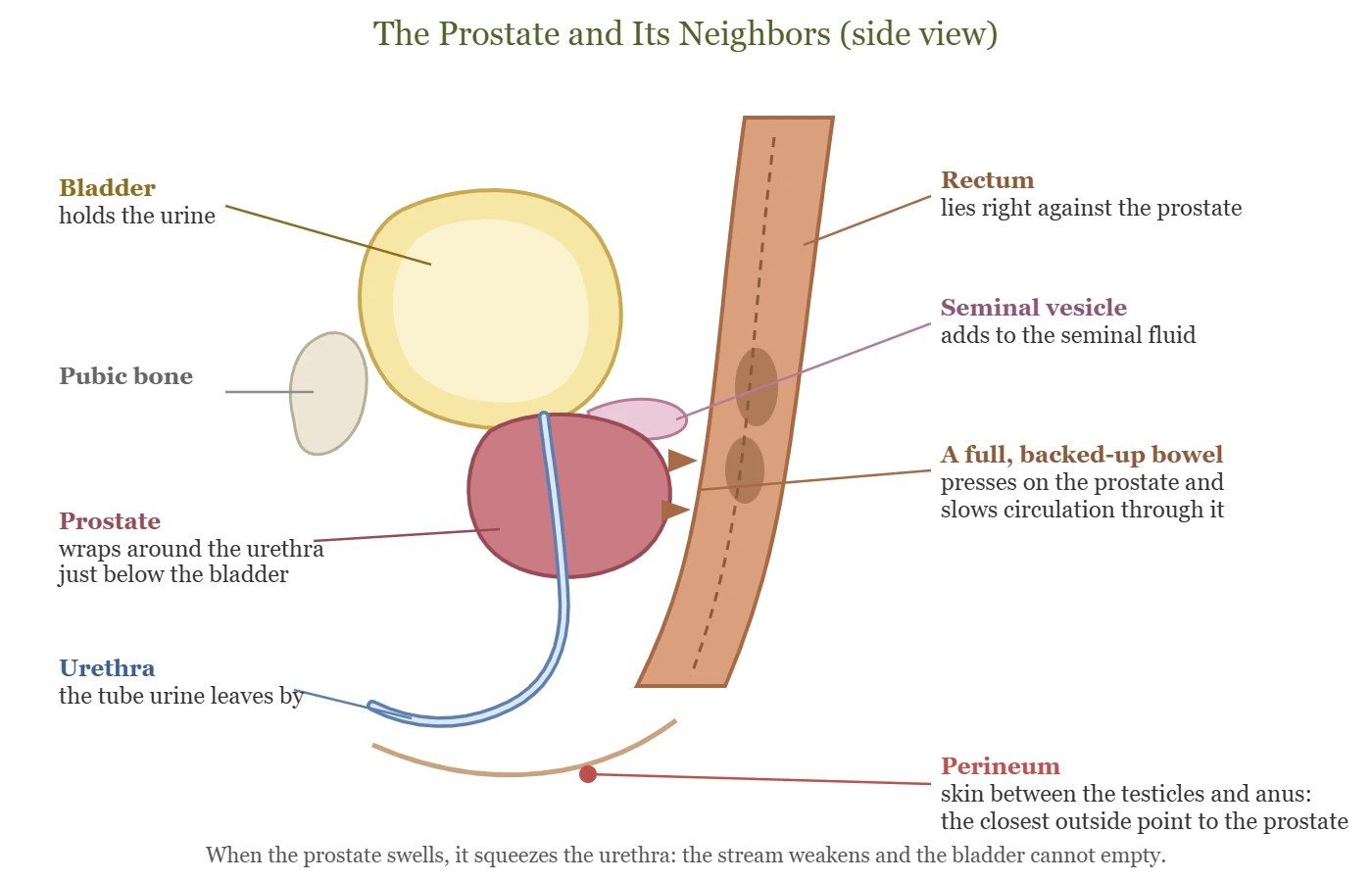
Side view diagram of the bladder, prostate, urethra, seminal vesicle, rectum and perineum

The prostate and its neighbors, seen from the side. A backed-up bowel presses on the gland, and the perineum is the closest outside point to it. Simplified diagram drawn for H.E.A.L.

How Prostate Cancer Forms

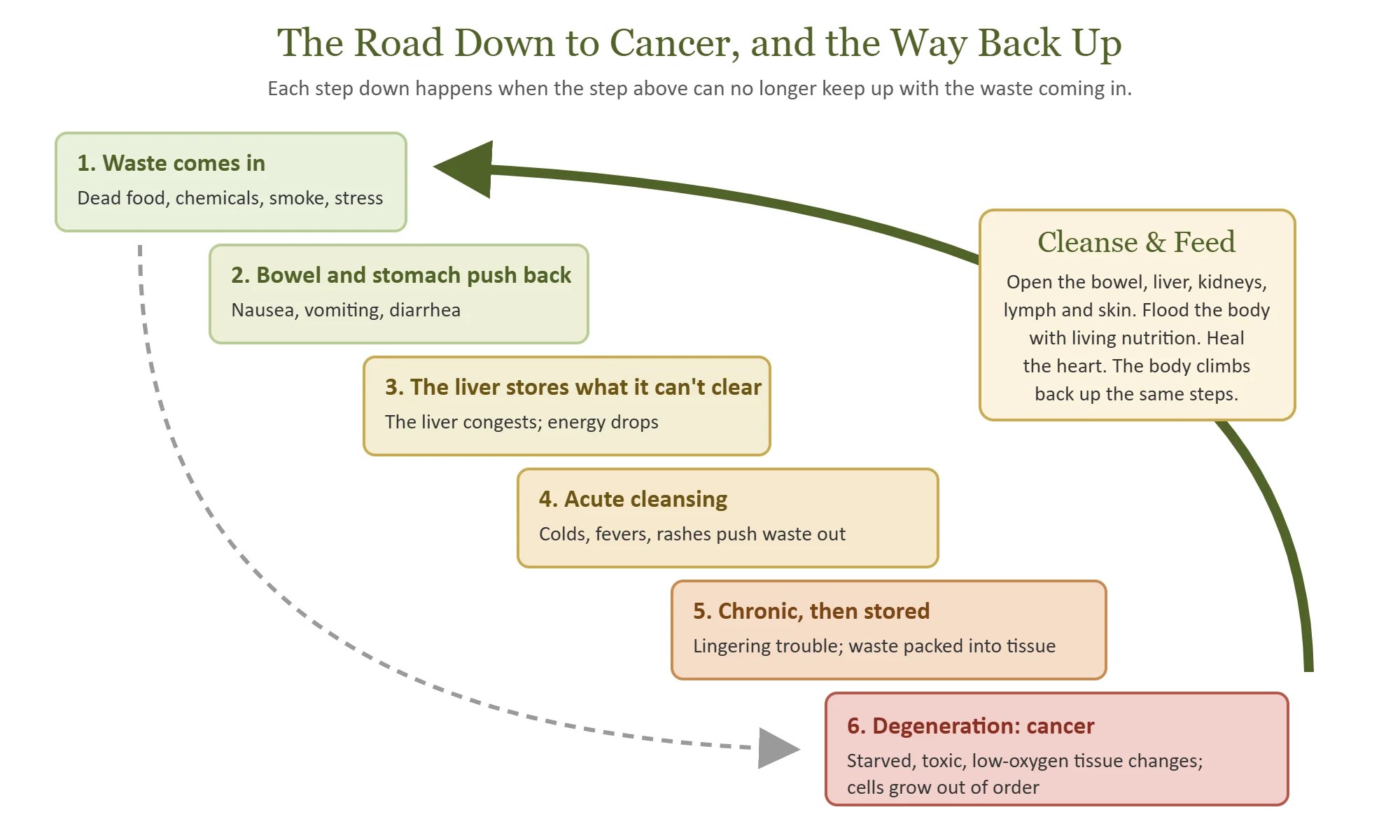
Prostate cancer follows the same road down that the Cancer sheet describes: years of waste coming in faster than the bowel, liver, kidneys and lymph can carry it out, until the tissue is starved, congested and no longer able to keep its designed structure. Dr. Christopher taught that the prostate fills with mucus and sediment, often in a body whose own hormones are no longer keeping the gland working well.

  • A stagnant pelvis. The prostate sits at the bottom of the pelvis, where circulation is slowest. A constipated bowel pressing against it, long hours of sitting and little movement all let the area grow stagnant. Dr. Richard Schulze said it plainly: “With the prostate, you really need to increase the circulation.”
  • Hormones. Prostate cells grow in response to male hormones. The liver breaks hormones down once they have done their work; a congested liver leaves the gland bathed in old hormones longer.
  • Food. Dr. Christopher warned strongly against processed meats such as hot dogs, bologna and other cold cuts, with their nitrates and nitrites. In my practice, going completely meat-free while the prostate recovers is very important, and sandwich meats and beef products are the worst offenders.
  • What can’t be changed. Age is the biggest one: about 6 in 10 prostate cancers are found in men 65 or older. A father or brother with prostate cancer, African ancestry, and inherited genes such as BRCA2 also raise the risk (American Cancer Society). A tendency is only a weak spot, not a sentence.

About 1 in 8 men in the United States will be diagnosed with prostate cancer in his lifetime, and about 1 in 49 will die of it (American Cancer Society, 2026). Many prostate cancers grow very slowly, and many men live with them for years.

How It Progresses

  • In the gland. Abnormal cells grow inside the prostate, often for years without any symptom at all.
  • Through the wall. The cancer grows through the gland’s outer capsule into the tissue around it and the seminal vesicles.
  • Lymph nodes. Cells travel along the lymph to the nodes in the pelvis.
  • Distant spread. Prostate cancer spreads most often to the bones, especially the spine and hips, and sometimes to other organs.

About the PSA test. PSA is a protein the prostate makes, measured in a blood test. Cancer can raise it, but so can an enlarged prostate, infection, a recent ejaculation and even a long bicycle ride. One number on its own tells you little. Dr. Schulze taught men to compare a reading to their own earlier numbers rather than to a chart: the direction it is moving matters more than where it stands.

Know the Signs, and When to Get Help

Early prostate cancer usually has no symptoms. Later signs can include trouble starting or keeping a stream, a weak flow, getting up often at night, blood in the urine or semen, new trouble with erections, and pain in the hips, back or other bones. Most of these are more often caused by an enlarged prostate than by cancer, but each one deserves a look. Those of you who use a doctor will want to have them checked.

Get help right away if you cannot pass urine at all, or if you have a fever with pain low in the pelvis. A bladder that cannot empty is an emergency.

Imaging and a biopsy are the only ways to know for certain whether it is cancer. My caution about biopsy is on the Tumors & Lumps sheet; weigh what you will gain from knowing. Prostate cancer can be a serious, life-threatening disease. Herbs and cleansing are support alongside medical care, not a replacement for it. If you are having surgery, radiation or hormone treatment, tell your doctor what you are doing.

The Emotional Side: the Energy Work

Healing the whole person. We are body, mind and spirit, and all three must heal together. When one part is neglected, the other two cannot find complete healing.

The prostate sits at the center of a man’s sense of himself as a man. Trouble here very often comes with trouble in the bedroom, and with fears about growing older and losing strength. Many men carry this quietly and alone. Facing it, and talking about it with the people who love him, is part of the healing.

Louise Hay, in her book Heal Your Body, describes these patterns:

  • Prostate: “Represents the masculine principle.” Turn it around: “I accept and rejoice in my masculinity.”
  • Prostate problems: “Mental fears weaken the masculinity. Giving up. Sexual pressure and guilt. Belief in aging.” Turn it around: “I love and approve of myself. I accept my own power. I am forever young in spirit.”
  • Cancer: “Deep hurt. Longstanding resentment. Deep secret or grief eating away at the self. Carrying hatreds. ‘What’s the use?’” Turn it around: “I lovingly forgive and release all of the past. I choose to fill my world with joy. I love and approve of myself.”

Emotional patterns quoted from Louise Hay, Heal Your Body (Hay House). These are not faults to blame anyone for; they are a reminder of how much the heart is carrying.

Areas Affected & Opening the Way to Healing

The prostate is where the cancer shows, but the work starts with the whole body. First establish the full program on the Cancer sheet. A week or two on the Incurables Program clears the liver and kidneys and shores up the body to heal. Then work on three areas: the bowel, which presses on the gland and must carry the waste out; the kidneys and urinary tract, which the prostate is part of; and the prostate itself, through the rectum and the perineum.

Opening the Way to Healing

1. Clear the blockage.

2. Get the healing nutrients into the area.

3. Let sunshine and fresh air cycle over and through the affected part.

4. Bathe regularly.

5. Move the area as much as you can.

6. Know which area is truly affected. With prostate cancer the trouble shows in the gland, but the bowel pressing against it and the liver behind it are where it is held. Keep them open, or the prostate has nowhere to send its waste.

Clear the Bowel, Liver and Kidneys

  • The bowels must move. The Lower Bowel Formula (LBF), building up until the bowels move two or three times a day. A full bowel presses directly on the prostate.
  • Liver and kidney flushing on the schedule in the Cancer sheet, with castor oil packs over the liver and bowel at night.
  • Kidney Support. The prostate is part of the whole urinary system, and it all needs to be supported. Take Kidney Support alongside the prostate formula.
  • The Blood Purifying Formula or the Detox Formula during the cleanse weeks, as directed on its formula sheet, and Essiac as on the Cancer sheet.
  • Echinacea every day, to keep the immune system strong enough to handle the die-off. If you have an autoimmune condition, talk with Dara before starting. Echinacea can overstimulate an immune system that is already attacking the body. In its place we use astragalus and marshmallow root. This is much slower, and the whole program has to be done in a gentler way so the body can handle the detoxing. Some people are able to use Echinacea later, once their system has healed and cleared; others never can.

Using Chaparral With Care

Chaparral is one of the herbs in the Blood Purifying Formula. It has long been regarded as one of the strongest blood purifiers in herbal use and has had years of bad press, but used wisely it supports the body in clearing what has built up. Stay at the dose on the formula sheet. Avoid it with existing liver disease. If the skin or the whites of the eyes turn yellow, the urine turns dark, or there is pain under the right ribs, stop and have the liver checked.

Feeding and Clearing the Prostate: Prostate Support

Prostate Support is our main formula for the prostate: saw palmetto berry, pygeum bark, nettle root, cleavers, corn silk, juniper berry, uva ursi, thuja and oat tops. These herbs are traditionally used to reduce swelling and congestion in the gland, keep the urine flowing, and feed the prostate what it needs.

  • On the program: 1 teaspoon every three hours, five times a day.
  • Once things are under control: 1 teaspoon two or three times a day; to maintain, once a day.
  • It works best used steadily for 3 to 4 months, along with the foundational programs.
  • For urgent flow or infection: Dr. Christopher’s Male Urinary Tract Support Tea (goldenseal, gravel root, marshmallow, parsley root, juniper, lobelia and cayenne) is a very good formula. We no longer make it because it is so expensive to produce, but you can make it yourself: the recipe is on its own sheet. Take 2 capsules morning and night, or ½ cup of the tea often through the day when the need is urgent.

Working on the Prostate Itself

Because the prostate lies against the rectum and just above the perineum, we can reach it from two sides: from inside, with suppositories and garlic, and from outside, with packs over the perineum. Every HEAL salve is available as the oil, before the beeswax is added; ask for the oil form when you order.

Prostate suppositories, nightly at bedtime, and as needed throughout the healing to support the flow of urine:

  • Make them: mix 60% M&L Oil with 40% coconut oil. Pour into the fingers of an unpowdered disposable glove and freeze for 20 minutes. Tie off the fingers and store them in the dairy compartment of the refrigerator.
  • Insert: put a little olive oil on the rectal opening, then insert one suppository as deeply as you can, toward the prostate. As it melts, it eases the blockage in the prostate and brings back a better flow of urine.
  • For a stronger anti-inflammatory effect, make them the same way with the Healing Salve oil.

A garlic clove. Peel a whole clove, cut one small slice in it if you like to let out a little of the juice, and insert it into the rectum, toward the prostate. Never use crushed garlic here; it is far too painful.

The M&L Salve and castor oil pack, overnight:

  • Lay a piece of flannel, folded two layers thick, over the lap and rest the genital area (his manhood) on it.
  • Pack M&L Salve well into the perineum, the area between the testicles and the anus. It is the closest point on the outside of the body to the prostate. Cover the genitals with a good coating as well, and a little over the lower belly just above the shaft.
  • Lay a castor-oil-soaked flannel over the salve. The salve opens the area, and the castor oil breaks up the congestion.
  • Fold the flannel around the genitals and back underneath, leaving the tip free so he can pass urine without unwrapping. Leave it on all night.
  • Give the area at least 6 hours a day out of the pack so the skin can absorb the extra oil.

Hot and cold showers with a shower wand. Aim the spray low, at the area between the legs and the lower belly: hot for about 3 minutes, then cold for 30 seconds to a minute. Repeat three times and finish with cold. This pumps fresh circulation through the prostate without putting anything into the body.

A spastic bladder. Sometimes the prostate is flowing, but there is still a sudden, urgent need to go. That is the bladder in spasm. One dropperful of Lobelia by mouth stops the bladder spasm.

Movement. Walk or rebound every day. The pelvis grows stagnant with sitting, and the lymph depends on movement to carry the waste away.

The Prostate and the Marriage Bed

When there is trouble with the prostate, there is very often trouble with erections too. An erection is all about circulation: the fluids must flow freely through the area, and any blockage or buildup there keeps the shaft from filling properly. Surgery, radiation and hormone treatment for prostate cancer can also bring this on. It is nothing to be ashamed of, and it can be helped.

The M&L Salve pack above opens the area and frees the constrictions so the fluids can flow. It usually helps after one or two applications, and it can be repeated as needed while the prostate and male glands are being restored.

If hormones need support too, Male Support and Male Booster are available. You can decide whether you need the added support: read their formula sheets, and if you have questions, ask. Keep in mind that prostate cancer often grows in response to male hormones, which these formulas support, so weigh that with your own program. Male Support contains yohimbe, so anyone on heart or blood pressure medicines should check with Dara first.

Food

  • Go completely meat-free while the prostate recovers. The worst offenders are sandwich meats and beef products. Once the body has recovered, you can decide what you can safely eat again.
  • The full food program on the Cancer sheet: the juicer going every day, at least 32 ounces of carrot juice, Superfood, and fresh vegetables, fruit, whole grains, nuts and seeds.
  • Pumpkin seeds. Dr. Christopher wrote that “the pumpkin seed has given much relief to prostate problems.” A small handful a day.
  • Drink plenty of distilled water so the urinary tract stays flushed.

Use distilled water for all teas, and when taking your extracts in hot water.

Level of Commitment

  • Gentle support. For a man with a family history who wants to stay ahead of it: a clean, mostly meat-free diet, bowels moving well, daily movement, Prostate Support once a day, and the hot and cold showers.
  • Focused cleansing. For a rising PSA with no diagnosis, or an enlarged prostate: see the Prostate Health sheet.
  • Incurables Program. For any diagnosed prostate cancer. The full program on the Cancer sheet, full time, with the prostate work on this sheet. Plan on six months or longer, and don’t stop when the numbers improve.

More Is Not Faster

These doses are set to what the body can clear. Taking more stirs up more than the bowels, liver and kidneys can carry out, and that is when cleansing starts to feel like poisoning. Healing the body requires steady, consistent nutrition and action, not a bigger dose.

People are different, and now and then someone reacts poorly to a particular herb. If that happens, stop it. What I offer here is a guideline. You are the one living in your body, so work with the Holy Spirit and the wisdom the Lord has given you to apply these supports in the best way for your life.

A Loose Healing Plan

  • First: know what you are working with. If you use a doctor, learn the type, size and stage, and keep a record of your PSA numbers. Tell your doctor what you are doing.
  • Weeks 1 and 2: the foundation. The Cancer sheet’s program: food program or juice fast, Superfood, Echinacea, LBF until the bowels move two or three times a day, castor oil packs over the liver nightly. Start Prostate Support and Kidney Support. Go meat-free.
  • Week 3: liver flushing. Then Week 4: kidney flushing. Repeat the cycle as the Cancer sheet calls for.
  • From the start, every night: a prostate suppository at bedtime, and the M&L Salve and castor oil pack over the perineum. Add the garlic clove as you are able.
  • Every day: hot and cold showers with the wand, walking or rebounding, plenty of distilled water.
  • All along: the heart work. Talk with your wife. Let go of the fear of growing old. You are forever young in spirit.
  • Every few months: take stock. If you use a doctor, compare your PSA to your own earlier numbers. Keep going long after things improve.

Stories from the Work

I have supported many men with prostate trouble over the years. Men don’t tend to share many details, and I often don’t hear the end of the story.

Dara’s Story: Finding the Gift in M&L Salve

A few years ago I set out to find a natural answer for trouble with erections. That is when I discovered the gift we have in the M&L Salve. It worked after one application, and any time the need comes up again, it still works, usually with just one application. For it to be completely effective, Male Support needs to be taken along with it: the hormonal support helps build and hold the erection. Male Support is strong, and daily use can be more stimulation than a man wants, so many find it works best taken only when the need arises.

From Dr. Richard Schulze: The Engineer Who Would Not Be Cut

An engineer in his early fifties came to Dr. Schulze with a tumor wrapped so tightly around his prostate that his doctors wanted to remove the prostate, the urethra and most likely the bladder. He was a runner, but also a big meat eater with high cholesterol. He did the full Incurables Program: bowel cleansing, juice fasting, garlic in the rectum every day, hot castor oil packs between the anus and the testicles, and plenty of exercise.

At about three to four months the tumor, once hard as a baseball, had softened like a rubber ball. By six months it was about half its size, and over about ten months he could no longer feel it at all. His PSA, very high at the start, came down steadily into the normal range, and his oncologist finally told him, “Whatever you are doing, go with it.” A year later he slipped off his program and felt twinges again, until he got back on track. He gave up meat for good.

Credited to Dr. Richard Schulze, from his interviews with Sam Biser.

More on Prostate Cancer

Cleansing & Flushing, Herbal Healing

Skin Cancer

This sheet is part of the cancer series. The Cancer sheet explains what allows cancer to form anywhere in the body and lays out the full Incurables Program. This sheet covers what is particular to the skin. Lumps under the skin, moles and other look-alikes are on the Tumors & Lumps sheet.

Understanding the Condition

How the Healthy Skin Works

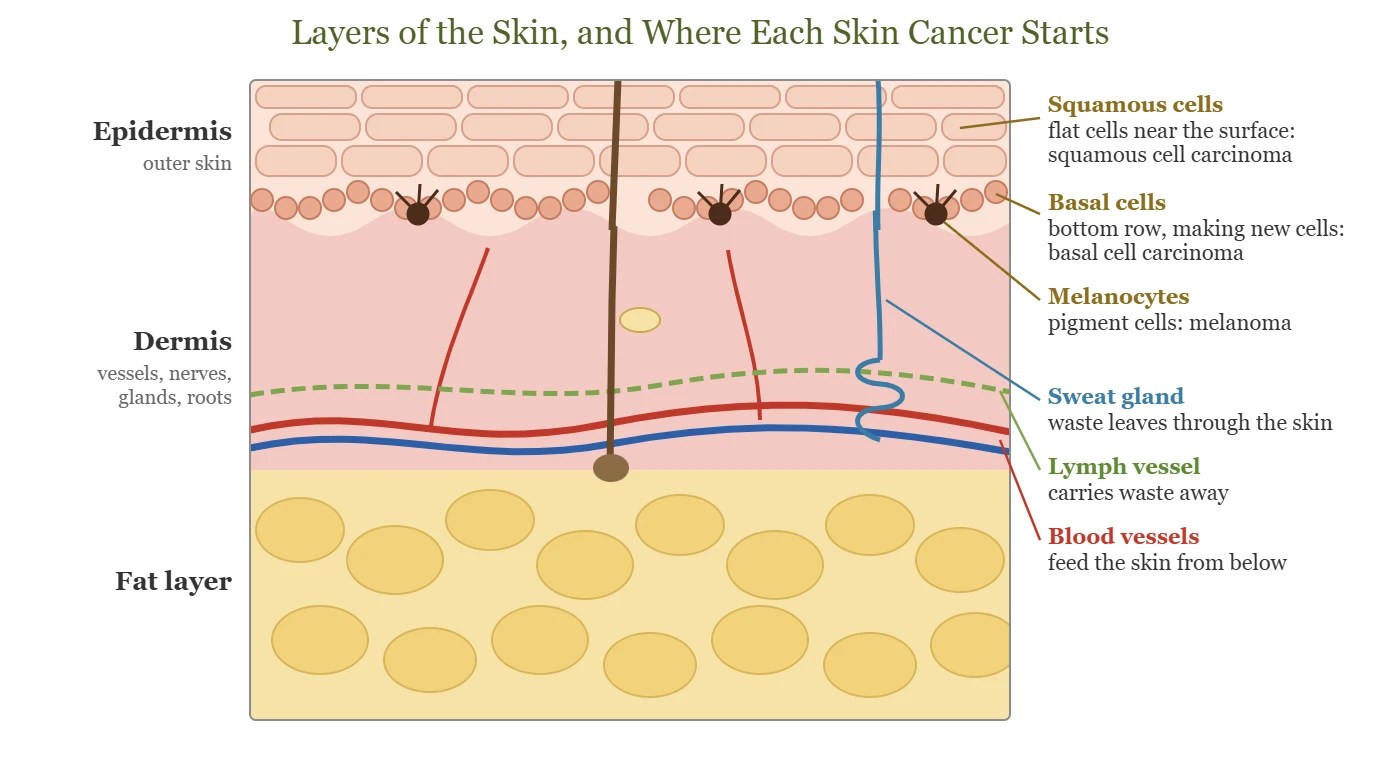
The skin is the largest organ of the body. It has three layers. The epidermis is the thin outer layer we see. Its surface is made of flat cells called squamous cells, which are always wearing away and being replaced. At the bottom of the epidermis sits a row of basal cells, which divide all day long to make the new cells that move up to the surface. Scattered among the basal cells are the melanocytes, the pigment cells. They make melanin, the brown color of the skin, and when the sun touches the skin they make more of it. A tan is the skin’s own sun shade.

Under the epidermis is the dermis, a thicker layer full of blood vessels, lymph vessels, nerves, hair roots, oil glands and sweat glands. The blood feeds the skin from below and the lymph carries its waste away. Below that is a cushion of fat.

The skin is also one of the body’s channels of elimination. Through the sweat glands it carries waste out every day, which is why it has been called the third kidney. The liver is the vacuum cleaner of the body. When the liver and bowel are backed up, the body pushes more of its waste out through the skin, and the skin shows it: rashes, boils, acne, eczema. Skin cancer grows in this same skin.

Diagram of the layers of the skin showing where basal cell, squamous cell and melanoma start

The layers of the skin. Each of the three main skin cancers starts in a different kind of cell in the epidermis. Simplified diagram drawn for H.E.A.L.

How Skin Cancer Forms

Skin cancer follows the same road down that the Cancer sheet describes: years of waste coming in faster than the bowel, liver, kidneys and lymph can carry it out, until the tissue is starved, congested and no longer able to keep its designed structure. The skin cells at the bottom of the epidermis divide constantly, and when they are damaged and poorly fed, they can begin to grow out of order.

Dr. Christopher taught that skin cancer starts on the inside. In his words, “it is the putrid condition of the body that is poisoning the tonsil, or the skin!” He did not believe the sun creates cancer. He taught that the sun can “ripen and bring the cancer that is already there to the surface, wherein the waste matter can slough off, so that the body may heal.” He pointed to tribal peoples who lived in the sun year round with very little cancer until they began eating “civilized” food.

What science has found. Ultraviolet light from the sun and tanning beds can damage the inner workings (the DNA) of skin cells, and repeated burning is linked to skin cancer (World Health Organization). But the kind of sun matters. A review of 57 studies found that sunburns roughly doubled the risk of melanoma and short, intense bursts of sun on unprepared skin raised it, while steady, regular sun, such as outdoor work, did not raise it (Gandini and others, European Journal of Cancer, 2005). And food matters. In a two-year study of people who had already had skin cancer, those who cut their fat intake to 20 percent of calories grew about one-third as many new precancerous spots as those who ate their usual diet (Black and others, New England Journal of Medicine, 1994).

Other things that raise the risk: fair skin that burns easily, many moles, a family history, older age, a weakened immune system (for example, from anti-rejection drugs after a transplant), arsenic and other chemical exposures, smoking (especially for cancers of the lip), old scars and wounds that never fully healed, and tanning beds. Melanoma can also appear where the sun rarely reaches, such as the soles of the feet, the palms, under the nails and inside the mouth (American Cancer Society). The sun is not the whole story.

The Three Main Kinds

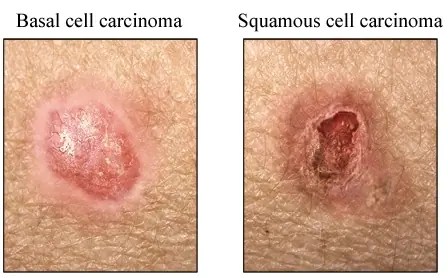
  • Basal cell carcinoma is by far the most common: about 8 out of 10 skin cancers (American Cancer Society). It starts in the basal cells and usually shows up on the face, nose, ears, neck, scalp and other places that get a lot of sun. It often looks like a pearly or waxy bump, sometimes with tiny blood vessels on the surface, or a flat, pink, scaly patch. It may bleed, crust over, seem to heal and then come back. It grows slowly and almost never spreads to other parts of the body, but if it is left alone for years it can dig deep and destroy the tissue around it.
  • Squamous cell carcinoma is the second most common. It starts in the flat cells near the surface and often looks like a rough, scaly red patch, a firm bump, a wart-like growth or an open sore that will not heal. It favors the face, ears, lips, scalp and backs of the hands. It is more likely than basal cell to grow deep and, now and then, to spread, so it deserves more attention.
  • Melanoma starts in the pigment cells. It is much less common, but it is the most serious, because it can spread through the lymph and blood to other organs, sometimes quickly. It can start in an existing mole or as a new dark spot. Most melanomas are brown or black, but some are pink, red or skin colored.
Left, basal cell carcinoma: a pink, pearly, raised spot. Right, squamous cell carcinoma: a rough, crusted sore.

Left, basal cell carcinoma: a pink, pearly, raised spot. Right, squamous cell carcinoma: a rough, crusted sore. Photos: National Cancer Institute (public domain).

Know a Melanoma: ABCDE

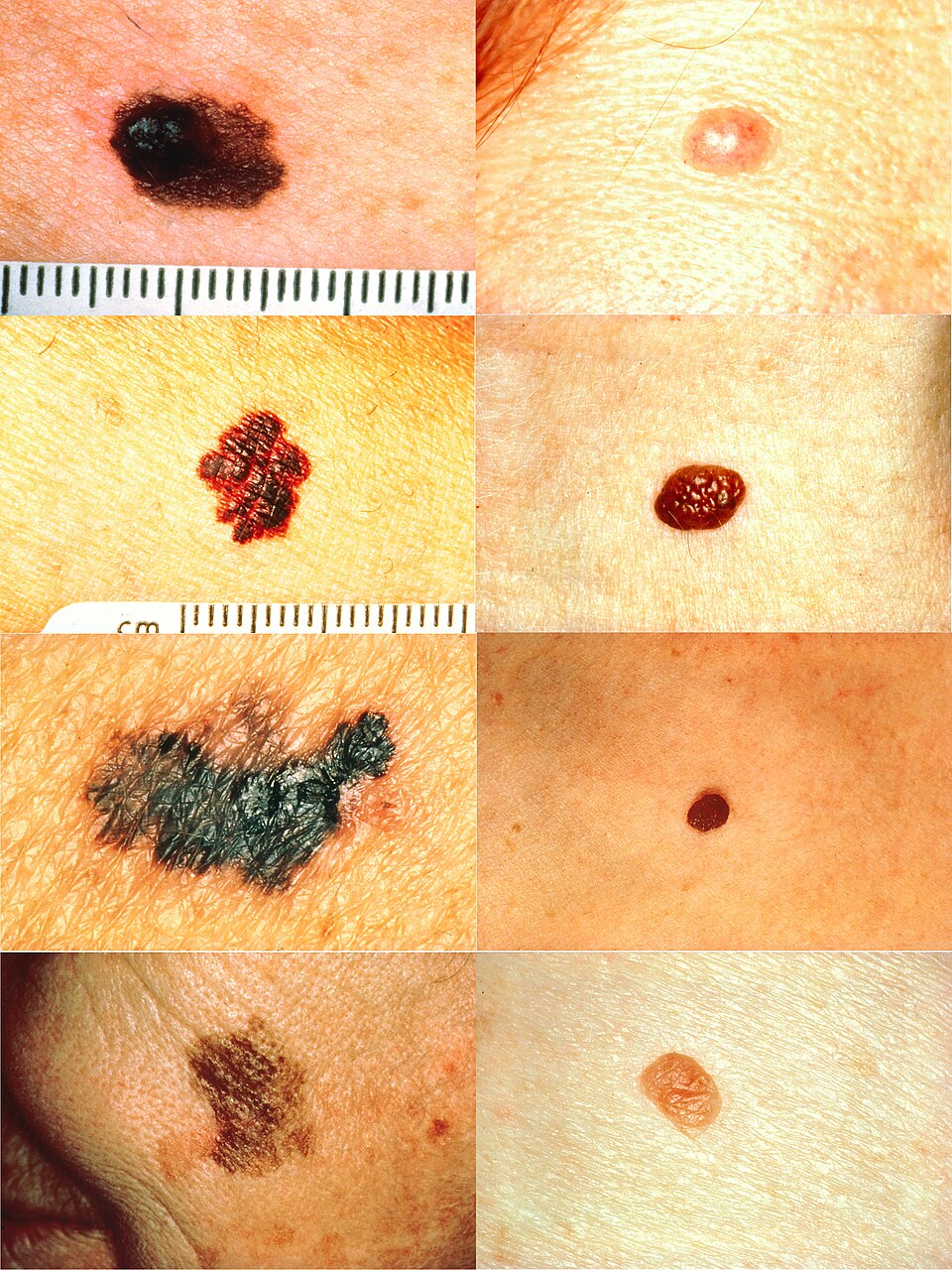
Most moles are harmless. A normal mole is usually small, round or oval, with a smooth, even edge and one even color. The signs that a mole or dark spot may be a melanoma are easy to remember:

  • A, Asymmetry. One half does not match the other half.
  • B, Border. The edges are ragged, notched or blurred.
  • C, Color. The color is not the same all over: shades of brown or black, sometimes with patches of pink, red, white or blue.
  • D, Diameter. It is larger than ¼ inch (6 mm), about the size of a pencil eraser, though melanomas can be smaller.
  • E, Evolving. It is changing in size, shape or color, or it begins to itch, crust or bleed.

Watch also for the “ugly duckling,” a spot that looks different from all the other moles on your body.

Melanomas on the left beside normal moles on the right for Asymmetry, Border, Color and Diameter

A melanoma (left) beside a normal mole (right) for each sign, from top: Asymmetry, Border, Color, Diameter. Photos: National Cancer Institute, NCI Visuals Online (public domain), via Wikimedia Commons.

Before Cancer: Rough Spots (Actinic Keratosis)

Many skin cancers announce themselves years ahead. Actinic keratoses are small, rough, dry patches that feel like sandpaper, often easier to feel than to see. They may be pink, red, tan or skin colored, and they come and go on the face, ears, scalp, lips and backs of the hands. They are not cancer, but some of them, left alone, go on to become squamous cell carcinoma. This is the easiest stage to turn around, and it is the body telling you it is time to clean house. It is also the stage the low-fat diet study above was measuring.

Spots That Are Not Cancer

Not every spot is something to fear. Moles are small clusters of pigment cells, and almost all are harmless. Seborrheic keratoses are waxy, brown, “stuck-on” looking growths that come with age; they are harmless. Skin tags are small, soft flaps of skin on a thin stalk, often on the neck, under the arms or around the eyes. Warts are rough growths caused by a virus. Cherry spots (cherry angiomas) are tiny, bright red dots of blood vessels. See the Tumors & Lumps sheet for what to do with these. Any spot that is changing, bleeding or not healing should be looked at more closely.

Watch Your Skin, and Know When to Have a Spot Checked

Check your skin once a month, front and back, using a mirror for the back and scalp. Take a dated photo of any spot you are watching, with a ruler beside it, so you can see real changes instead of guessing.

A spot deserves a closer look if it follows the ABCDE signs above; if it is new and growing; if it is a sore that does not heal within about a month; if it bleeds without being hurt; or if it keeps coming back in the same place. Those of you who use a doctor will want to have it checked.

Melanoma is the one to take most seriously. It can spread quickly through the lymph. If you go straight to the poultice, work closely with someone experienced and keep your weekly photos. If a dark spot keeps growing while you are on the program, if new dark spots appear around it, or if a gland near it (in the neck, under the arm or in the groin) swells and stays swollen, have it seen right away. Herbs and cleansing are support alongside medical care, not a replacement for it.

Imaging and a biopsy are the only ways to know for certain what a spot is. My caution about biopsy is on the Tumors & Lumps sheet; weigh what you will gain from knowing.

The Emotional Side: the Energy Work

Healing the whole person. We are body, mind and spirit, and all three must heal together. When one part is neglected, the other two cannot find complete healing.

The skin is the boundary between ourselves and the world. It is how we are seen, and it is the first thing that feels what comes at us. When we are carrying fear, anxiety or old hurts we have never dealt with, the skin is often where it shows.

Louise Hay, in her book Heal Your Body, describes these patterns:

  • Skin: “Protects our individuality. A sense organ.” Turn it around: “I feel safe to be me.”
  • Skin problems: “Anxiety, fear. Old, buried guck. I am being threatened.” Turn it around: “I lovingly protect myself with thoughts of joy and peace. The past is forgiven and forgotten. I am free in this moment.”
  • Cancer: “Deep hurt. Longstanding resentment. Deep secret or grief eating away at the self. Carrying hatreds. ‘What’s the use?’” Turn it around: “I lovingly forgive and release all of the past. I choose to fill my world with joy. I love and approve of myself.”

Emotional patterns quoted from Louise Hay, Heal Your Body (Hay House). These are not faults to blame anyone for; they are a reminder of how much the heart is carrying.

Areas Affected & Opening the Way to Healing

The spot is where you see it, but it was fed from the inside. The work has two sides. On the inside: open the bowel, clear the liver and blood, and keep the lymph moving, so the waste has somewhere to go. On the outside: draw the spot out with the Black Cancer Poultice, then rebuild the skin. For melanoma, or any skin cancer that is large, deep or spreading, first establish the full program on the Cancer sheet.

Opening the Way to Healing

1. Clear the blockage.

2. Get the healing nutrients into the area.

3. Let sunshine and fresh air cycle over and through the affected part.

4. Bathe regularly.

5. Move the area as much as you can.

6. Know which area is truly affected. With skin cancer the spot is on the skin, but the liver is where the trouble is held. The poultice draws the waste out, and the liver has to be free to carry it away.

Clear the Liver and the Blood

  • Bowel first. The Lower Bowel Formula (LBF), building up until the bowels move two or three times a day. Castor oil packs over the whole front of the body, with a hot water bottle over the liver, to soften years of backup.
  • Liver and kidney flushing. A week of liver flushing followed by a week of kidney flushing. Plan on at least one, and better two, rounds of liver flushing while the poultice is working on a spot. This is the step people skip, and it is the one that decides whether a spot clears for good.
  • The Blood Purifying Formula or the Detox Formula during the cleanse weeks, as directed on its formula sheet. Either one supports the liver in clearing the blood and tissues. Chaparral, the backbone of the Blood Purifying Formula, has a long history with skin cancer: Dr. Christopher wrote that it “aids in reducing the size of and eliminating growths and malignant tumors, malignant melanomas… and skin cancers.” See his story of the man with the recurring melanoma below.
  • Essiac for diagnosed skin cancer, as on the Cancer sheet.
  • Echinacea every day for squamous cell or melanoma, and for anyone on the full program, to keep the immune system strong enough to handle the die-off. If you have an autoimmune condition, talk with Dara before starting. Echinacea can overstimulate an immune system that is already attacking the body. In its place we use astragalus and marshmallow root. This is much slower, and the whole program has to be done in a gentler way so the body can handle the detoxing. Some people are able to use Echinacea later, once their system has healed and cleared; others never can.

Using Chaparral and Comfrey With Care

Chaparral is one of the herbs in the Blood Purifying Formula. It has long been regarded as one of the strongest blood purifiers in herbal use and has had years of bad press, but used wisely it supports the body in clearing what has built up. Stay at the dose on the formula sheet. Avoid it with existing liver disease. If the skin or the whites of the eyes turn yellow, the urine turns dark, or there is pain under the right ribs, stop and have the liver checked.

Comfrey root is one of the nine herbs in BF&C, where it feeds and rebuilds tissue as part of a traditional blend. Take the extract at 1 teaspoon three times a day. Use the salve as an overnight pack, and leave the area open and clear of salves for at least 6 hours each day. More is not faster.

Working on the Spot: The Black Cancer Poultice

The Black Cancer Poultice is my first choice for skin cancer. It is a dry mix of red clover blossoms, powdered poke root, slippery elm, bentonite clay, goldenseal and activated charcoal, blended into a paste with apple cider vinegar, bloodroot, tea tree oil and garlic. In my experience it does not harm the healthy skin around the spot. Garlic is the big killer in this poultice and one to respect.

  • Make the 50/50 solution: 4 oz raw apple cider vinegar and 4 oz distilled water. Add 1 oz bloodroot extract for every 8 oz of 50/50 solution.
  • Blend: In a Magic Bullet, pour in 2 oz of the solution first, so the liquid is on the bottom. Add ¼ tsp tea tree oil for every 8 oz of liquid used. Add 1 to 2 Tbsp of the herbal powder mix on top (start small; a skin spot needs only a little), then more solution on top of the powder. Add 3 large garlic cloves for every 16 oz of liquid; adjust it to your preference. Blend until smooth, adding solution until it is a paste.
  • Store in a lidded glass jar in the refrigerator for up to one week.
  • Apply a thick layer over the spot twice a day and hold it in place with a bandage. It often dries to a hard crust, which can be soaked off in the shower or bath before the next application.
  • What to expect. As the poultice works, the spot usually becomes red, angry and tender, and it may open. Sometimes a core or a solid mass comes out of the middle. Then it crusts over and begins to heal from the bottom up. This can take a few weeks for a small spot, and much longer for a larger or older one.
  • When the bleeders begin, add cayenne. Dr. Christopher and Dr. Schulze both taught adding cayenne powder right into the poultice mix to help prevent small bleeds: a rounded teaspoon in a regular batch, more for a larger one. If a bleed breaks through, pack it with cayenne powder.
  • Don’t stop when it looks better. The poultice works all the way down if you stay with it long enough. Spots come back when people stop as soon as the surface looks healed. I have watched a spot on the back of a hand come and go for years because the poultice was stopped every time it looked better. Keep going past that point.
  • Stop if the healthy skin around the spot becomes raw, blistered or very painful, and let it calm before starting again.

Watch How It’s Made: Making a Black Drawing Poultice

See the poultice mixed step by step in our video, Making a Black Drawing Poultice.

Dr. Christopher’s Black Ointment, a drawing salve of chaparral, comfrey, red clover, poke root and other herbs in pine tar and mutton tallow, was used the same way in his day, and his newsletters carry many letters about it clearing skin cancers. We use the Black Cancer Poultice for this work today.

Healing and Rebuilding the Skin

  • Healing Salve first, once the poultice work is done, to calm the inflammation.
  • Then BF&C (Bone, Flesh & Cartilage) to rebuild the tissue: the extract at 1 teaspoon three times a day, and the BF&C Salve as an overnight pack, leaving the skin open and clear of salves for at least 6 hours each day. Done this way, the skin can fill in and heal over until you cannot see where the spot was.
  • A word of warning about BF&C. It has a good chance of reminding you of any and all old injuries that healed poorly. The formula goes through and cleans house beautifully, so an old hurt may ache or act up for a while as it is finally put right. Once you are reminded, you need to support the proper healing process: rest and support that area (a sling for an arm or shoulder, for example) and keep up the BF&C until it has healed correctly.
  • For scars and hardened tissue: the three-oil massage. Once the skin has closed, massage the area with castor oil for two days, olive oil the next two days and wheat germ oil the following two days, then rest a day and repeat. Dr. Christopher taught that the castor oil cleanses and draws out toxins, the olive oil feeds and rebuilds the flesh, and the wheat germ oil, rich in vitamin E, heals. Follow it with a short sunbath (see below). He used it for a woman whose three C-section scars were so bad her doctors told her another pregnancy would kill her. Her scar tissue softened and became healthy tissue, and she went on to have more children.
  • Potassium foods. Dr. Christopher taught that moles, warts and growths form where the body lacks potassium: fresh vegetables and their juices, and the Potassium Broth on the Tumors & Lumps sheet.

The Sun, Used Wisely

The sun is a true healer, and I find it sad that people have been made afraid of a free source of healing. Dr. Christopher called it “the Great Doctor of all times,” but he warned that it “is like fire, which can either provide gentle warmth or it can burn a city down.” A burn is the opposite of healing. The answer is not to hide from the sun but to build up to it slowly and never burn. Wisdom must be used, or anything, no matter how healing, can become toxic.

Dr. Christopher’s directions, with his three-oil massage, which he taught lets the skin take the sun without burning:

  • The three oils. Massage the whole body with castor oil for two days, olive oil the next two days, and wheat germ oil the following two days. Rest one day, then repeat the cycle week after week.
  • Right after the oil massage, lie in the sun with as much of the body bare as you can: 2 minutes on the front and 2 minutes on the back the first day. Add 2 minutes front and back each day. Fair skin that has never sunned should start with 1 minute, timed by a clock, and add a minute a day.
  • Never at midday. No sunbathing between 11 and 1, when the sun is harshest. The sun feels so good that you will want to stay longer, and that is where the trouble starts.
  • Help from inside. Burdock root or burdock seed tea, which works on the lymph and the oil glands, makes the sunbath more beneficial.
  • Keep a spot under treatment covered with its poultice and bandage while you sun the rest of the body.
  • Some medicines, including some antibiotics and chemotherapy drugs, make the skin burn very easily. Ask your doctor or pharmacist before sunbathing while you take them.

When you will be out longer than your skin is built up for, cover with light clothing, a wide-brimmed hat or shade.

Food, Skin and Bathing

  • Eat for clean skin. The full food program is on the Cancer sheet. Cut the fried foods, fatty meats and refined oils; the low-fat diet study above shows how quickly the skin responds. Fresh vegetables, fruit and their juices every day, with carrot juice a favorite.
  • Dry skin brushing every day with a natural-bristle brush, toward the heart, to open the pores and move the lymph.
  • Hot and cold showers to open the pores and drain the skin. Finish with cold.
  • Sweat. A good sweat, from exercise or a hot bath, lets the skin do its work as a channel of elimination.
  • Move the lymph. Rebound or walk every day. The lymph has no heart to pump it; it depends heavily on movement and breathing.

Use distilled water for all teas, and when taking your extracts in hot water.

Level of Commitment

  • Gentle support. For healthy skin and for anyone with fair skin, many moles or a family history who wants to stay ahead of it: a clean food program, daily juice, seasonal liver cleansing, skin brushing, and sunshine built up slowly so you never burn. Check your skin monthly.
  • Focused cleansing. For rough precancerous spots and small basal cell spots: bowel cleansing, a week of liver flushing followed by a week of kidney flushing, the Blood Purifying or Detox Formula during the cleanse week, the Black Cancer Poultice on the spot twice a day, and Healing Salve and BF&C to rebuild. My father’s small spots cleared with this; his large one did not, because his liver was never flushed.
  • Incurables Program. For squamous cell carcinoma that is growing, any melanoma, a large or deep spot, a spot that keeps coming back, or any sign of spread. The full program on the Cancer sheet, full time, with the poultice work on this sheet. Plan on six months or longer, and keep going after the skin looks clear.

More Is Not Faster

These doses are set to what the body can clear. Taking more stirs up more than the bowels, liver and kidneys can carry out, and that is when cleansing starts to feel like poisoning. Healing the body requires steady, consistent nutrition and action, not a bigger dose.

People are different, and now and then someone reacts poorly to a particular herb. If that happens, stop it. What I offer here is a guideline. You are the one living in your body, so work with the Holy Spirit and the wisdom the Lord has given you to apply these supports in the best way for your life.

A Loose Healing Plan

  • First: know what you are working with. Look closely at the spot, measure it and photograph it. If you use a doctor, have it checked. For melanoma or a large spot, set up the full Cancer sheet program before starting the poultice.
  • Week 1: open the bowel. LBF until the bowels move two or three times a day, castor oil packs over the liver and bowel, juices and Superfood every day. For a small spot, start the Black Cancer Poultice twice a day.
  • Week 2: liver flushing, with the Blood Purifying or Detox Formula. Week 3: kidney flushing. Repeat the cycle while the poultice is working.
  • As the spot opens and drains: keep the poultice going twice a day, add cayenne if it bleeds, and keep the liver clearing. Stay with it past the point where it looks better.
  • When the spot has closed: Healing Salve to calm it, then BF&C Salve packs and the extract to rebuild the skin.
  • All along: the three-oil massage and the sunbath built up slowly, skin brushing, hot and cold showers, potassium foods, and the heart work.
  • Every month: take stock. Check your skin and compare your photos. Keep flushing on schedule.

Stories from the Work

Dara’s Story: The Spot Beside My Husband’s Nose

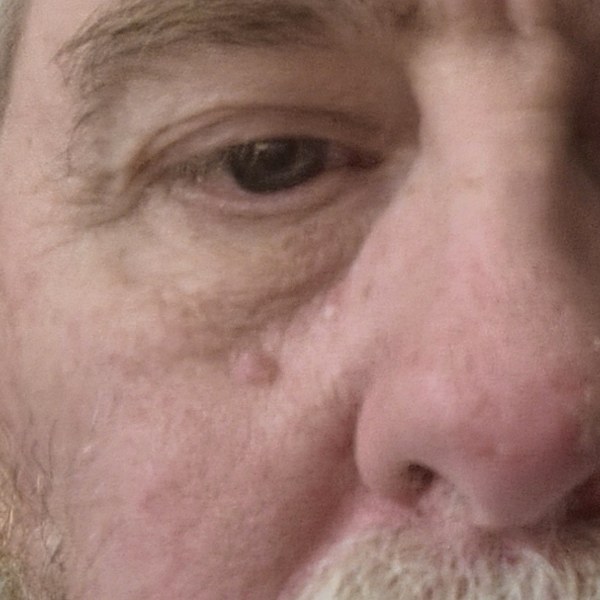
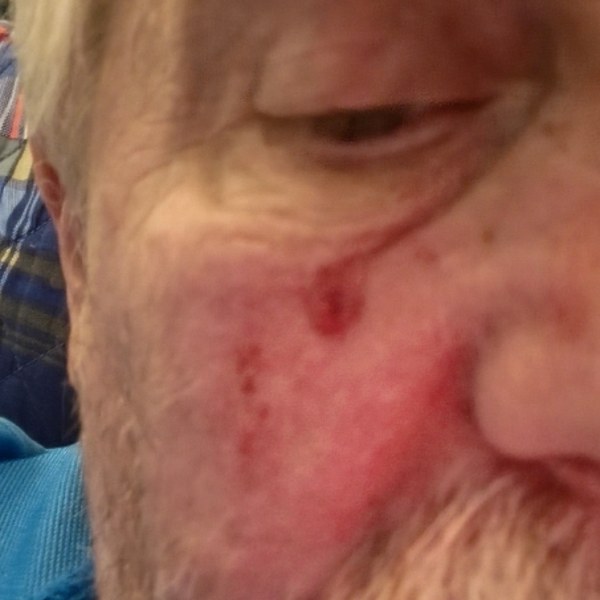
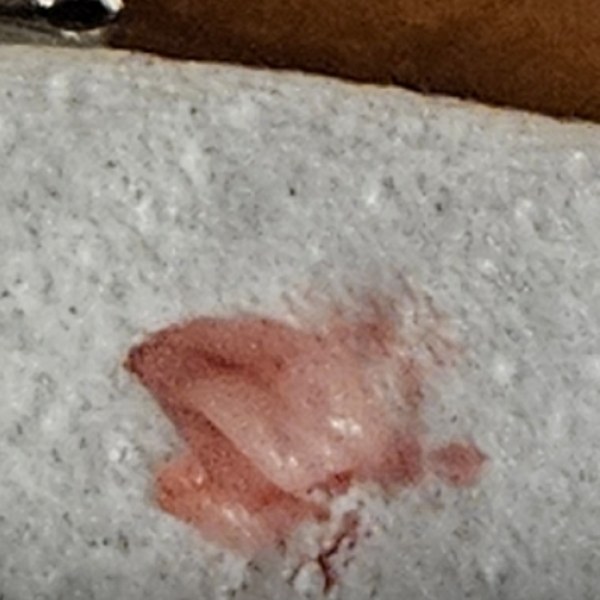
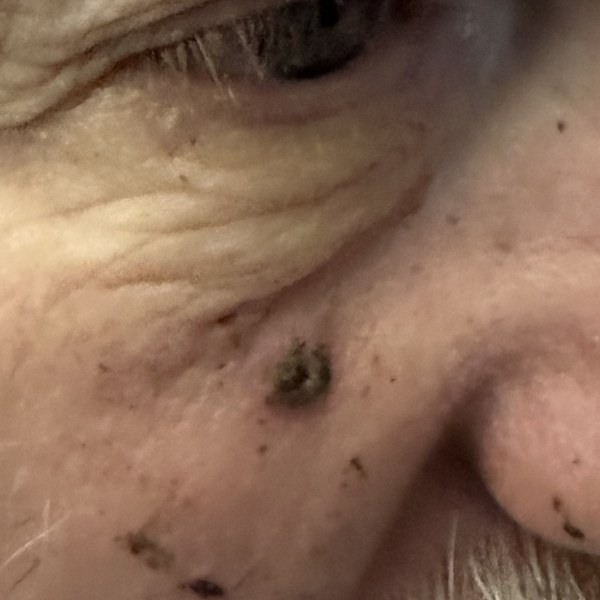
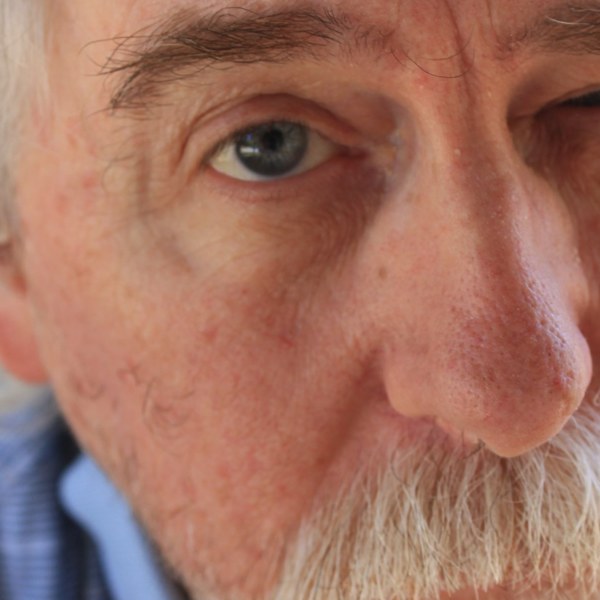
For years my husband had a small pale bump right beside his nose, just under his eye. Then it began to grow. At first he thought it was a pimple, but it didn’t act like one, and by the time of his cataract surgery it had grown so large that his eye doctor told him he should have it looked at. He never did see a doctor for it. He put the cancer poultice on it himself and stayed with it for quite a while before the lump opened, and the opening was something he had to endure. On October 17, 2025, it broke open and a solid mass came out of the middle. He kept up the poultice as it crusted over, even using a batch that was over a month old, and it kept working. It sealed up and healed over, and today you cannot see where it was. It was never diagnosed, so we will never know for sure what it was. Stay with it until the job is done.

Family photos, used with permission.

Dara’s Story: My Father’s Skin Cancer

My father came to live with us in 2008 with three spots of skin cancer, diagnosed at the VA, where he had already had others cut out. The Black Cancer Poultice cleared the smaller spots in short order, with no harm to the skin around them, even though he wasn’t careful to keep it only on the spots. But he would not do a liver flush. The largest spot, right beside his nose, would not clear. His liver was full and could no longer draw the cancer out, so he went in for surgery to have the rest removed. The poultice draws the waste out, but the liver has to be free to carry it away.

A Member’s Story: Deborah’s Spot

Deborah, a local member, had a spot on the side of her face. Around 2018 she used the Black Cancer Poultice on it several times, and it went away. This past year it came back. She spends a lot of time out in the sun, and she likely did not stay with the poultice long enough the first time to clear it completely.

Her story is a good reminder: keep going past the point where it looks better, and keep the liver clearing, so the spot clears all the way down.

From Dr. Christopher: The Man With the Recurring Melanoma

Dr. Christopher often told of a case reported by doctors at the University of Utah. An 85-year-old man had a malignant melanoma on his right cheek that had been cut out three times, and each time it grew back larger. When it returned a fourth time, with a large tender mass in his jaw and neck, he refused more surgery and went home. On the advice of a friend, he began drinking 2 to 3 cups of chaparral tea every day. Within about three months the growth on his cheek had shrunk to a few millimeters and the mass in his neck was gone, and his weight, color and strength had greatly improved.

Credited to Dr. John R. Christopher’s writings; the case was published by Dr. C. R. Smart and others in Cancer Chemotherapy Reports, 1969.

I have not used chaparral on skin cancer myself; the Black Cancer Poultice does that job well. In my work chaparral goes in through the Blood Purifying Formula, to help the liver clear the blood.

From Dr. Christopher’s Letters

“We have used your Black Ointment with great results. I had skin cancer on my forehead; in six weeks it healed up beautifully.”

A woman whose doctor wanted to refer her to a skin cancer specialist told him it was her body and she would try the herbal remedy first. In six weeks the spot was cleared, and it had not returned two years later. Her husband was then using the ointment on a spot on his nose.

Letters to Dr. John R. Christopher, from his newsletters. His Black Ointment was his drawing salve; we use the Black Cancer Poultice for the same work.

More on Skin Cancer

1 Corinthians, Bible Studies, Spiritual Healing

Sanctioned by Our Presence

“So then, when you come together, it is not the Lord’s Supper you eat, for when you are eating, some of you go ahead with your own private supper. As a result, one person remains hungry and another gets drunk.” 1 Corinthians 11:20–21, NIV

When the believers at Corinth came together, Paul told them plainly that it was not the Lord’s Supper they were eating. Each one hurried ahead with his own meal. One went home hungry while another drank too much. They had the bread and the cup, the gathering, the outward form of the table, and none of its heart.

A Room Full of Strangers

What Paul describes is a room full of strangers coming together for a special meal, one they don’t understand. The whole occasion lacks the Spirit of Christ. His loving act, His intentions, are lost on them. They are there for the food, regardless of the needs or cares of anyone else. It is not the Lord’s Supper they are celebrating; it is only a feeding they are having together.

The remedy is simple. Remember that when you come together, it is from the Lord’s table that you are eating, so be like Him. He served His disciples. Yet at Corinth it was everyone for themselves, one rushing ahead of another, no one serving anyone. It was all about gratifying self.

What the Table Was Meant to Be

The Lord’s Supper, or any meal taken with believers, can be an uplifting time where topics are discussed, testimonies are shared, and encouragement is offered. In a family, time at the table is special, set apart from other activities just for the family to share and reconnect. Many homes don’t do this any longer, but those who hold to it find a true blessing: a chance to truly know your family and be a part of their day.

The Lord’s Supper was a missed opportunity for that infant church to bless each other and be blessed themselves. Instead it had become a meal the tender-hearted would avoid.

Our Presence Is a Statement

This morning I tried to put myself in that congregation, to imagine what it would have felt like to walk into that room. And I realized I would have refused to attend. It is not a place I would have sanctioned with my presence.

Sometimes our actions say more than words could convey. By attending, we add our endorsement to what is practiced there. At times, absenting ourselves is our only choice, when to attend would put our endorsement on the wrong side.

But it depends on who you are in that congregation. Someone of noble bearing or strong personality might stand up and turn the direction of the meeting. Corinth, though, was already torn by factions. Paul had heard of the divisions, and the hostility between the cliques ran strong right alongside this sacrilege of the Lord’s Supper. In a room that bitter, even a gracious example would likely be read as taking a side. Nothing could be accomplished by showing up.

That is why Paul’s admonition was so needed. Someone from the outside, someone they all respected, had to speak up and clean out the misunderstandings and pettiness. Even Paul knew a letter would not be enough; the rest, he said, he would set in order when he came.

The sad part is that when the wise stop attending, the table is left even more empty of the love of Christ.

From the Inside Looking Out

I did not have to imagine all of this. I grew up close to the center of a very conservative church community, and I saw much from the inside looking out, things I could have lived my whole life without knowing. I watched men kneel on the platform on Sabbath morning whose lives behind the scenes told a very different story. As a young girl I had no standing and no voice. The only statement in my power was to quietly absent myself when I knew a situation would be wrong.

It confused me for a long time. But the Lord kept loving me, kept showing me there was something better, and I kept choosing to go toward the light and the good.

The bride of Christ, pure and holy: who He is still calling His church to be.

Our Choices Are What We Have

That is all we have in this life: our choices. We cannot always stop the bad from happening to us, but we can choose the good. If in our hearts we choose and want the good, Christ counts us as good.

The ones in the outward places of honor may have every form of the table and none of His heart. The one with no standing at all may have none of the form and all of the choosing. Christ sees the heart. That is what this passage tells me about God.

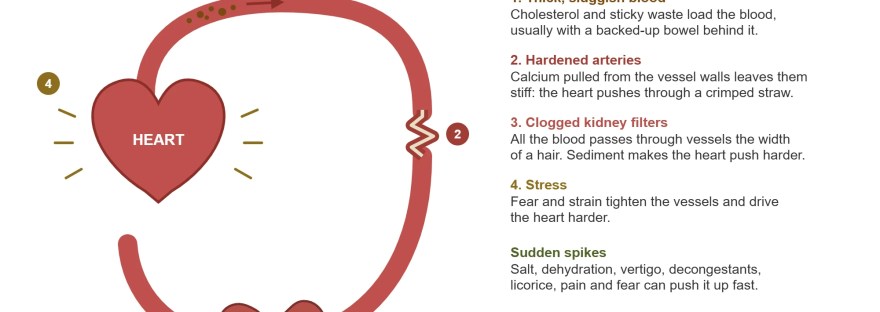
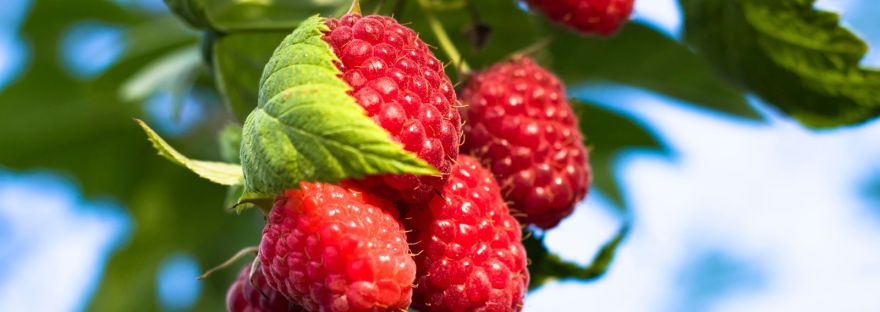
Diagram of the four causes that drive blood pressure up: thick blood, hardened arteries, clogged kidney filters and stress.
Heart, Blood & Circulation, Herbal Healing

Blood Pressure

High Blood Pressure, Sudden Spikes and Low Blood Pressure

Blood pressure is the pressure the blood puts on the walls of the arteries. It depends on the force of the heartbeat, how elastic the vessel walls are, the resistance in the tiny capillaries, and how thick the blood is. When the pressure climbs, the real question is what is driving it up. Forcing the number down without clearing the cause does not heal anything.

Understanding the Condition

What the Numbers Mean

A reading has two numbers. The top number (systolic) is the pressure while the heart squeezes; the bottom number (diastolic) is the pressure while it rests between beats. Dr. Christopher taught that there is no hard and fast rule: people differ, and heavy meat eaters run higher than those who eat simply. Know your own normal. My own normal runs low, somewhere between 106/60 and 116/64, so a top number in the 130s is high for me.

As a general guide, readings that stay at 130/80 or higher are considered high, and readings of 180/120 or higher are dangerous. Take your pressure sitting quietly for five minutes first, feet flat on the floor and arm resting at heart level, and write it down with the time. One reading tells you little; the pattern over days tells you a lot.

Four Things That Drive It Up

Diagram of the four causes that drive blood pressure up: thick blood, hardened arteries, clogged kidney filters and stress.

The four causes that make the heart push harder. Diagram drawn for H.E.A.L.

  • Thick, sluggish blood. Excess cholesterol and sticky, mucus-like waste load the circulatory system and thicken the blood. This usually goes hand in hand with a clogged bowel, which is why cleansing the bowel is part of purifying the blood.
  • Clogged kidneys. The kidneys filter all of the blood; there is no bypass. Their tiny vessels are about the width of a hair, and any pus or sediment there makes the heart pump harder to push the blood through.
  • Hardening of the arteries. When the body needs calcium, it pulls it from the walls of the veins and arteries as well as from the bones. The vessels grow hard and lose their give, and the heart is left pushing blood through a crimped straw.
  • Emotional stress. Stress can kill. It tightens the vessels and drives the heart harder. It is important to find ways to unplug and relax.

The first three are brought on by a poor diet, too little rest and exercise, and a lack of vitality in the body. That is why no formula works alone. You cannot be healthy while breaking the laws of health.

What Can Suddenly Spike the Pressure

A slow climb over months is one thing; a sudden spike is another. In my own life I have had three, each from a different cause (my stories are at the end of this sheet):

  • Salt. A single can of butter beans I didn’t check sent mine dangerously high overnight. Read the sodium on canned and packaged foods.
  • Dehydration. Too little water thickens the blood and the body fights to hold its pressure. A busy day when I forgot to drink put me in the ER.
  • Vertigo. When the head is spinning, the whole body goes into alarm and the pressure climbs with it.
  • Caffeine. Coffee, black and green tea, and chocolate narrow the blood vessels.
  • Decongestants and licorice. Many cold and cough medicines (look for “decongestant,” pseudoephedrine or phenylephrine on the label) push the pressure up. So can licorice in larger amounts, including licorice candy and some cough drops.
  • Pain, fear and panic. Fear of the numbers can push the numbers higher. Stay calm.

Low Blood Pressure

Some people run low, and for many that is simply their normal. Low pressure becomes a problem when it brings dizziness, lightheadedness on standing, fatigue or fainting. Dr. Christopher taught that low pressure, like high, comes from a circulatory system that is not working as it should, and that more oxygen is needed: deep breathing helps the herbs work faster. Dehydration can drop the pressure too, as can taking blood pressure medicine and herbs together as the body heals.

The Emotional Side: the Energy Work

Healing the whole person. We are body, mind and spirit, and all three must heal together. When one part is neglected, the other two cannot find complete healing.

Pressure in the body often mirrors pressure in the life: worry carried for years, problems never resolved, a heart always braced for the next blow. Learning to unplug, rest and trust is part of bringing the numbers down.

Louise Hay, in her book Heal Your Body, describes these patterns:

  • High blood pressure: a longstanding emotional problem not solved. Turn it around: “I joyously release the past. I am at peace.”
  • Low blood pressure: lack of love as a child; defeatism, “What’s the use? It won’t work anyway.” Turn it around: “I now choose to live in the ever-joyous NOW. My life is a joy.”

Emotional patterns quoted and paraphrased from Louise Hay, Heal Your Body (Hay House). These are not faults to blame anyone for; they are a reminder of how much the heart is carrying.

When to Call 911

Blood pressure is not something to play around with. “I might have been able to support myself at home, but the IV fluids put me back together much quicker. If you don’t have a game plan and lack the experience, your spiked blood pressure is a serious issue that needs to be taken care of.” Dara

Call 911 for a high reading with any of these: chest pain or pressure; shortness of breath; a sudden, severe headache; confusion or trouble speaking; weakness, numbness or drooping on one side of the face or body; vision changes; or dizziness with trouble walking. These can be the start of a stroke or heart attack, and minutes matter.

Get seen the same day: a reading of 180/120 or higher even without symptoms; a pressure that keeps climbing or won’t come down within an hour of your cayenne; a first-ever spike; or low pressure with fainting.

While you wait for help, cayenne in warm water supports the heart. Sit down, breathe slowly and stay calm.

Herbs are support alongside medical care, not a replacement for it.

Areas Affected & Opening the Way to Healing

High blood pressure is the heart working too hard to push blood through a system that is clogged, stiff or tight. Clear each cause and the heart no longer has to push so hard.

Opening the Way to Healing

1. Clear the blockage.

2. Get the healing nutrients into the area.

3. Let sunshine and fresh air cycle over and through the affected part.

4. Bathe regularly.

5. Move the area as much as you can.

6. Know which area is truly affected. The number shows up in the arteries, but the cause may be in the bowel, the liver, the kidneys, the vessel walls or the nerves. That is what needs clearing.

My Three Blood Pressure Formulas

I keep three combinations for blood pressure. Each goes after a different cause, and they can be used together. None of them is designed to force the pressure down; they clear what is driving it up. It normally takes two to three months for the pressure to begin to come down, and when it does, the numbers stay down, because the causes have been cleared. A common amount for each is ½ to 1 teaspoon in water or juice, up to three times a day.

  • Blood Pressure 1 (Calming Support). Built on Dr. Shook’s Calming Herbal Food Compound (valerian, licorice, buckthorn, speedwell, linden, rue and goldenrod), for when stress, physical or emotional, is pushing the numbers up.
  • Blood Pressure 2 (Arterial Support). Built on Dr. Shook’s arterial formula, heavy on buckthorn and senna, with sassafras, goldenrod, buckbean, black cohosh, poke root and cassia. It goes after the vascular system itself, and because the waste it clears must be carried out by the bowels, it keeps them moving. It is helpful for constipation too.
  • Blood Pressure 3 (Circulation Support). Dr. Christopher’s circulation formula (his BPE), led by cayenne with parsley, ginger, goldenseal, garlic and ginseng. Cayenne equalizes the pressure, bringing high pressure down and low pressure up, so this is the formula for low blood pressure as well as the boost to Blood Pressure 1 or 2 when a program needs a bigger push.

When stress and a vascular system that needs clearing are both part of the picture, Blood Pressure 1 and 2 work well together.

Matching the Help to the Cause

  • Thick blood and a clogged bowel: bowel cleansing, and liver flushing (the ELF) followed by a week of kidney flushing, so the body stays on top of the healing. Blood Pressure 2 keeps the bowels moving.
  • The kidneys: clear the kidneys well at least once. When the pressure has been ticking up slowly over days or weeks, do the Ultimate Kidney Flush (the Stone Dissolve Routine, on my Kidney Flushing sheet), an ELF for the kidneys. Keep up with the daily Hot Lemonade and Kidney Support afterward. For a sudden spike, a cup of burdock root tea helps the kidneys filter the blood.
  • Hardened arteries: the Calcium formula feeds calcium back to the body so it no longer has to pull it from the vessel walls. Kelp tones the vessel walls and is believed to help clear deposits and restore their elasticity; it can help normalize low pressure too.
  • Stress: Blood Pressure 1, and NFX to keep calm, especially when the numbers themselves are frightening.
  • Circulation: Blood Pressure 3, and cayenne on its own.
  • Vertigo spikes: the Brain Formula. It is mostly ginkgo, a vasodilator that opens the vessels; when cayenne alone could not touch my vertigo spike, the Brain Formula cleared it in minutes.
  • A weak or racing heart: Heart Formula (hawthorn) feeds the heart muscle and can be used alongside the blood pressure formulas.

Cayenne: the Equalizer

Cayenne runs the whole show. It increases the power of the heart, moves the circulation, and equalizes the pressure: if it is high, cayenne helps bring it down, and if it is low, it helps bring it up. I’d like to see a drug that can do both at once. To me, that is a gift straight out of God’s pharmacy.

  • Daily: work up to a teaspoon three times a day. A pinch with meals helps move the blood.
  • Hot Lemonade: in a 16-ounce glass of hot water, 1 teaspoon cayenne, 1 tablespoon apple cider vinegar, and fresh lemon juice and maple syrup to taste.
  • In a spike: 1 teaspoon of cayenne, or a few dropperfuls of the tincture, in warm water. Repeat about every hour while the numbers are up.

Food, Water and Daily Habits

  • Water, steadily. Sip all day rather than gulping a lot at once. I put lemon juice in my water and add a bit of Celtic salt once or twice a day; it goes down much better than plain water, and the salt keeps the sodium up so the water doesn’t wash it out. Distilled water is best for teas.
  • Garlic, regularly and generously. Dr. Christopher considered it one of the best helps for high pressure.
  • Wheat germ oil, a traditional source of vitamin E, long used to feed the heart and support healthy blood vessels.
  • Juices. For high pressure: celery, celery with garlic and parsley, dandelion, grapefruit, and pure tomato juice. For low pressure: beet, grape and pomegranate.
  • Cut back on salt from canned and packaged foods, caffeine, liquor, tobacco, mucus-forming foods and late hours.
  • Move and breathe. Daily exercise and deep breathing bring oxygen to the cells and help the herbs work faster.

Use With Care

Medication: keep taking your medication until your body shows you it no longer needs it. While you are on the herbs, check your pressure daily and work with your doctor as the numbers drop. The herbs and the drug together can push the pressure too low; dizziness or lightheadedness is the sign.

Hawthorn (Heart Formula): do not combine with any drug that slows the heart rate, such as beta blockers. Use cayenne alone instead.

Blood thinners: cayenne, garlic and ginkgo (in the Brain Formula) gently thin the blood. Keep that in mind if you take a blood thinner.

Licorice: can raise blood pressure in larger amounts. The small amount in Blood Pressure 1 is balanced by the other herbs, but don’t reach for licorice-rich formulas, such as our regular Pancreas Support, during a spike.

Blood Pressure 1: contains rue; not during pregnancy or if you may become pregnant.

Blood Pressure 2: moves the bowels strongly; start with the low end of the dose. It contains a small amount of sassafras bark and poke root: not during pregnancy or nursing, with liver problems, or in the week or two before surgery.

Level of Commitment

  • Gentle support. For borderline readings, an occasional spike, or low pressure: cayenne and the Hot Lemonade daily, water with lemon and a bit of Celtic salt, garlic, cutting back on salt and caffeine, daily movement and rest. Blood Pressure 3 for low pressure.
  • Focused cleansing. For pressure that stays high: the blood pressure formula that matches your cause for two to three months, bowel cleansing, a week of liver flushing followed by a week of kidney flushing, and the Ultimate Kidney Flush at least once. Keep checking your pressure and working with your doctor on any medication.
  • Incurables Program. For high blood pressure that has already damaged the heart, kidneys or vessels, after a stroke, or alongside kidney disease or heart failure: the full program, with medical care.

More Is Not Faster

These doses are set to what the body can clear. Taking more stirs up more than the bowels, liver and kidneys can carry out, and that is when cleansing starts to feel like poisoning. Healing the body requires steady, consistent nutrition and action, not a bigger dose.

People are different, and now and then someone reacts poorly to a particular herb. If that happens, stop it. What I offer here is a guideline. You are the one living in your body, so work with the Holy Spirit and the wisdom the Lord has given you to apply these supports in the best way for your life.

A Loose Healing Plan

  • A sudden spike (no warning signs): sit down and stay calm; cayenne in warm water or the Hot Lemonade every hour; Blood Pressure 1 if you have it; a cup of burdock root tea; NFX if you are frightened; the Brain Formula if vertigo is part of it. Recheck every 15 to 20 minutes and write the numbers down. If it won’t come down within an hour, or climbs back up, get seen.
  • Weeks 1 to 2: start the blood pressure formula that matches your cause; cayenne daily, working up; water with lemon and Celtic salt; cut salt, caffeine and junk food; start bowel cleansing; check your pressure daily.
  • Weeks 2 to 6: a week of liver flushing followed by a week of kidney flushing; do the Ultimate Kidney Flush at least once; add the Calcium formula and kelp for stiff arteries; walk daily.
  • Months 2 to 3: keep going. This is when the pressure normally begins to come down and stay down. Work with your doctor as the numbers drop.
  • Low pressure: Blood Pressure 3 and cayenne daily, steady water with a little Celtic salt, beet and grape juice, deep breathing, and stand up slowly.
  • All along: find ways to unplug and rest.

Stories from the Work

Dara’s Story: The Butter Bean Soup

I made a pot of scrumptious vegetable bean soup, and added a can of butter beans without checking the sodium. The afternoon and evening after, I didn’t feel well, but I wasn’t overly concerned. In the morning I woke with a headache, a little dizzy and lightheaded, and when I took my blood pressure it was in very serious condition. I won’t share how high it had gone.

Here is what I did: 1 teaspoon of cayenne in my morning drink of lemon juice and apple cider vinegar with distilled water, repeated every hour through the morning; 2 teaspoons of Blood Pressure 1 right after the first cayenne drink, then 1 teaspoon two more times before noon; my regular Echinacea; a rounded teaspoon of burdock root steeped 15 minutes, to help the kidneys filter the blood; and ½ teaspoon of NFX (then called NF) so I didn’t panic over the numbers on the monitor.

I went on with my day, except the treadmill. My head stopped pounding by midmorning. By 2 pm my pressure was 106/62, a little low for my normal. My body had removed the excess sodium and its effect.

Dara’s Story: Vertigo After a Tooth Was Pulled (2024)

After a broken tooth was pulled, I developed a severe case of vertigo, and it was affecting my blood pressure. Those spikes were serious. Cayenne had always cleared my occasional head-spinning episodes before, but this time it just was not working. My husband and I prayed, and I finally called the paramedics; the pressure had to be addressed.

One of the two paramedics understood herbs. Knowing the cayenne wasn’t working, he suggested an herb to dilate the blood vessels and asked what would be best. Ginkgo, of course. I took a full teaspoon of the Brain Formula, which is mostly ginkgo, and everything cleared in a matter of minutes. I also learned that any caffeine brings on my vertigo.

Dara’s Story: The Day I Forgot to Drink (October 2026)

I got so busy one day that I forgot to drink, and before dawn the next morning I woke dizzy, with my pressure shooting up. I held it down with cayenne, but it kept climbing back, and since my husband can’t drive in the dark, I went to the ER by ambulance.

On the way it reached 165/92. The attendant didn’t want to give me any water, but I told her I was not going to have a stroke just because she felt she had to keep me from drinking. I put four dropperfuls of cayenne in my mouth and washed it down with water. By the time we reached the hospital it was down to 136/70. She got to learn something about the power of cayenne.

While I was on the gurney, I sent my labs to Claude, and by the time the doctor came around I already knew I was fine, just dehydrated: everything was clear except low sodium. The IV fluids put me back together, and by that evening I was at 113/53, back near my normal. Now I put lemon juice and a bit of Celtic salt in my water.

A Member’s Story: An ELF for the Kidneys

So many of the great healing truths I have discovered have come from our members. One of our brightest members noticed her blood pressure ticking up without a real reason. She understood that clogged kidneys make the heart work harder to force the blood through, and she wanted an intense flush. Her idea was to use the Kidney Stone Dissolve Routine as an extreme kidney flush: an ELF for the kidneys. It brought her numbers back down. That is how the Ultimate Kidney Flush was born.

From Dr. Christopher: His Own Blood Pressure

From his middle twenties to his middle thirties, Dr. Christopher could not buy even a small life insurance policy because of hardening of the arteries and a tendency to high blood pressure. He began taking cayenne, working up to a teaspoon three times a day. At forty-five, applying for a large policy, he was examined by two doctors. One was astounded at the blood pressure of a healthy teenager; the other kept repeating the reading, sure his equipment was broken, because the chart said forty-five and the pressure was perfect. Near seventy, he let a pre-medicine student take his pressure in class, and it was still that of a healthy young man. He credited the mucusless diet and cayenne taken as a food every day.

Credited to Dr. John R. Christopher’s writings.

From Dr. Christopher: The Traveling Companion

A younger traveling companion asked about the cayenne and wheat germ oil Dr. Christopher took each morning. He had hemorrhoids, his mother had died of high blood pressure, and he had high blood pressure too. He began taking both. By spring his hemorrhoids had cleared, and at his checkup his doctor took his pressure three or four times and said, “This is supposed to be progressively worse. Your systolic and diastolic are near perfect. You don’t need to come back.”

Credited to Dr. John R. Christopher’s writings.

These stories are shared to show what the work can look like, not as a promise of results. Every body and every life is different, and the physical, spiritual and emotional life rise and fall together.

More on the Heart & Circulation

This information is provided for educational purposes and reflects traditional herbal practice. It is not intended to diagnose, treat, cure, or prevent any disease. Please consult a qualified health practitioner regarding any health concern.

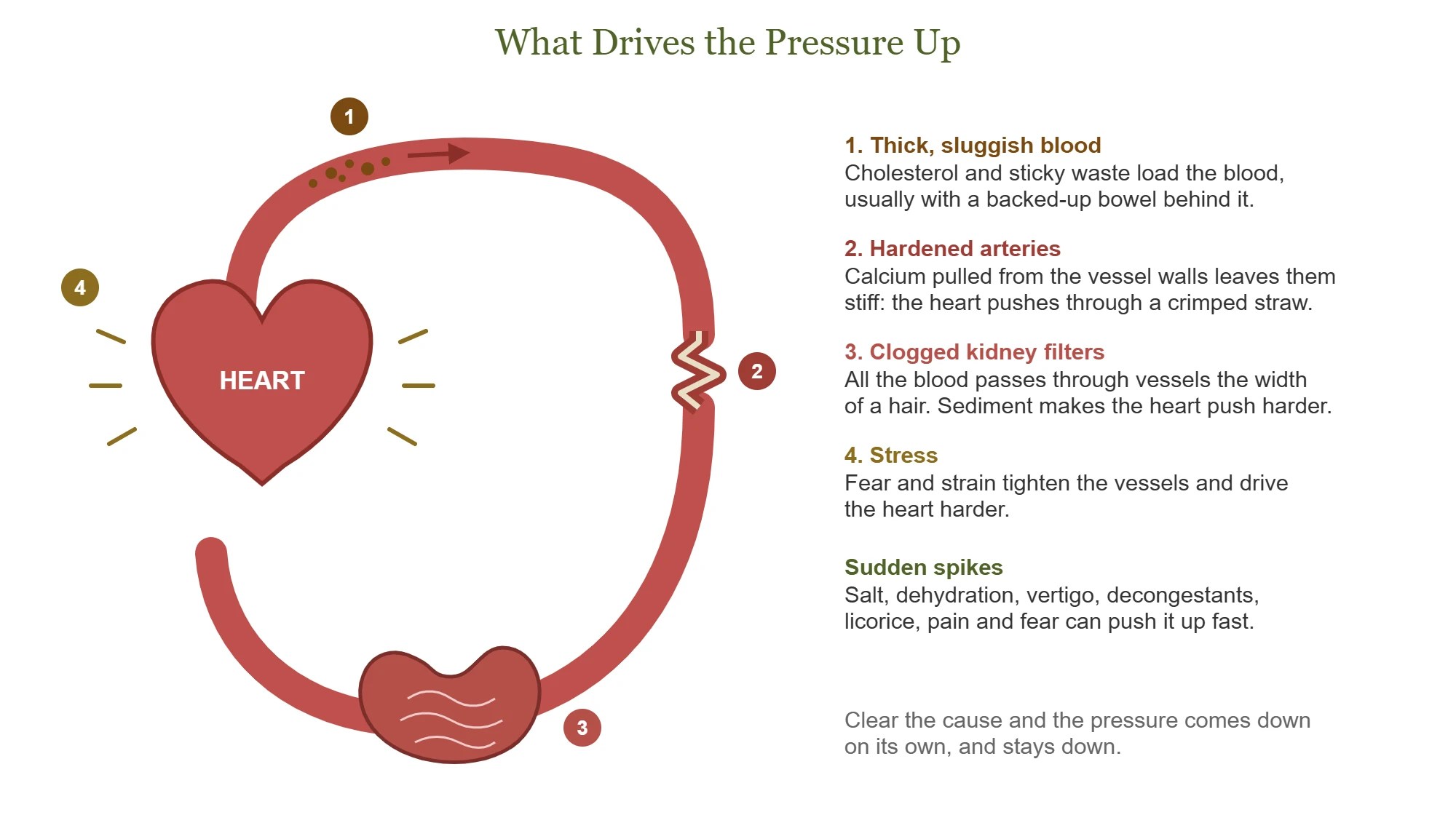
Ripe red raspberries and green raspberry leaves on a sunlit bush.
Herbal Healing, Women's & Men's Health

Breast Health

Tenderness, Nursing, Plugged Ducts, Mastitis, Sore Nipples and Benign Lumps

This sheet covers the everyday care of the breasts: the tenderness of growing up and of the monthly cycle, the troubles that can come with nursing a baby, and the lumps that are not cancer. Breast cancer has its own sheet, and the Tumors & Lumps sheet explains the difference between a harmless lump and one that needs a closer look. Any new lump gets checked.

Understanding the Condition

How the Healthy Breast Works

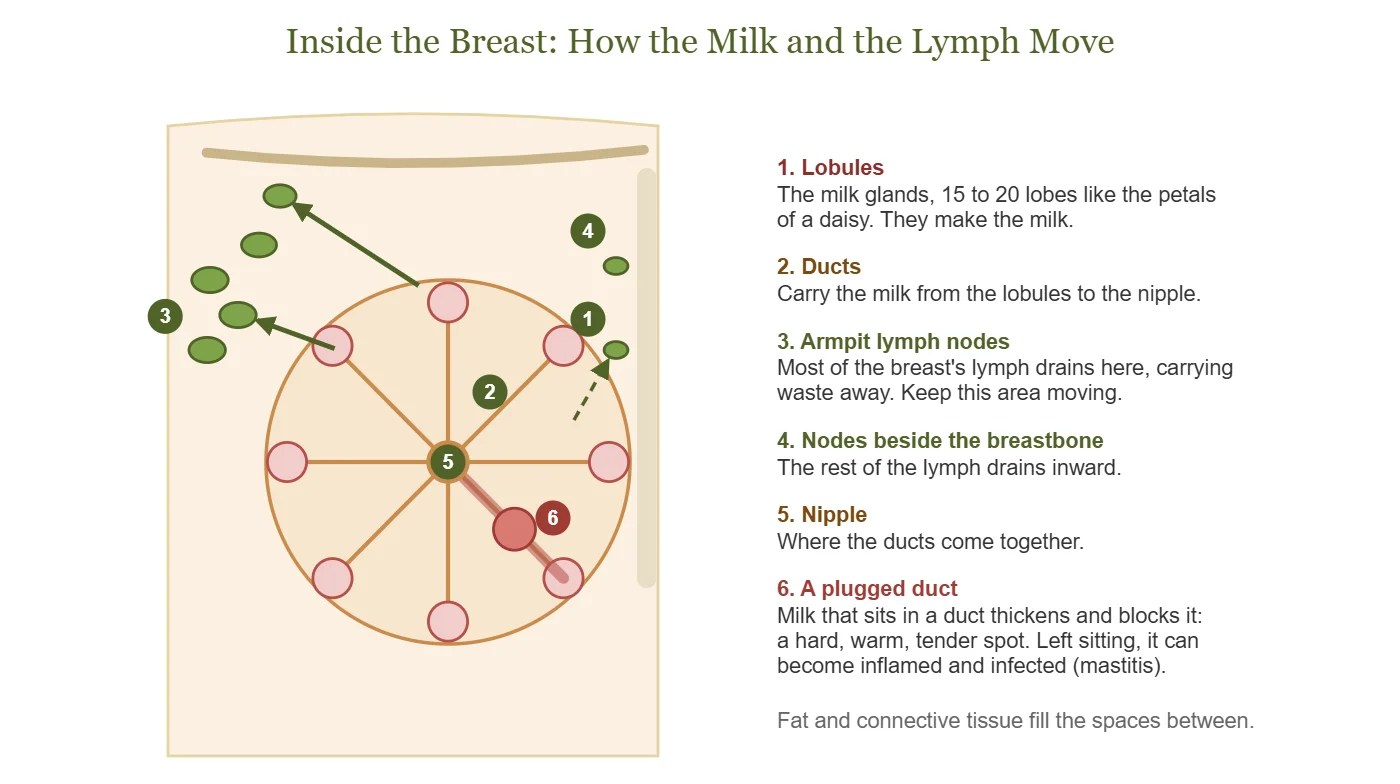
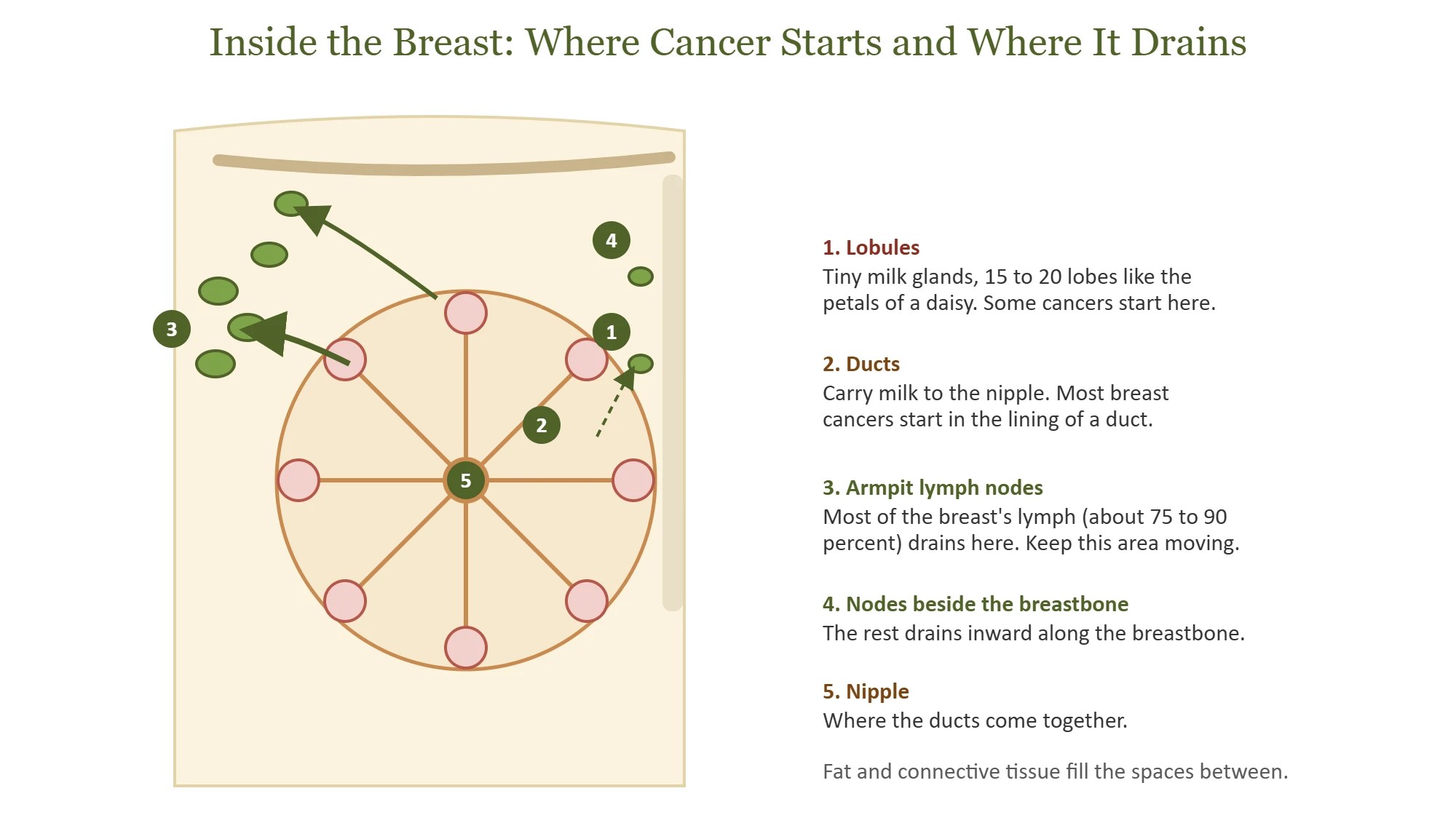
The breast is a gland, not a muscle. Each breast has 15 to 20 lobes, arranged like the petals of a daisy, and each lobe holds many small lobules, the milk glands. Thin ducts carry the milk from the lobules to the nipple. Fat and connective tissue fill the spaces between and give the breast its shape.

Woven all through the breast are blood vessels and a fine network of lymph vessels. The lymph carries waste out of the breast to the lymph nodes, most of it to the nodes under the arm. The lymph has no heart to pump it; it depends on movement, breathing and loose clothing. When the lymph backs up, the breast becomes congested, tender and lumpy.

Diagram of the inside of the breast showing the lobules, ducts, nipple, lymph nodes and a plugged duct.

Inside the breast: the lobules make the milk, the ducts carry it to the nipple, and the lymph drains toward the armpit. Diagram drawn for H.E.A.L.

Tenderness in Girls and Women

A girl’s breasts begin with a small, tender “breast bud” under the nipple, and it is normal for that new tissue to ache as it grows. The same hormones keep working through the monthly cycle: in the days before a period the breast tissue holds extra water, and the stretching makes the breasts swollen and sore. This tenderness comes and goes with the cycle and is a sign of healthy development, not disease. What deserves attention at any age is a lump that is hard, stays on one side, or does not come and go with the cycle.

Nursing: When the Milk Does Not Move

A mother’s body makes milk on demand: the more the baby nurses, the more milk is made. Nearly every nursing trouble comes back to milk that is not moving out of the breast.

  • Engorgement. In the first days after birth, as the milk comes in, the breasts can become full, hard and painful. A baby may have trouble latching onto a breast that is too full.
  • A plugged duct. When milk sits in a duct, from a poor latch, missed feedings, a sleepy baby, or pressure from a tight bra or a baby carrier, it thickens and blocks the duct. It shows up as a hard, warm, tender spot.
  • Mastitis. Left sitting, that stagnant milk can become inflamed and infected, especially when bacteria get in through a cracked nipple. Mastitis often comes on fast: a hot, red, swollen and painful area of the breast, sometimes with red streaks, along with fever, chills and flu-like aches.

Many breast infections come from an exhausted mother. Stress, little sleep and a run-down body leave the immune system too tired to keep up. A midwife’s observation from my old files is worth keeping too: a calcium imbalance in the body can be part of what sets up a breast infection.

Sore and Cracked Nipples

Tender nipples are common in the first days of nursing while mother and baby learn together. A poor latch, a baby who chews or pulls, or skin that stays wet can lead to soreness and cracks. A crack is more than a pain; it is an open door for infection to get into the breast.

Lumps That Are Not Cancer

Most breast lumps are not cancer. The most common are:

  • Fibrocystic breasts. Lumpy, rope-like, tender breasts that change with the monthly cycle and are often worse just before a period. More than half of women have these changes at some point in their lives.
  • Cysts. Round, fluid-filled sacs that can feel soft or firm and may come and go with the cycle.
  • Fibroadenomas. Smooth, rubbery lumps that move easily under the fingers, most common in young women.

Dr. Christopher taught that when toxic waste builds up from a poor diet, a sluggish bloodstream and poor circulation, the glands become congested and swell. The breast is a gland, and a lumpy, tender breast is often a congested one. Opening the lymph and keeping the liver and bowel clear gives that waste a way out.

When to See a Doctor

Have a doctor check: a new lump that does not go away after your next period; a lump that is hard or fixed in place; dimpling, puckering or an orange-peel look to the skin; a nipple that pulls in; or discharge from one nipple, especially bloody discharge, when you are not nursing.

For a nursing mother: if mastitis is not clearly better within a day, if the fever is high or keeps climbing, if red streaks spread, if a hot, painful lump may be an abscess, or if you feel very ill. Antibiotics are sometimes needed, and you can keep nursing while you take them.

Herbs and these home routines are support alongside medical care, not a replacement for it.

The Emotional Side: the Energy Work

Healing the whole person. We are body, mind and spirit, and all three must heal together. When one part is neglected, the other two cannot find complete healing.

The breast represents the nurturing of the self. So many women pour themselves out for everyone else and leave nothing for their own care. Healing the breast often means learning to receive care as well as give it.

A new mother whose nursing is not going well can carry a heavy load of guilt and a sense of failure. I know that feeling well (see my story at the end of this sheet). Be gentle with yourself. Rest, ask for help, and let others care for you while you care for your baby.

Louise Hay, in her book Heal Your Body, describes these patterns:

  • Breasts: represent mothering and nurturing and nourishment. Turn it around: “I take in and give out nourishment in perfect balance.”
  • Breast problems (cysts, lumps, soreness, mastitis): “A refusal to nourish the self. Putting everyone else first.” Overmothering, overprotection, overbearing attitudes. Turn it around: “I am important. I count. I now care for and nourish myself with love and with joy. I allow others the freedom to be who they are.”

Emotional patterns quoted and paraphrased from Louise Hay, Heal Your Body (Hay House). These are not faults to blame anyone for; they are a reminder of how much the heart is carrying.

Areas Affected & Opening the Way to Healing

The breast depends on milk that keeps moving, lymph that keeps draining, and a liver and bowel that carry the waste away. Open those, keep the circulation flowing, and the breast can clear itself.

Opening the Way to Healing

1. Clear the blockage.

2. Get the healing nutrients into the area.

3. Let sunshine and fresh air cycle over and through the affected part.

4. Bathe regularly.

5. Move the area as much as you can.

6. Know which area is truly affected. With a plugged duct or mastitis, the blockage is the milk that is not moving; keep it moving. With lumps and tenderness, it is the lymph under the arm and the liver and bowel behind it.

Engorgement and Plugged Ducts

  • Keep the milk moving. Nurse often, starting on the sore side, and empty the breast. If the baby can’t, express the milk by hand or with a pump.
  • A hot shower with firm but gentle massage. Let the hot water run over the breast while you massage the hard area toward the nipple to open the duct and get the milk flowing. Firm, but not rough; too much pressure can leave the breast bruised and sore for days.
  • A castor oil pack over the breast, with a hot water bottle, softens the hardness. Wipe the breast clean before the baby nurses.
  • The Charcoal & Flaxseed Poultice, laid on hot, draws and comforts.
  • Loose clothing. No tight bras or straps pressing on the breast.

Mastitis

We use salves, not fomentations; salves are what busy mothers will actually use.

  • M&L Salve first. Spread it over the sore area and up toward the armpit to open the lymph so the waste can move out. It may be all you need.
  • Healing Salve on top. Mastitis is a condition of inflammation, and the Healing Salve adds its anti-inflammatory support.
  • No salves on hand? A hot Charcoal & Flaxseed Poultice (the Infection Poultice) brings support, and the wet heat alone is very comforting.
  • Wipe the breast clean before nursing. The salves won’t make the baby sick, but the taste might keep the baby from wanting to eat.
  • On the inside: the mother takes regular adult doses; the baby receives only a small amount through the milk, and it usually helps. Echinacea is always good. The Gland Formula (the same herbs as the M&L Salve, as a liquid extract) opens the glands from the inside. Add Herbal Aid 2 if the breast is hot and inflamed. Skip Herbal Aid 1 while nursing: its garlic can change the taste of the milk, and some babies object.
  • Keep nursing on the sore side, or express the milk. Stopping makes it worse.
  • Rest and plenty of liquids. Rest is part of the treatment, not an afterthought.
  • The Calcium formula, taken through pregnancy and nursing, supports a mother who may be running low.

Sore and Cracked Nipples

  • Healing Salve after each feeding.
  • Infection Salve for a crack that looks like it may be getting infected. You would think it would taste bitter, but it really isn’t bad; we give the same herbs to small children and animals for their infections, and they take them easily.
  • M&L Salve is soothing to the soreness.
  • Keep the nipple clean, let it air dry, and wipe off any salve before the baby nurses.
  • Leave off anything bitter. BF&C Salve and goldenseal are good for healing, but they are too bitter; the baby may refuse the breast.

Bringing In the Milk

  • Fenugreek is the herb I reach for to increase a mother’s milk. I have no experience of my own with it, but the women I have worked with, including Rene Dietz and Breanne Fariss, have found it a real help. It is an important herb for the nursing mother.
  • Plenty of water, rest and good food. A tired, dry, underfed mother makes less milk.
  • Eat for the milk. From Breanne Fariss, a mother of several premature babies: “I was never very hungry after I had a baby. I really struggled with making myself eat, probably because all of my babies were premature and I was so focused on the baby. But I learned that I had to eat three significant meals a day, including first thing in the morning when I was least hungry, and they needed to be heavy with healthy carbs. If I didn’t eat in the morning, I wouldn’t have enough milk by the evening.” Think a big sandwich or two, rice and beans or a burrito, oatmeal, sweet potatoes, stuffed baked potatoes.
  • Nurse often. The more the baby nurses, the more milk is made.

Drying Up the Milk

From the mountains of North Carolina, shared by my longtime assistant, Kimala Snowden:

  • Cover the breasts with Watkins Mentholated Salve.
  • Wrap the breast area in a towel, pulled as tight as you can get it and pinned. As her mother said, “If you can breathe, it’s not tight enough.” It helps to have someone wrap it for you.
  • When the towel loosens, reapply the salve and wrap it again, as tight as you can.
  • Keep it wrapped, day and night, for as long as needed; most of the time it is only one to three days. Take it off only long enough to shower.
  • Have someone else feed the baby. Just being around a hungry baby can bring the milk down again.

Lumps, Cysts and Fibrocystic Breasts

  • Have every new lump checked so you know what you are working with.
  • M&L Salve under a castor oil pack over the breast every night, to open the lymph and soften the lumps.
  • The Poke Root Poultice is a blessing for women with a lot of lumps and bumps. The directions are on the Tumors & Lumps sheet.
  • Keep the lymph moving: rebound or walk every day, and wear loose, natural-fiber bras, or none at home.
  • Keep the bowel and liver clear with LBF and seasonal liver and kidney flushing, so the waste the breast lets go of has somewhere to go.
  • Try cutting caffeine. Some women find their breasts are less tender and lumpy when they cut out coffee, black tea, cola and chocolate. The research is mixed, but it costs nothing to try: go without for two months and see what your own body tells you.

Use With Care: Poke Root

Poke root is a powerful lymphatic cleanser and should be used with respect. Used too freely it causes uncontrolled vomiting; internally, use it only in a blend with other herbs, never alone. On the skin it is strong enough to burn and blister if the body is not ready; if that happens, take the poultice off, use warm charcoal and flaxseed poultices, and let the skin heal before trying again. Not while nursing or pregnant. Keep the fresh root away from children and pets.

Teenage and Monthly Tenderness

  • Reassurance first. It is a normal part of growing up and of the monthly cycle.
  • A warm castor oil pack eases the ache during a tender week.
  • Female Formula helps balance the cycle.
  • Cut the junk food. The food program for some teens is horrid. If they want to feel their best, the junk food has to go.

Use distilled water for all teas, and when taking your extracts in hot water.

Level of Commitment

  • Gentle support. For monthly or teenage tenderness, sore nipples, or an occasional plugged duct: the salves, castor oil packs, rest, good food, plenty of water, and loose clothing. Most nursing troubles clear in a few days.
  • Focused cleansing. For mastitis that keeps coming back, or fibrocystic breasts and cysts: all of the above, plus bowel cleansing, a week of liver flushing followed by a week of kidney flushing, nightly M&L Salve under a castor oil pack, and the Poke Root Poultice for many lumps. Give it two or three months.
  • Incurables Program. Not needed for the troubles on this sheet. For a diagnosed breast cancer, see the Breast Cancer sheet.

More Is Not Faster

These doses are set to what the body can clear. Taking more stirs up more than the bowels, liver and kidneys can carry out, and that is when cleansing starts to feel like poisoning. Healing the body requires steady, consistent nutrition and action, not a bigger dose.

People are different, and now and then someone reacts poorly to a particular herb. If that happens, stop it. What I offer here is a guideline. You are the one living in your body, so work with the Holy Spirit and the wisdom the Lord has given you to apply these supports in the best way for your life.

A Loose Healing Plan

  • A plugged duct or engorgement (first hours): nurse often from the sore side; a hot shower with firm but gentle massage; a castor oil pack or hot Charcoal & Flaxseed Poultice between feedings; loose clothing. Most open within a day or two.
  • Mastitis (day 1): M&L Salve, then Healing Salve, several times a day; Echinacea, the Gland Formula, and Herbal Aid 2 if hot and inflamed; keep nursing; rest and drink plenty. If it is not clearly better within a day, or the fever climbs, see a doctor.
  • Sore or cracked nipples: Healing Salve or Infection Salve after every feeding; keep clean and dry; wipe clean before the next feeding.
  • Low milk: fenugreek, plenty of water, rest, good food, and nurse often.
  • Weaning: Kimala’s salve and tight towel wrap for one to three days, with someone else feeding the baby.
  • Lumps and fibrocystic breasts: have it checked; nightly M&L Salve under a castor oil pack; move every day; cut caffeine for two months. After a month, see how the lumps change through your cycle; add liver and kidney flushing and the Poke Root Poultice if there are many.
  • All along: rest, receive care, and nourish yourself as well as everyone else.

Stories from the Work

Dara’s Story: I Felt Like Such a Failure

When my daughter, my only child, was born in February 1982, I had a plugged duct. It was painful, but I got it open and the milk flowing with a hot shower and massage. I really applied the pressure to the breast.

I remember I felt like such a failure to not be able to nurse my daughter. She was hungry and could not get milk from me. It was a horrible feeling of failure. I think this was the worst part of it all. The pain from the breast massage was nothing compared to the feeling I might not be able to nurse her.

Looking back, I was likely a little rough on myself. I was sore for a few days, but the milk did finally start flowing.

From Dr. Christopher: A Cold Night and a Hard Breast

Dr. Christopher’s daughter was nursing her baby on a hot night and left the window open. A cold breeze blew in while she wasn’t well covered, and by morning her breast was so hard and sore that she could hardly nurse at all; she tried until she felt like screaming. She called her father, about eighty miles away, who came with his mullein and lobelia fomentation. She applied it as hot as she could stand it, covered it with plastic and a towel, and by morning she was nursing the baby again with no pain and no more hardness.

Credited to Dr. John R. Christopher’s writings. Our M&L Salve is made from these same two herbs.

From Dr. Christopher: Mastitis in Roy, Utah

A nursing mother developed mastitis so severe that her breast was double its normal size and streaked with red, with a fever and flu-like misery; she could not let her hungry, crying baby nurse on that side. Dr. Christopher had her put on a mullein and lobelia fomentation under plastic, and drink half a cup of the tea every half hour until bedtime. The next morning she called to say the swelling, soreness and flu symptoms were gone, and the baby was nursing happily on that side again.

Credited to Dr. John R. Christopher’s writings.

From Dr. Christopher: Milk for an Adopted Baby

On a snowy day a woman came into Dr. Christopher’s office with a baby nursing at her breast. She had been planning to adopt and wanted to nurse. She took blessed thistle tea for a few days before the baby came, then simply put the infant to her breast, and it nursed right away. She had adopted three other children, but she said this one felt like her very own, because it was receiving her own milk.

Credited to Dr. John R. Christopher’s writings.

These stories are shared to show what the work can look like, not as a promise of results. Every body and every life is different, and the physical, spiritual and emotional life rise and fall together.

More on Women’s Health

This information is provided for educational purposes and reflects traditional herbal practice. It is not intended to diagnose, treat, cure, or prevent any disease. Please consult a qualified health practitioner regarding any health concern.

Herbal Healing, Pain, Joints & Injuries

A&R Salve for Painful Joints

Arthritis & Rheumatism Salve: a salve pack for painful, inflamed and arthritic joints

Members often ask me for the A&R Salve by name, so here it is in one place. A&R stands for Arthritis & Rheumatism. It is our Joint Support formula made as a salve. Dr. Christopher taught that this formula should be made both ways, as an extract to take by mouth and as a salve to work right at the joint, and we make it both ways. Laid on as a pack, it goes straight to where the pain is.

The Herbs in A&R Salve

  • Hydrangea Root. Dr. Christopher called it the solvent of solvents; there was no greater aid, he taught, for getting rid of stones and inorganic mineral deposits throughout the body.
  • Yucca Root. Long used to ease arthritic pain and reduce swelling and inflammation in the joints.
  • Mormon Tea. An aid for reducing swelling and inflammation, long used as a blood purifier and for rheumatism.
  • Chaparral. A strong blood purifier and anti-rheumatic, long used in rheumatism and as a poultice for body pains.
  • Black Walnut Hulls. A powerful cleansing herb rich in organic iodine, antiseptic and anti-fungal.
  • Burdock Root. One of the best blood-purifying herbs in nature.
  • Sarsaparilla Root. A tonic blood purifier, useful in rheumatism that stems from impure blood.
  • Wild Lettuce. A mild, calming herb long used to ease pain and nervousness.
  • Valerian Root. A nervine that calms and feeds frayed nerves and eases pain.
  • Black Cohosh. A nervine and antispasmodic that feeds, regulates and strengthens the nervous system.
  • Lobelia. Removes obstructions and congestion, especially in the blood vessels.
  • Wormwood. The most bitter herb there is, a stimulating tonic and antiseptic.
  • African Bird Pepper. A circulatory stimulant that brings fresh blood to the joint and carries the other herbs where they need to go.

How It Works

This combination brings together herbs that detoxify; herbs that act as a solvent for calcium deposits the body has accepted but not assimilated; herbs that relieve pain; herbs rich in organic calcium the body can actually use; and herbs that fight fungus and infection.

An arthritic flare can often be calmed in a few hours with the salve. For a joint that has been stiff and painful for a long time, there is a longer rebuilding job to do, and steady overnight packs with the extract taken by mouth bring gradual relief.

How We Make It

The herbs are fully extracted in extra virgin olive oil in a 150° oven for three hours, then the spent herbs are swapped for fresh and the same oil is run through again, three times in all. Beeswax is then added to bring the infused oil to a salve.

How to Use It

  • As a pack: spread the salve on flannel, lay it over the painful or inflamed joint, and hold it in place with Press’n Seal wrap. Dramatic results often appear when the pack is left on overnight.
  • For a flare: lay a thick layer of salve over the whole joint, wrap it with gauze, and leave it on.
  • With the extract: for joints that ache every day, take Joint Support extract, ½ to 1 teaspoon in a cup of hot distilled water, two to three times a day, while you use the salve packs.

Pairs Well With BF&C Salve

A&R Salve takes down the inflammation so healing can begin, and BF&C (Bone, Flesh & Cartilage) knits the damaged joint back together. The two work very differently and work well together. Use both as packs over extremely painful or crippled areas.

My Story: A Finger Shooting Bullets

I do a lot of work with my hands: embroidering, painting and all types of crafts to keep myself occupied. I woke up one morning and my index finger was shooting bullets of pain I did not know it had the gun to shoot. On a scale of 1 to 10 it was well into the 9 range. I could hardly stand to touch it, and I could not bend it or move it at all without a lot of pain. I laid a thick layer of the A&R Salve over the entire finger, wrapped it with a roll of gauze and tried to ignore it. By lunchtime the pain was gone, and it did not come back. That was about four hours.

More on Joints

This information is provided for educational purposes as part of traditional herbal practice and is not intended to diagnose, treat, cure, or prevent any disease. Always consult a qualified healthcare provider regarding any health condition.

Two tufted titmice perched together on an iron hook, one holding a seed
1 Corinthians, Bible Studies, Spiritual Healing

Like Hearts Drawn Together

Reflections on 1 Corinthians 11:19

A close cluster of pink azalea blossoms
Like hearts are drawn together and bloom side by side.

“No doubt there have to be differences among you to show which of you have God’s approval.” (1 Corinthians 11:19, NIV)

“But I suppose you feel this is necessary so that you who are always right will become known and recognized!” (Living Bible)

Some mornings a verse surprises me. Paul has just said he hears there are divisions among the Corinthian believers, and then he says something that sounds almost like permission: there must be divisions among you.

Translation after translation says it plainly. Knox speaks of those who are “true metal.” The TEV says the ones in the right may be clearly seen. Then I came to the Living Bible, and it turned the whole thing around.

Which Is It?

Is Paul saying the factions come from the ego of strong-minded believers, each collecting followers so they can stand out from the rest? Or is he saying divisions are a natural outcome, something to be expected as people’s heart convictions draw others of like heart together?

I believe Paul had a real insight here, and it is too important to toss aside as sarcasm. Divisions are to be expected, not because of pride or selfish hearts wanting followers, but because like hearts are drawn together. When they meet, they enjoy conversation shared freely at the level of their own spiritual maturity. They become sounding boards for one another’s newly formed thoughts, trusting the integrity and understanding of those they share with.

That is a good thing. To gather with others of like mind, for the purpose of stirring the heart and mind toward God, is a worthwhile pursuit. Every member, at every level, needs such a group: an open group where they can be fed, share freely, and be valued for what they understand.

Iron Sharpens Iron

There is a natural reason for this. Iron sharpens iron (Proverbs 27:17). A mind is honed against a mind of similar strength; you cannot sharpen your thinking on a mind less capable than your own. Strength of mind and intellect are gifts from God, given to be used in His service, and we naturally form our closest relationships around those we can share with, who bless us as we bless them. That is not exclusiveness. It is simply how communities and life actually work.

Picture a third grader sitting in on a college course discussion, thinking he can contribute. He is not lesser for being there; he simply cannot yet sharpen or be sharpened in that room. I have been in rooms where the minds around me towered over mine and I could barely follow along. I kept my mouth shut and soaked it in like a sponge, and I came away richer. There is snobbery on both sides of this. Those with a strong intellect must not look down on others, and those without it need to accept that God gives each of us different gifts, and this may not be one of ours. Paul says as much in the very next chapter: there are different gifts, but the same Spirit (1 Corinthians 12:4).

Someone Further Down the Road

But every group also needs someone a little further down the road. A circle of young believers left to itself tends to stay where it is. It needs a stronger, more mature believer to nurture it and draw it toward more beneficial things. That kind of mentoring seems to have been missing in the young church at Corinth, and the camps were becoming exclusive and hostile toward one another.

When the Focus Moves

People gathering with others of like heart is not the problem. The problem is the unsanctified, prideful, selfish heart that finds itself at an immature level and decides to settle in, put down roots and stay there, refusing to keep learning and growing.

Of course, as humans we want others to agree with us. So we use the power of our personality, persuasion and position to convince others to follow our lead. And slowly the focus moves. It is no longer on Christ, on building up His body, on our own growth and healing, or on blessing our fellow man with the glorious Truth of salvation, Love and Grace flowing freely from Christ. Instead it is about our pride, our fear of change, and our wanting to be in control.

This is not just Corinth. It is every society, every family circle. It is human nature, unhealed human nature.

Paul Had This

Paul needed to refocus his fledgling fellowship before they self-destructed and lost their peace and joy in this life, and their future glory with it. That work takes an understanding of people and of human nature, strongly developed, along with wisdom that comes from the heart of God and a great deal of patience. Mostly it takes Love, true love for people.

Paul had this.

And this is the work we are called to as well. We cannot bless people if we do not know them, and we will not know them if we have no interest in who they are. Where are they on the road? What can they receive today? Who is walking beside them? The answers begin with caring enough to ask.

Cleansing & Flushing, Herbal Healing

Breast Cancer

This sheet is part of the cancer series. The Cancer sheet explains what allows cancer to form anywhere in the body and lays out the full Incurables Program. This sheet covers what is particular to the breast. Everyday breast care (tenderness, nursing, plugged ducts and mastitis) is on the Breast Health sheet.

Understanding the Condition

How the Healthy Breast Works

The breast is a gland, not a muscle. Each breast has three main parts: lobules, ducts and connective tissue (CDC). Each breast has 15 to 20 lobes, arranged like the petals of a daisy, and each lobe holds many small lobules, the milk glands. Thin ducts carry the milk from the lobules to the nipple. Fat and connective tissue fill the spaces between and give the breast its shape.

Woven all through the breast are blood vessels and a fine network of lymph vessels. The lymph carries waste out of the breast tissue to the lymph nodes. About 75 to 90 percent of the breast’s lymph drains to the nodes under the arm on the same side; the rest drains inward to nodes along the breastbone. That pathway matters a great deal: it is the road waste must travel to leave the breast, and it is the road cancer travels when it spreads.

Inside the breast: lobules, ducts, nipple and the lymph nodes the breast drains to

Inside the breast: the lobules and ducts where cancer starts, and the lymph nodes the breast drains into. Simplified diagram drawn for H.E.A.L.

How Breast Cancer Forms

Breast cancer follows the same road down that the Cancer sheet describes: years of waste coming in faster than the bowel, liver, kidneys and lymph can carry it out, until the tissue is starved, congested and changing from its designed structure. It settles in the breast because the breast is where that woman’s tissue is weakest and most burdened.

  • Hormones. Breast tissue grows and changes with every monthly cycle, driven by estrogen and progesterone. Estrogen and progesterone are broken down mainly in the liver before they leave the body. A congested liver that cannot keep up leaves the breast bathed in old hormones longer.
  • Stagnant lymph. When the lymph under the arm and around the breast backs up, waste sits in the breast tissue instead of moving out. The lymph has no heart to pump it; it depends heavily on movement and breathing, so little movement and shallow breathing slow it further.
  • Lifestyle. The CDC lists these risk factors a woman can change: not being physically active, being overweight after menopause, certain menopausal hormone therapy and some birth control pills, a first pregnancy after 30, not breastfeeding, and drinking alcohol, with risk rising as intake rises. Smoking, chemical exposure and night-shift work may also raise risk.
  • What can’t be changed. Getting older, inherited genes such as BRCA1 and BRCA2, early periods or late menopause, dense breasts, and a family history of breast or ovarian cancer (CDC). As Dr. Joel Robbins teaches, a tendency is only a weak spot, not a sentence. It shows itself when the laws of health are broken, and then the trouble shows up in the weakest tissue first.
  • Breastfeeding protects. Across 47 studies in 30 countries, every 12 months of breastfeeding lowered a woman’s breast cancer risk by about 4.3 percent, on top of about 7 percent for each birth (Collaborative Group on Hormonal Factors in Breast Cancer, The Lancet, 2002).

About 1 in 8 women in the United States will be diagnosed with breast cancer in her lifetime (American Cancer Society, 2026).

How It Progresses

Most breast cancers begin in the ducts or the lobules (CDC). Invasive ductal carcinoma, starting in the lining of a milk duct, is by far the most common type, about 70 to 80 percent of cases; invasive lobular carcinoma, starting in the lobules, is the next most common.

  • Cancer in place (DCIS). Abnormal cells sit inside the lining of a duct and have not broken through. This is the easiest stage to turn around.
  • Invasive. The cells break through the duct or lobule wall into the breast tissue around it.
  • Lymph nodes. Cells travel along the lymph, most often first to the nodes under the arm.
  • Distant spread. In time, cells can travel to the bones, liver, lungs or brain.

Know Your Breasts, and Have Changes Checked

Have a doctor check any of these warning signs (CDC): a new lump in the breast or underarm; thickening or swelling of part of the breast; irritation or dimpling of the breast skin; redness or flaky skin in the nipple area or the breast; the nipple pulling in, or pain in the nipple area; nipple discharge other than breast milk, including blood; any change in the size or shape of the breast; or pain in any area of the breast. These can also be caused by conditions that are not cancer, but every one deserves a look.

Imaging (mammogram, ultrasound or MRI) can show where a lump is and how big it is. Only a biopsy can tell for certain whether it is cancer. My caution about biopsy is on the Tumors & Lumps sheet; talk it over with your doctor and weigh what you will gain from knowing. Breast cancer is a serious, life-threatening disease. Herbs and cleansing are support alongside medical care, not a replacement for it. If you are having surgery, radiation, chemotherapy or hormone-blocking drugs, tell your doctor what you are doing.

The Emotional Side: the Energy Work

Healing the whole person. We are body, mind and spirit, and all three must heal together. When one part is neglected, the other two cannot find complete healing.

The breast represents the nurturing of the self. I have seen this again and again: women who have done the perfect herbal program and still not healed, because they stayed in abusive or degrading marriages, or never learned to nurture themselves. So many women pour themselves out for everyone else and leave nothing for their own care. Healing the breast often means learning to receive care as well as give it.

Louise Hay, in her book Heal Your Body, describes these patterns:

  • Breasts: represent mothering and nurturing and nourishment. Turn it around: “I take in and give out nourishment in perfect balance.”
  • Breast problems (cysts, lumps, soreness): “A refusal to nourish the self. Putting everyone else first.” Overmothering, overprotection, overbearing attitudes. Turn it around: “I am important. I count. I now care for and nourish myself with love and with joy.”
  • Cancer: “Deep hurt. Longstanding resentment. Deep secret or grief eating away at the self. Carrying hatreds. ‘What’s the use?’” Turn it around: “I lovingly forgive and release all of the past. I choose to fill my world with joy. I love and approve of myself.”

Emotional patterns quoted and paraphrased from Louise Hay, Heal Your Body (Hay House). These are not faults to blame anyone for; they are a reminder of how much the heart is carrying.

Areas Affected & Opening the Way to Healing

The breast is where the cancer shows, but the work starts with the whole body. First establish the full program on the Cancer sheet: the foundational programs (Echinacea, bowel cleansing and nutrition), liver and kidney flushing, the Blood Purifying or Detox Formula, Essiac, the food program and juicing, and the hydrotherapy. Then work on three areas: the liver, which must clear the hormones and the waste; the lymph under the arm and along the breastbone, which is the breast’s drain; and the breast itself.

Opening the Way to Healing

1. Clear the blockage.

2. Get the healing nutrients into the area.

3. Let sunshine and fresh air cycle over and through the affected part.

4. Bathe regularly.

5. Move the area as much as you can.

6. Know which area is truly affected. With breast cancer the lump is where you see it, but the liver, the bowel and the lymph under the arm are where it is held. Keep them open, or the breast has nowhere to send its waste.

Keep the Liver Clearing

  • Castor oil pack over the liver every night, with a hot water bottle.
  • Liver flushing on the schedule in the Cancer sheet, and an ELF (Emergency Liver Flush) each night for up to five nights in a row while the poultice is drawing.
  • The bowels must move. If they begin to tighten, increase the Lower Bowel Formula (LBF #1) until they are moving well again. Waste drawn out of the breast has to leave through the bowel.

Keep the Lymph Moving

  • M&L Salve over the breast and over any swollen lymph nodes, under the arm and along the breastbone, several times a day. It opens the area so the waste can move out through the lymph.
  • Hot charcoal and flaxseed poultice over swollen lymph nodes and over the liver during the day, as hot as can be tolerated, changed every 3 or 4 hours, and again at bedtime for the whole night. It draws waste out and keeps the lymph from backing up. Never reuse a poultice.
  • Mullein and lobelia fomentation. Dr. Christopher’s glandular fomentation: a tea of 3 parts mullein to 1 part lobelia, soaked into a natural-fiber cloth, laid over the swollen glands as warm as possible, covered with plastic and left on all night. He also had it taken as a tea, ½ cup three times a day.
  • Rebound 10 to 15 minutes a couple of times a day. The lymph has no heart to pump it; it depends heavily on movement and breathing.
  • Hot and cold showers, paying special attention to the breast and underarm, and dry skin brushing toward the armpit and the heart.
  • Wear loose, natural-fiber clothing, and give the breasts time free of anything that binds the armpit, especially at night.
  • The Prune Juice Flush is a good lymphatic flush to add while the poultice is drawing. Expect loose, watery stools: you are dumping old, stagnant lymph fluid, and that is what you want. Don’t worry about it; just stay well hydrated with distilled water and herbal teas. Directions are on its direction sheet.

Working on the Breast Itself

Two strong poultices draw the waste out of the breast through the skin. Both are powerful tools that belong with the Incurables Program, never on their own; the body needs clear, open channels to carry away what they draw out.

The Black Cancer Poultice has been a huge aid with breast tumors. Smear a generous amount onto flannel, lay it over the tumor and bandage it in place; leave it on overnight or 6 to 8 hours, alternating with the castor oil pack. The full recipe and directions are on the Tumors & Lumps sheet. It contains bloodroot, a strong herb: stop if the healthy skin around the area becomes raw, blistered or very painful. When bleeders begin, add cayenne to the poultice; if a bleed breaks through, pack it with cayenne powder and call your doctor that same day. Bleeding that does not slow with pressure, or signs of infection (fever, spreading redness or red streaks, foul-smelling pus with fever), need emergency care.

The Poke Root Poultice for the Breast

Dr. Christopher’s poke root and bayberry poultice for cancer of the breast, after Dr. Jethro Kloss. We developed the supporting program around it with a young woman who had been doing a faithful Incurables Program for over a month before she began. Read these directions carefully, and read them again.

  • When to begin. Establish the foundational programs, then do a week of liver flushing followed by a week of kidney flushing. Begin the poultice during the second liver flushing week.
  • Increase Echinacea to two ounces a day, six days a week, the whole time the poultice is being used. The poultice breaks down a great deal of tissue, and the immune system has to be strong enough to handle that much die-off.
  • If you have an autoimmune condition, talk with Dara before starting. Echinacea can overstimulate an immune system that is already attacking the body. In its place we use astragalus and marshmallow root. This is much slower, and the whole program has to be done in a gentler way so the body can handle the detoxing. Some people are able to use Echinacea later, once their system has healed and cleared; others never can.
  • You need: fresh poke root, ground fine; bayberry powder; and, only if the root is dry, poke root extract diluted to 1/16 strength. Use fresh root each time and grind only enough for one use. Wear gloves when handling it.
  • Make it. Cut a piece of muslin or cheesecloth large enough to cover the breast, and cut a hole for the nipple before adding the root (it is much easier). Spread small spoonfuls of the ground root over the cloth and level it with a rolling pin, pressing it into the cloth, about ¼ to ½ inch deep (our member used ⅛ to ¼ inch).
  • Apply it. Lie down while your support person places it on you, root against the skin. Cover the back with a piece of old cotton T-shirt, then plastic wrap, and tape it snug to hold in the moisture. Moisten it once a day with the diluted extract only if the root is dry. Never use the extract full strength.
  • Change it every 2 to 3 days, depending on how much waste is coming from the breast. When the poultice is off, do hot and cold changes in the shower to open and drain the pustules. Fever, spreading redness or red streaks mean infection: see a doctor.
  • What to expect. Within about two weeks, often much sooner, the breast breaks out in pustular sores as the waste comes out through the skin. Continue one to two weeks after the breakout begins. If the lymph nodes become painful and swollen, take a break and let the body catch up: rebound, flush, and use the warm charcoal and flaxseed poultice.
  • Healing the skin. When the drainage stops, wash carefully with diluted apple cider vinegar, dust with bayberry powder and let the breast dry. The skin heals in about 7 to 10 days.
A member’s poke root poultice: the breakout of sores, the skin calming between rounds, and the used poultice

What to expect: a member’s poke root poultice, from left: the breakout of pustular sores as the waste comes out; the skin calming between rounds; the used poultice. Member photos, used with permission.

Use With Care: Poke Root

Poke root is a powerful lymphatic cleanser and should be used with respect. Used too freely it causes uncontrolled vomiting; internally, use it only in a blend with other herbs, never alone. On the skin it is strong enough to burn and blister if the extract is used full strength or the body is not ready. If that happens, take the poultice off, use warm charcoal and flaxseed poultices, and let the skin heal before trying again. If you feel weak, dizzy or faint, or begin vomiting, take the poultice off, wash the skin with soap and water, and call your doctor or Poison Control (1-800-222-1222). Keep the fresh root away from children and pets.

Rebuilding the Breast

  • BF&C (Bone, Flesh & Cartilage) feeds and knits the tissue back together: the extract at 1 teaspoon three times a day, and the BF&C Salve as an overnight pack once the area has softened, leaving the skin open and clear of salves for at least 6 hours each day.
  • Soothing. Once the drawing is done, aloe vera, slippery elm and comfrey are soothing and healing on the tissue. Dr. Richard Schulze taught that the same programs that remove a tumor also heal and regrow the breast, and that many women make the mistake of quitting as soon as the tumor is out.
  • Nutrition is the big key: the juicer going every day, Superfood, and the rest of the food program on the Cancer sheet.

Use distilled water for all teas, and when taking your extracts in hot water.

Level of Commitment

  • Gentle support. For keeping the breasts healthy, or for a woman with a family tendency who wants to stay ahead of it: an 80/20 food program, daily juice, seasonal cleansing, movement, loose clothing, and caring for herself as well as everyone else. Breastfeed your babies if you can.
  • Focused cleansing. For a lump that has been checked and is not cancer, such as a cyst or fibroadenoma: bowel cleansing, liver and kidney flushing, castor oil packs and M&L Salve over the area, and the charcoal and flaxseed poultice. See the Tumors & Lumps and Breast Health sheets.
  • Incurables Program. For any diagnosed breast cancer, including cancer still in place (DCIS). The full program on the Cancer sheet, full time, with the liver, lymph and breast work on this sheet. Plan on six months or longer, and don’t stop when the lump is gone.

More Is Not Faster

These doses are set to what the body can clear. Taking more stirs up more than the bowels, liver and kidneys can carry out, and that is when cleansing starts to feel like poisoning. Healing the body requires steady, consistent nutrition and action, not a bigger dose.

People are different, and now and then someone reacts poorly to a particular herb. If that happens, stop it. What I offer here is a guideline. You are the one living in your body, so work with the Holy Spirit and the wisdom the Lord has given you to apply these supports in the best way for your life.

A Loose Healing Plan

  • First: know what you are working with. Have the lump checked and learn its type, size and stage. Tell your doctor what you are doing.
  • Weeks 1 and 2: the foundation. The Cancer sheet’s program: food program or juice fast (at least 32 ounces of carrot juice a day), Superfood, Echinacea, LBF until the bowels move two or three times a day, castor oil packs over the liver nightly, hot and cold showers, rebounding. M&L Salve over the breast and underarm several times a day.
  • Week 3: liver flushing. Then Week 4: kidney flushing.
  • Week 5: the second liver flushing week. Begin the poke root poultice (or the Black Cancer Poultice), raise Echinacea, add nightly ELFs for up to five nights, and keep the charcoal and flaxseed poultice over the nodes and liver by day.
  • As the breast drains: keep the lymph moving, take breaks when the nodes swell, and keep flushing on schedule.
  • When the drawing is done: heal the skin with apple cider vinegar and bayberry, then rebuild with BF&C and soothing herbs.
  • All along: the heart work. Rest. Receive care. Let go of what you have been carrying. Put yourself on your own list.
  • Every month: take stock. Have the breast checked and measured. Keep going long after it looks clear.

Stories from the Work

A Member’s Story: Learning the Poke Root Poultice

A member in Michigan, diagnosed with invasive ductal carcinoma, sent in her pictures and her story so other women would know how to do this poultice. Her first attempt went badly because she misread the directions: she added undiluted extract to fresh root that was already moist, and it burned and blistered her skin and left her weak and dizzy. She healed within about a week. “Let me urge you to read and re-read these instructions carefully before doing this.”

Her second attempt, with no extract added, “produced amazing results.” Within a day the breast was covered in pustular sores: “It was amazing to see how much garbage was being pulled right out through my skin!” By the third day a sour-milk smell came from the sores, which she connected to her tumor being inside a milk duct. When her lymph nodes became painful and swollen, she took a break, did lymph cleansing, rebounding and liver flushing, and used warm charcoal and flaxseed poultices, and the pain quickly went away. Her advice: “Know that it isn’t pleasant, it isn’t comfortable, but it is powerful! Don’t be afraid of the sores and swelling.” A third try, after only a two-day break, burned and blistered her within an hour; her body needed more time. At the time she wrote, her tumor had not yet cleared: “My body is still working on that.”

Her story is shared to show what the poultice process looks like, not as a promise of results. Every body and every life is different, and healing asks for the whole person: diet, cleansing, emotions and faith together. The physical, spiritual and emotional life rise and fall together; if one is not being nurtured and healed, it will pull the others down or hold them back.

From Dr. Christopher: The Woman on the Airplane

On a flight to Toronto, Dr. Christopher sat beside a woman who told him her story. She had lost one breast to cancer, then the other six months later, and six months after that the doctors wanted to remove her reproductive organs and part of her bowel. She refused further surgery and chemotherapy, went home and prayed, and felt led to change her diet: fruits, vegetables, grains, nuts and seeds, as much as possible raw. A few months later her doctor found her amazingly improved, with only a little cancer showing on her Pap smear. After a few more months on natural foods, even that cleared. She spent years afterward traveling the country telling women what had helped her.

Credited to Dr. John R. Christopher’s writings.

More on Breast Cancer

Cleansing & Flushing, Herbal Healing

Cancer

Understanding the Condition

A Word That Brings Fear

Few words stop us cold the way “cancer” does. The fear is understandable, but fear is a poor guide. Understanding what cancer is, and what has to happen inside a body before it can take hold, takes away much of the fear and shows the way to clearing it. Dr. Christopher preferred the words “cell deterioration,” because they describe what is really happening better than the word “cancer” does.

How Healthy Cells Live

Your body is made of trillions of cells, and every one of them is born, does its work, wears out and is replaced in an orderly way. Skin, the lining of the bowel and the blood are renewed constantly. Healthy cells grow only when the body needs them, stay in their own place, and die off when they are damaged or no longer needed. To do this, every cell needs three things every day: good nutrition carried in by the blood, oxygen, and a clean way for its waste to be carried off through the lymph, the liver, the kidneys, the bowel, the lungs and the skin.

The body also keeps its own guard. Every day a few cells are copied wrong. The immune system, including the white blood cells called natural killer cells, finds these abnormal cells and clears them away long before they can cause trouble. Researchers call this immune surveillance. A body with a strong immune system and open channels of elimination handles these mistakes quietly, every day of our lives.

What Cancer Is

Cancer is cells growing out of order. A group of cells stops listening to the body’s signals. They keep dividing when they should rest, they do not die when they should, and they crowd into a mass. Unlike a benign tumor, a cancer has no smooth wall around it. It reaches into the tissue around it like roots, and cells can break away into the blood or lymph and start new growths somewhere else (Medline Plus; American Cancer Society). Cancer is named by where it begins: breast, colon, prostate, lung, skin, blood and so on.

Not every lump is cancer, and most are not. The Tumors & Lumps sheet explains benign and malignant tumors and the lumps that are not tumors at all, and it gives the full directions for the poultices and packs mentioned on this sheet.

What Allows Cancer to Form

Natural healing asks a different question than “How do we kill it?” It asks, “What happened in this body that the guard could no longer keep up?” Dr. Christopher taught that cancer is not an isolated problem. It shows up in an old injury or a weakened part of the body because the whole bloodstream is carrying more waste than the body can clear, and it settles where the tissue is weakest. In his words, it “is a systematic disease. It depends on filth in the bowel and the blood stream.” That is why cutting it out, by itself, so often fails: the cancer “breaks out in another place.” The bloodstream must be cleaned.

Dr. Joel Robbins’ article Health Through Nutrition gives one of the clearest pictures I know of how a body travels down to cancer. I have shared it with my members for years. Here is the heart of it in plain words.

The road down to cancer and the way back up

The road down to cancer and the way back up, after Dr. Joel Robbins’ “The Disease Process” in Health Through Nutrition. Diagram drawn for H.E.A.L.

  • Disease is the body’s effort to keep us alive. The body is designed only for health. When we break the laws it runs by, it does not quit; it makes the best adjustment it can to survive. That adjustment is what we call disease. “We do not ‘catch’ a disease or illness, we earn it.”
  • Waste comes in by mouth and by breath. At first the body refuses it: we cough, sneeze, gag or turn away from what burns. Sugar and habit override those warnings, and the bowel takes over, throwing waste out by vomiting and diarrhea.
  • The liver takes the load. When the bowel can no longer keep the waste out, it is absorbed, and the liver must neutralize it before it reaches the blood. To protect itself and the blood, the liver begins to store what it cannot clear. It becomes congested, and everything it does for the body slows down.
  • The blood and tissues take the overflow. When the liver can hold no more, waste slips into the blood, and the body moves it out of the blood and into the tissues to keep the blood clean enough to live. Robbins calls a pocket of stored waste “a localized area of constipation.”
  • Acute cleansing. While the body still has strength, it pushes this waste out through the skin and mucous membranes: colds, fevers, rashes, sinus and ear trouble. These are cleansing efforts. When they are suppressed again and again and the waste keeps coming, the body loses the energy to throw it off.
  • Chronic, then stored. The cleansing becomes weak and lingering, a chronic disease. At last the body can only pack the waste deeper into the tissues. Robbins names arthritis, diabetes, senility and cancer as diseases of this deepest level.
  • Degeneration. Tissue that has been starved of nutrition and buried in its own waste for years begins to change from its designed structure. “The tissues, in essence, are mutated from their normal state.” This is the soil where cancer grows.

Robbins also explains why two people living the same way get different diseases. Four things decide it: our attitude, the kind and weight of the stress we put on the body, the body’s vitality, and our genetic tendency. A tendency is passed down from parents, but it is only a weak spot, not a sentence. It shows itself only when we break the laws of health, and then the trouble shows up in our weakest tissue first.

Source: Dr. Joel Robbins, D.C., N.D., M.D., Health Through Nutrition (Tulsa, Oklahoma). Quotations are his words.

Rabbits and Cigarette Tar

In the 1950s, Dr. Ernest Wynder and his colleagues produced cancers on rabbits’ ears and necks by painting them with tar from cigarette smoke over the animals’ life spans. The cancers came only after long, steady exposure. The study looked at the skin, not the inner organs, but what I take from it, and from what I have seen in my own work, is that before a tumor or cancer can form, the eliminative organs (the liver, kidneys and bowel) have already been worn down until they can no longer clear the waste. The cancer is not the real issue. It is a symptom of a degraded internal system. Not until those organs are rebuilt and able to carry out waste again can a body be truly free from cancer.

Study: E. L. Wynder (Sloan-Kettering Institute), E. A. Graham and A. B. Croninger (Washington University, St. Louis); rabbits painted with cigarette-smoke tar over their life spans (reported December 1957). The conclusion about the eliminative organs is my own teaching, not a finding of the study.

What Science Has Found

Much of what the old natural healers taught is now being described by researchers in their own words:

  • Cancer takes years to build. Most cancers grow slowly from the first changed cells. In the colon, “a polyp can take as many as 10 to 15 years to develop into cancer” (American Cancer Society). There is time to change the soil.
  • Cancer cells live in a starved, low-oxygen, acid place. Nearly a century ago, Dr. Otto Warburg found that cancer cells burn sugar by fermentation even when oxygen is present, leaving lactic acid behind. The tissue around a tumor becomes acid, about pH 6.0 to 6.5, and that acid weakens the immune cells sent to clear it (Warburg, Science, 1956; Barba and others, International Journal of Molecular Sciences, 2024).
  • Long-standing inflammation feeds cancer. The National Cancer Institute states that “over time, chronic inflammation can cause DNA damage and lead to cancer,” and people with long-term inflammatory bowel disease have more colon cancer.
  • Much cancer is preventable. The World Health Organization says “between 30–50% of all cancer cases are preventable,” naming tobacco, alcohol, poor diet, low activity, excess weight, infections, polluted air, workplace chemicals and radiation.
  • What we eat matters. In 2015 the World Health Organization’s cancer agency classed processed meat as a cause of cancer in humans (Group 1), mainly colon cancer, and red meat as a probable cause (Group 2A).

How Cancer Progresses

The medical picture and the natural healing picture describe the same road from two sides.

How cancer grows out of order, from healthy cells to spread

How cancer grows out of order, from changed cells to spread. Simplified diagram drawn for H.E.A.L.

  • Pre-cancer. Some cells in a tissue begin to look and act wrong. A doctor may call this dysplasia, atypical cells, or a precancerous polyp or spot. This is the easiest place to turn things around.
  • Cancer in place. The changed cells have become cancer but are still sitting in the lining where they began (“in situ”). They have not broken through.
  • Invasive cancer. The cells break through the floor of the tissue and grow into the tissue around them.
  • Spread. Cells travel in the lymph or blood. They often lodge first in the nearby lymph nodes, then in distant places, most often the bones, liver, lungs or brain. By now the whole body is deeply involved.

In natural healing terms, each stage is the body losing more ground: less vitality, more stored waste, and an immune guard that can no longer keep up. Some cancers move quickly. Among the most serious and fast moving are pancreatic and lung cancer. With these, the window for clearing is often very narrow, and even with the most aggressive natural programs the diagnosis can come too late. Others linger for years. The individual’s constitution matters too: someone strong in body, mind and spirit will usually have a much easier time clearing the disease.

Cleanse & Feed

Dr. Christopher taught cleansing and rebuilding, and I put it as “cleanse & feed.” You must cleanse out the waste while you feed and rebuild the system. Cancer and tumors do not appear in the body until there has been a serious degrade in the body’s organs, so understanding that a body which has developed cancer must be nourished and rebuilt is as important as supporting the liver in flushing out the waste.

The natural healing programs vary little from one condition to another. A case of hives and a case of cancer are cleared through the same channels. Hives usually clear quickly; cancer takes many months.

The Emotional Side: the Energy Work

Healing the whole person. We are body, mind and spirit, and all three must heal together. When one part is neglected, the other two cannot find complete healing. A person can follow a perfect herbal program, but if she stays in a life that keeps wearing her down, or never makes time to care for herself, the body will keep losing ground. Healing the body often means facing what is happening in the heart and spirit as well.

I have seen this again and again with breast cancer. The breast represents the nurturing of the self (Louise Hay also writes that the breast represents mothering, nurturing and nourishment). Women have done the perfect herbal program and still not healed because they stayed in abusive or degrading marriages, or never learned to nurture themselves. Dr. Robbins lists the same things among what decides how long healing takes: freedom from pent-up emotional scars, freedom from ongoing anxiety, spiritual alignment, and the amount of “want to” a person brings. Dr. Christopher often said, “There are no incurable diseases, but at times there are incurable patients.”

Louise Hay, in her book Heal Your Body, describes this pattern:

  • Cancer: “Deep hurt. Longstanding resentment. Deep secret or grief eating away at the self. Carrying hatreds. ‘What’s the use?’” Turn it around: “I lovingly forgive and release all of the past. I choose to fill my world with joy. I love and approve of myself.”

Emotional pattern quoted from Louise Hay, Heal Your Body (Hay House). This is not a fault to blame anyone for; it is a reminder of how much the heart is carrying. Forgiving everyone in your past, including your doctors, is part of the work.

Cancer Needs Medical Care

Cancer is a serious, life-threatening disease. Have any new or changing lump, a sore that will not heal, unusual bleeding or discharge, a change in bowel or bladder habits, a lasting cough or hoarseness, trouble swallowing, or unexplained weight loss, fevers or night sweats checked by a doctor. Only a doctor can diagnose cancer, and knowing its type, place and stage tells you how much time you have to work.

The choice of treatment is yours to make, with your eyes open. Herbs and cleansing are support alongside medical care, not a replacement for it. If you are having chemotherapy, radiation or surgery, or take any prescription, tell your doctor what you are doing; some herbs and flushing routines need to be timed around treatment. Don’t stop a prescribed medication without your doctor. If a tumor bleeds and does not stop quickly, or you have sudden severe pain, trouble breathing, confusion or a high fever, get help right away.

Areas Affected & Opening the Way to Healing

Cancer shows itself in one place, but it was built by the whole body. The work starts with the channels that carry waste out: the bowel, the liver (the vacuum cleaner of the body), the kidneys, the lymph, the skin and the lungs. Open those channels first. At the same time, flood the body with living nutrition so the immune system can do the work it was designed for. Then work directly on the site where the cancer is.

Opening the Way to Healing

1. Clear the blockage.

2. Get the healing nutrients into the area.

3. Let sunshine and fresh air cycle over and through the affected part.

4. Bathe regularly.

5. Move the area as much as you can.

6. Know which area is truly affected. Not where the symptoms show up, but the part causing the issue. That is the area that needs to be cleared. With cancer, the tumor is where you see it, but the bowel, the liver and the blood are where it comes from. Clear them, and the cancer has nothing left to feed on.

The Foundational Programs

Three programs must be established first and continued all through the healing: boosting the system with Echinacea, bowel cleansing, and nutritional support. Begin with these before you do a liver flush.

  • Bowel: the Lower Bowel Formula (LBF). Start with 1 capsule just after dinner and add one capsule each day until the bowels move two or three times a day. Once the bowel is working, add LBF #2, the drawing and detoxifying formula, to keep it clean.
  • Castor oil pack over the front of the body. Soak a flannel in castor oil, lay it over the whole front of the body (neck to groin), and put a hot water bottle over the liver for about 1½ hours. It turns years of “cement” in the bowel into soft mud that is easily evacuated, and softens the waste in the liver so the flushes work better.
  • Echinacea to build the immune guard: 2 dropperfuls four times a day on the full program. Echinacea is never alternated or rotated out. It is a steady-use formula that keeps the immune system fired up and able to deal with the healing process from beginning to end.
  • If you have an autoimmune condition, talk with Dara before starting. Echinacea can overstimulate an immune system that is already attacking the body. In its place we use astragalus and marshmallow root. This is much slower, and the whole program has to be done in a gentler way so the body can handle the detoxing. Some people are able to use Echinacea later, once their system has healed and cleared; others never can.

Clearing the Liver and Kidneys

Keeping your liver actively pulling and dumping waste is the key to removing any major disease. The liver is the organ that carries the waste of a tumor out of the body, through the bowel. On the full program:

  • A castor oil pack over the liver every night.
  • A week of liver flushing every other week, with a week of kidney flushing between, so the kidneys stay on top of what the liver releases.
  • An ELF (Emergency Liver Flush) three nights a week during both the liver and the kidney flushing weeks.

When what was working stops working, it is time to flush the liver again. The vacuum bag is full.

Cleansing the Blood and Lymph

  • The detox formulas: Blood Purifying or Detox Formula. H.E.A.L. has two anti-cancer detox formulas, and either one will do the work of supporting the liver to detox the blood and tissues. Use one; switching between them is fine if you can use both, but it isn’t necessary. The Blood Purifying Formula is free of cayenne and black walnut, so it is the one for anyone who should not use cayenne or has a nut allergy. It is Dr. Christopher’s Red Clover Combination, built on red clover, chaparral, burdock and poke root; he called it the same type of formula Harry Hoxsey used for years. Dr. Christopher taught that “the bloodstream must be cleaned,” and this is his formula for it. In my practice, many members have used it over the years to clear tumors. Take it as directed on its formula sheet, traditionally 2 dropperfuls 4 to 6 times a day during a cleanse week, in a few ounces of grape juice.
  • Essiac Tea. I use Essiac for cancer only. Its four herbs, burdock root, sheep sorrel, slippery elm and Turkish rhubarb root, cleanse the blood and lymph and keep the waste moving out through the bowel. For serious conditions, take up to 3 ounces three times a day, warmed or in hot water. The recipe and brewing directions are on the Essiac page.
  • Red clover tea for sipping through the day, with a very small amount of raw honey if desired.
  • Garlic. At least 3 cloves of fresh raw garlic every day, eaten, swallowed whole, chopped into food or put through the juicer. The hotter the better. If you take a blood thinner, or have surgery coming up, talk with your doctor first.
  • Move the lymph. The lymph has no heart to pump it; it depends heavily on movement and breathing. Rebound or walk every day, and keep M&L Salve over any swollen lymph nodes.

Using Chaparral, Poke Root and Comfrey With Care

Chaparral is one of the herbs in the Blood Purifying Formula, long regarded as one of the strongest blood purifiers and one of the herbs I have relied on most in cancer work. Stay at the dose on the formula sheet. Avoid it with existing liver disease. If the skin or the whites of the eyes turn yellow, the urine turns dark, or there is pain under the right ribs, stop and have the liver checked. Dr. Christopher noted that as chaparral pushes waste into a deposit, a growth can look larger for a time before it shrinks.

Poke root is a powerful lymphatic cleanser and should be used with respect. The amount in the detox formulas is safe, and it is a valuable tool for healing when used together with the entire Incurables Program. Used too freely it causes uncontrolled vomiting, so internally use it only in a blend with other herbs, never alone.

Comfrey is one of the nine herbs in BF&C, where it feeds and rebuilds tissue. Take the extract at 1 teaspoon three times a day. More is not faster.

Feeding the Body

Cleanse and feed: clear the waste out while flooding the body with nutrients at the level of the cell. Raw fruits and vegetables come to us as complete packages, with their enzymes, minerals and water still alive. Every step of processing takes more away, until fried, canned and additive-laden food gives nothing and adds toxins. Robbins urges a diet of 70 to 80 percent alkaline (mostly raw plant) foods.

  • The food program. For the first 30 days, all food is raw and vegan: vegetables, fruits, raw nuts and seeds, and soaked or sprouted beans and grains, as fresh, organic and local as you can get. No meat, eggs, milk or milk products, no cooked foods, and no alcohol, coffee, black tea or sugar. If you are seriously ill, a fresh juice fast for the full 30 days is stronger still: 8 to 10 ounces of fresh juice every hour, about a gallon a day. A juice fast is not for someone who is thin, frail or losing weight, or who has kidney disease or takes blood-pressure or heart medicine that raises potassium, without their doctor. Either way, juice fast at least one day each week. If you cannot get organic, don’t let that stop you; do the very best you can.
  • Fresh juice. At least 32 ounces of fresh carrot juice a day on the full program, or carrot, apple and parsley. Sip it slowly, by itself, not with food. A juicer is not an option; if you don’t have one, buy one.
  • Superfood. 2 tablespoons twice a day (a double dose), blended into 8 ounces of fresh juice, 8 ounces of distilled water and ½ to 1 cup of fresh fruit.
  • Potassium Broth. 1 to 3 cups a day between meals. The recipe is on the Tumors & Lumps sheet.
  • Protein in the morning only. Dr. Christopher taught that a person with cancer should not overdo protein, which he said overworks the pancreas. Eat 8 to 10 almonds in the morning and again at noon, no peanuts, and no protein from evening until the next morning, giving the body 16 to 18 hours of rest. No meat at all. If you are losing weight or muscle, work with your practitioner to be sure you are getting enough protein from plant foods.

Use distilled water for all teas, and when taking your extracts in hot water. If you use a hot water dispenser for your teas, using only distilled water greatly adds to the life of the unit.

Fasting: Giving the Body Time to Clean House

Dr. Christopher’s long overnight rest from food, the weekly juice-fast day, and the 30-day juice fast all give the body time to stop digesting and turn its energy to cleaning out. Research is now pointing the same way:

• A long overnight fast. In a study of 2,413 women with early breast cancer, those who went less than 13 hours overnight without food had a 36% higher chance of the cancer coming back than those who fasted 13 hours or more. Shorter fasting also went with higher blood sugar and less sleep, though there was no difference in survival (Marinac and others, JAMA Oncology, 2016).

• Less protein, especially animal protein. Among adults aged 50 to 65 followed for 18 years, a high-protein diet was linked to about four times the cancer death rate of a low-protein diet, tied mostly to animal protein and the growth hormone IGF-1. Over age 65 the pattern reversed, so older and frail people need enough protein (Levine and others, Cell Metabolism, 2014).

• Tree nuts over peanuts. Stage III colon cancer patients who ate at least two 1-ounce servings of nuts a week after surgery and chemotherapy had 42% better disease-free survival and 57% better overall survival; the benefit came from tree nuts such as almonds, not peanuts (Fadelu and others, Journal of Clinical Oncology, 2018). Peanuts can also carry aflatoxin, a mold toxin that causes liver cancer.

• Dr. Jason Fung, a kidney specialist known for his work on fasting, makes the case in The Cancer Code (2020) that cancer is fed by the body’s growth signals, insulin and growth factors, and that fasting and a whole-food diet turn those signals down.

Fasting is a strong tool. Someone who is thin, frail or losing weight, diabetic, or in active cancer treatment should work it out with their doctor first.

Water, Sun, Air and Movement

  • Hot and cold showers. One minute hot, then one minute cold, seven times over, about 15 minutes, finishing cold. Do two or three a day for the first 60 days, paying special attention to the affected area, then at least one a day. A person too weak to stand can have it given while lying in the tub.
  • The Cold Sheet Treatment twice a week while on the program, then once a week after you have turned a corner.
  • High enema with distilled water, using a tea of equal parts chaparral, Oregon grape root and red clover. How often depends on how well the bowels are working. Three times a week (every other day) is good. Once a day takes time, but it has its benefits: done first thing in the morning, it clears the bowels so you will likely not need to go again until the afternoon. If you do it daily, use BF&C Salve as the lubricant to protect the skin around the rectum.
  • Follow with an implant. After the high enema, put in a small amount to be held and absorbed. Soothing: 8 ounces of aloe vera gel with 8 ounces of distilled water. Detoxifying: 2 ounces of wheatgrass juice with 16 ounces of distilled water. Anti-bacterial, anti-viral and anti-fungal: 1 to 2 cloves of garlic blended into 8 ounces of raw apple cider vinegar and 8 ounces of distilled water; this one is an excellent healing aid but can be very intense. Red clover tea for blood cleansing and Echinacea root tea for the immune system also make good implants. Step-by-step directions are on the How to Do a High Enema page.
  • The skullcap and catnip liver dump. A really good herbal mix for getting the liver to release. Put 1 rounded tablespoon of skullcap and 1 rounded tablespoon of catnip in a 32-ounce jar, fill it with boiling distilled water, set a saucer or loose lid on top, and leave it in the bathroom overnight. In the morning, strain it into your final enema bag of water: a small strainer that fits over the mouth of the enema bag works perfectly, or strain it into another glass first and then add it to the bag. Hold it until the need to let it out is clear. It normally takes effect in 5 to 10 minutes, and the liver will release a good amount of toxic waste, so stay close to the bathroom. A wonderful way to start the day with a cleared-out liver. I find it better than a coffee enema: it gets the liver to release without stressing the endocrine system with too much stimulation from the caffeine.
  • Sun and air bath daily, built up slowly so you never burn (see The Sun: the Great Doctor below). Walk barefoot on grass or earth and breathe deeply outdoors. Sleep with the window open in summer and cracked in winter.
  • Skin brushing and massage. Brush the whole body daily with a natural-bristle brush, toward the heart. Massage daily, and don’t be afraid to touch the sore or sick area; put some life back there.
  • Exercise every day, as much as you are able, with a walker if you need one. Wear and sleep in natural fibers only: cotton, wool, linen or silk.

The Sun: the Great Doctor

Dr. Christopher called the sun “the Great Doctor of all times,” but warned that it “is like fire, which can either provide gentle warmth or it can burn a city down.” Used gradually and wisely, he taught, it heals where herbs and other procedures are slower, and it helps the skin with acne, eczema and other troubles. He saw skin cancer as coming from the inside: “it is the putrid condition of the body that is poisoning the tonsil, or the skin!” The sun, he said, does not create the cancer but can “ripen and bring the cancer that is already there to the surface, wherein the waste matter can slough off, so that the body may heal. This is why we must work inside the body with herbs, as well as outside the body with the sun.”

His rule was always to build up slowly and never burn:

  • Never at midday. No sunbathing between 11 and 1, when the sun is harshest. Bare skin in the direct sun, not through glass.
  • Fair skin: start with 1 minute the first day, timed by a clock, and add a minute each day. The sun feels so good that you will want to stay longer, and that is where the trouble starts.
  • Darker skin: start with 2 minutes front and 2 minutes back, and add a little each day. On his Incurables routine, the patient builds up to 12 minutes front and 12 minutes back by the end of the first week.
  • Experienced sunbathers who sun every season may start with a little more.
  • Help from inside. Drinking burdock root or burdock seed tea, which works on the lymph and the oil glands, makes the sunbath more beneficial.

Some chemotherapy drugs and other medicines make the skin burn very easily in the sun. Ask your doctor or pharmacist before sunbathing while you take them.

Within about thirty days of gradual building, a person can be sunning up to an hour. A burn is the opposite of healing: it can cause third-degree burns, shock and even death.

Source: Dr. John R. Christopher, Helios-therapy and the Incurables sunbath. The sun is a true healer, and there is no need to fear it. But wisdom must be used, or anything, no matter how healing, can become toxic. Some people go overboard with sunshine, and sunburn is linked to skin cancer (World Health Organization), so keep Dr. Christopher’s rule: build up slowly and never burn.

Working at the Site

  • Castor oil packs over the cancer every night. Spread a layer of M&L Salve over the area first to open it so waste can move out through the lymph, then lay the castor-oil-soaked flannel over it and leave it on all night. Several packs can be used on different parts of the body. Castor oil packs nightly are critical; there’s no excuse for skipping them. For a deep area such as the prostate or pelvis, the pack can be alternated hot (10 minutes) and cold (5 to 10 minutes with an ice bag) to drive circulation through the stagnant area.
  • The poultices. For skin cancer and breast tumors, the Black Cancer Poultice and the Poke Root Poultice draw the waste out through the skin. They belong with the full program, never on their own, and the complete directions, with care notes, are on the Tumors & Lumps sheet. The Black Cancer Poultice contains bloodroot, a strong herb: keep it away from the eyes, and stop if the healthy skin around the spot becomes raw, blistered or very painful. When bleeders begin, add cayenne to the poultice; if a bleed breaks through, pack it with cayenne powder.
  • Watch, don’t guess. As a growth loosens, it often softens first, and it can look larger for a time before it shrinks. Have your doctor measure it so you know what is really happening.
  • Rebuild with BF&C. As the waste leaves, BF&C (Bone, Flesh & Cartilage) feeds and knits the tissue back together: the extract at 1 teaspoon three times a day, and the BF&C Salve as an overnight pack once the area has softened, leaving the skin open and clear of salves for at least 6 hours each day.

Level of Commitment

Cancer is the deepest level of disease, and it calls for the deepest level of work. Be honest with yourself about where you are:

  • Gentle support. For keeping well after you have cleared, or for anyone with a family tendency who wants to stay ahead of it: an 80/20 food program (80 percent raw, 20 percent cooked vegan food), daily juice and Superfood, and a seasonal bowel cleanse with liver and kidney flushing.
  • Focused cleansing. For precancerous findings: an abnormal Pap test, precancerous polyps, suspicious skin spots. Bowel cleansing, a raw food program, a week of liver flushing followed by a week of kidney flushing, the Blood Purifying or Detox Formula during cleanse weeks, and castor oil packs over the area. Repeat the cycle and have the area rechecked.
  • Incurables Program. For any diagnosed cancer. The full program, full time: the food program, juice, Superfood, Echinacea, bowel cleansing, repeated liver and kidney flushing with ELFs, the Blood Purifying or Detox Formula, Essiac, garlic, castor oil packs nightly, high enemas, hydrotherapy, sun, air and exercise, and the heart work. Plan on at least 30 days, and for cancer usually six months or longer. In severe cases, a break in the routine may not be wise.

Don’t stop when it looks better. Do not discontinue the program the minute your symptoms disappear. Continue until long after they are gone, or you may be only partially healed. After that, the 80/20 program is a good way to eat for the rest of your life. The 30-day program can also be used as a touch-up whenever your health starts running down again.

An honest word. Some people change their whole way of living and still do not win. Dr. Robbins names two reasons: either they were not ready in heart to take responsibility for their health and learn the lesson the disease was pointing to, or the disease had such momentum that there was not enough time for a tired, toxic body to use the new nutrition before the disease overtook it. Healing takes time. Robbins estimates about a year of healing for every seven years of toxic living, though many improvements come along the way. Even when time is short, the natural program can ease pain and bring comfort. An elderly or very frail person can do a strong program with great benefit, but begin slowly and watch how the body responds.

More Is Not Faster

These doses are set to what the body can clear. Taking more stirs up more than the bowels, liver and kidneys can carry out, and that is when cleansing starts to feel like poisoning. Healing the body requires steady, consistent nutrition and action, not a bigger dose.

People are different, and now and then someone reacts poorly to a particular herb. If that happens, stop it. What I offer here is a guideline. You are the one living in your body, so work with the Holy Spirit and the wisdom the Lord has given you to apply these supports in the best way for your life.

A Loose Healing Plan

  • First: know what you are working with. Get the diagnosis: the type of cancer, where it is, and its stage. Make your treatment choices with your eyes open, and tell your doctor what you are doing.
  • Before you start: have everything you need for the next 30 days on hand, including a juicer. Read the program through, take a deep breath, and read it again. Line up a good support person, someone who will help you along and not give in to the “why me?” days.
  • Week 1: the foundation. Begin the food program or juice fast, fresh juice and Superfood every day. Echinacea. LBF, building up until the bowels move two or three times a day. High enemas three times a week or daily, with the skullcap and catnip liver dump in the morning when you want a good liver release. Castor oil pack over the front of the body. Garlic. Hot and cold showers, sun and air, movement.
  • Week 1 onward: the site. M&L Salve and a castor oil pack over the cancer every night.
  • Week 2: liver flushing. A week of liver flushing with the Blood Purifying or Detox Formula, and ELFs three nights. Essiac every day.
  • Week 3: kidney flushing. A week of kidney flushing, still with ELFs three nights.
  • Week 4 onward: repeat the cycle. Liver flushing every other week, kidney flushing between. Add the poultices if the site calls for them. BF&C to rebuild.
  • All along: the heart work. Forgive, let go, rest, and fill your days with what brings you joy.
  • Every month: take stock. Have the cancer measured. Expect six months or longer. Keep going long after the symptoms are gone, then settle into the 80/20 program for life.

Stories from the Work

Dara’s Story: My Father’s Skin Cancer

My father came to live with us in 2008 with three spots of skin cancer, diagnosed at the VA, where he had already had others cut out. The Black Cancer Poultice cleared the smaller spots in short order, with no harm to the skin around them. But he would not do a liver flush. The largest spot, right beside his nose, would not clear. His liver was full and could no longer draw the cancer out, so he went in for surgery to have the rest removed. The poultice draws the waste out, but the liver has to be free to carry it away.

A Member’s Story: Twenty Years and Counting

A member in Michigan did his cancer work with us back in the early 2000s, when our offices were in Hendersonville. He was diagnosed with lymph cancer and did the entire Incurables Program. His doctors left a port in his neck for a few years, because they were sure the cancer would come back with a vengeance. It never did. More than 20 years later he is alive and well, still faithful to a clean, healthy life. He and his wife are always calling with questions about a friend or someone who works for them who needs help. Really great people.

From Dr. Christopher: A Man of Eighty

A man eighty years old was diagnosed with cancer throughout his body. His family gave him carrot and celery juice along with the blood cleansing formula (the Red Clover Combination) in capsule form, alternating the carrot and celery juice with grape juice. In four months’ time the doctors could not find any cancer cells. “They didn’t believe it was the same man.”

Credited to Dr. John R. Christopher’s writings.

From Dr. Christopher: The Woman on the Airplane

On a flight to Toronto, Dr. Christopher sat beside a woman who told him her story. She had lost one breast to cancer, then the other six months later, and six months after that the doctors wanted to remove her reproductive organs and part of her bowel. She refused further surgery and chemotherapy, went home and prayed, and felt led to change her diet: fruits, vegetables, grains and seeds, as much as possible raw. A few months later her doctor found her amazingly improved, with only a little cancer showing on her Pap smear. After a few more months on natural foods, even that cleared. Dr. Christopher thought, “This is exactly what I’ve been teaching all these years.”

Credited to Dr. John R. Christopher’s writings.

More on Cancer

Cleansing & Flushing, Digestion & Gut, Herbal Healing

Enema for an Infant or Young Child

By Breanne Fariss, written for the benefit of the H.E.A.L. members. Cautions added by H.E.A.L. are marked.

Why Do an Enema?

An enema is a washing of the colon by way of the rectum. Digestive illness and the general American diet can cause partial blockage in the colon, which backs up toxins that are meant to leave the body. Signs of a colon that is not properly cleaned out are a build-up of gas causing pain or bloating, mucus building up in other places because it can’t exit through the colon, and poor digestion. Diet change is important, but in the meantime enemas help get the waste out of the body.

All of this is true for children as well. Even a child who seems to go regularly can benefit from an enema when sick or uncomfortable, from the simplest cold or fever to childhood illnesses. Some feel it is extreme to wash the colon, but others feel it is a better choice than putting medicines into their little bodies when it can be avoided. It should, of course, go along with a pure diet and plenty of water.

Cautions First (added by H.E.A.L.)

Get medical help right away for a baby under 3 months with any fever (100.4°F or higher); a child who is hard to wake, limp, or unusually fussy and can’t be comforted; a stiff neck, a rash that doesn’t fade when pressed, or trouble breathing; signs of dehydration (no wet diaper in 6 to 8 hours, no tears, a dry mouth, a sunken soft spot); vomiting that won’t stop; a swollen, hard or very tender belly; or blood in the stool. An enema is not a substitute for care in these cases.

Use only a small amount. An infant can hold about a cup of water; a younger baby needs less. Stop when the child shows they are full.

Don’t keep repeating. If the water does not come back out, don’t give enema after enema. Water that stays in is being absorbed, and too much plain water in a small child can upset the body’s salt balance. One more try is plenty; if nothing comes, or the child is not taking fluids by mouth, call your doctor.

Never use the solution from a store-bought enema on a child. If you use a disposable enema bottle, empty it completely and rinse it out well before filling it with water.

Use distilled water, warm to the inside of your wrist.

What You Need

  • An adult-size Fleet or generic enema bottle, emptied and rinsed well. You can clean it and reuse it as many times as you like.
  • Olive oil or a water-based lubricant.
  • Warm distilled water.

How to Give It

Truth be told, the best way to relate to your child is to do a series of enemas yourself, so you know what it’s like and can prepare your child better. (Not to mention, it could be good for you too!)

  • Get ready. Lay your child on a towel on the bathroom floor. For an infant, put a fresh diaper underneath, ready to quickly fasten in case they go on you!
  • Keep it calm. Talk or sing gently. If they are old enough, explain why it will help, what they will feel, and encourage them to relax and let the water go in easy. If they don’t fight it, it goes much quicker and is more comfortable. Keep it light-hearted. Some children cry at the small discomfort; some never flinch. Read your child and keep it comfortable and quick.
  • Fill the bottle with warm distilled water.
  • Insert gently. Lubricate the nozzle and the child’s bottom. Lift their feet and bend their knees to their chest, as when changing a diaper. Find the opening with the nozzle tip, then gently and slowly twist slightly and slide it straight in, about an inch.
  • Squeeze in the water slowly and steadily until the bottle is empty, or until they let you know they have to go.
  • Let it come out. Help them onto the toilet, or fasten the diaper, and give them time. Sometimes it comes right away; sometimes it takes a few minutes, or comes in two or three rounds as gas and waste work their way out. The first time or two, only water may come out; after that you should see waste as things loosen.
  • Ease cramps. If they cramp, especially from gas, help them relax: massage the tummy in a clockwise circle, bend over, walk around, or lie back down on the towel until they are ready to go. If there’s an accident on the floor, encourage them that it can be cleaned up, and it’s better out than in!

Fever, Mucus and Long-Term Use

  • Fever. An enema can help bring a high fever down by a degree or so, and works even better followed by a cool bath. It can be repeated if the fever spikes again later. Watch for the warning signs in the caution box.
  • Mucus. A child dealing with mucus is often more constipated than you realize, which backs up even more mucus. An enema can be very helpful then.
  • Good bacteria. If you are giving enemas often over a long time, give a multi-strain probiotic in their juice each day, or empty a capsule or two into the enema water.

Growing Up

When children are old enough to do it themselves, move them up to an enema bag (see the How to Do a High Enema sheet). It’s easier than squeezing a little bottle and holds more water for a bigger child. The best way to teach is to do it yourself and then explain. Let them know the benefits outweigh the weirdness of it, and it’s just water! Have everything set up for them: the bag filled with warm water, the nozzle washed, the air cleared from the hose, a towel on the floor, and a favorite book or music. When they feel better afterward, they’ll be grateful and more willing next time.

After your first time or two, it will feel much smoother and simpler. Just relax about it, and your child will too. Happy cleansing!

Instructions by Breanne Fariss, written for the benefit of the H.E.A.L. members. Cautions added by H.E.A.L.